
How to Reduce Mold Heat Treatment Deformation in Precision Tooling
Heat treatment deformation is one of the key issues that affects mold accuracy, service life, and final manufacturing quality. For complex and high-precision molds, controlling deformation requires attention to mold steel quality, forging methods, structural design, machining sequence, and heat treatment process selection.
1. Improve Mold Steel Structure Before Heat Treatment
For complex precision molds, the carbide distribution in mold steel has a direct impact on heat treatment stability. When carbide segregation is severe, proper forging can help break up carbide clusters and improve their distribution inside the steel. This creates a more uniform internal structure and helps reduce the risk of deformation during hardening.
For large mold components that cannot be forged effectively, a refining solution treatment can be used to improve carbide morphology, reduce sharp structural transitions, and lower the deformation tendency during heat treatment.
2. Use Annealing and Stress Relief During Machining
Residual stress accumulated during rough machining and semi-finishing can significantly increase distortion after quenching. To reduce this risk, molds should be annealed at suitable stages before and after semi-finishing. Stress-relief treatment is also recommended to minimize internal stress before final hardening.
Lowering the quenching temperature where appropriate and controlling post-quench residual stress can help improve dimensional stability. In some cases, staged quenching, interrupted quenching, or oil cooling can also be used to reduce heat treatment stress and deformation.
3. Optimize Mold Structure During Design
Mold design has a major influence on heat treatment behavior. Structural asymmetry, sudden thickness changes, and uneven mass distribution can all increase the chance of distortion. During mold design, it is important to reduce wall thickness variation and avoid abrupt geometric transitions.
Smooth transition zones should be used between thick and thin sections. Designers should also reserve proper machining allowance based on expected deformation behavior, so that the mold can still meet dimensional requirements after quenching and finishing.
For some applications, a combined structural design may also help improve cooling balance after quenching and further reduce heat treatment deformation.
4. Control Heating Rate and Heat Treatment Method
Complex molds should be heated slowly and evenly during heat treatment. Rapid heating can create thermal stress, especially in large or high-alloy mold components. For high-alloy mold steels, multi-stage preheating is often recommended to reduce temperature gradients and improve heat penetration.
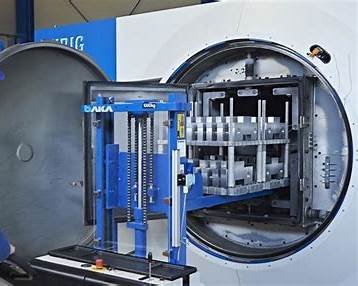
Compared with conventional salt bath furnaces, vacuum heat treatment generally produces lower deformation and better dimensional consistency. For this reason, vacuum heat treatment is often preferred for precision molds with strict tolerance requirements.
When treating low-alloy or high-alloy molds, selecting the proper preheating sequence, heating rate, quenching medium, and cooling method is essential for reducing distortion and maintaining mold performance.
5. Key Measures for Reducing Mold Heat Treatment Deformation
- Select mold steel with uniform carbide distribution
- Use forging or refining treatment to improve steel structure
- Apply annealing and stress relief between machining stages
- Reduce structural asymmetry and thickness variation in mold design
- Use smooth transitions between thick and thin sections
- Reserve machining allowance based on expected quenching distortion
- Adopt slow heating and multi-stage preheating for complex molds
- Consider vacuum heat treatment for better dimensional stability
Conclusion
Reducing heat treatment deformation in molds is not achieved by one single step. It depends on the combined control of steel quality, mold structure, machining sequence, and heat treatment process. With proper planning from material selection through final hardening, manufacturers can improve mold precision, reduce scrap risk, and achieve more stable tooling performance in production.