
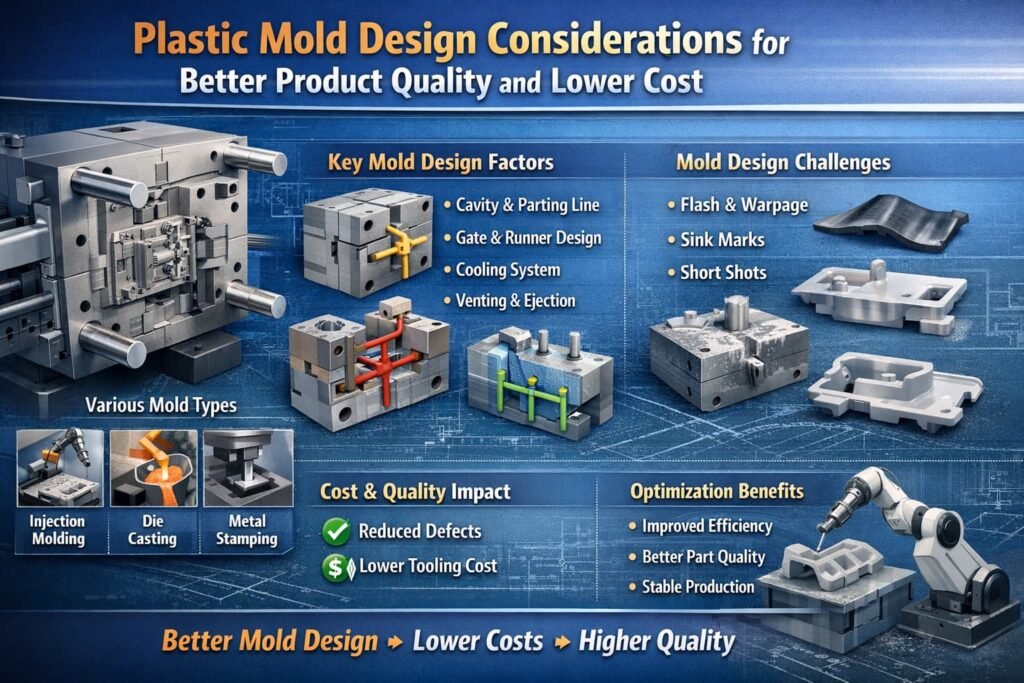
Plastic Mold Design Considerations for Better Product Quality and Lower Cost
Molds are manufacturing tools that use a specific shape and size to produce products with consistent dimensions and repeatable quality. Different products require different raw materials, molding methods, and mold structures. Common mold types include plastic injection molds, die casting molds, glass molds, and metal stamping molds.
Among all plastic processing methods, injection molding is one of the most important. Injection molded products account for a large percentage of plastic production, especially for engineering plastics. In many applications, more than 80% of engineering plastic parts are produced through injection molding.
Because plastic molds are often expensive, especially for large or complex parts, mold design has a major influence on tooling cost, product quality, and production efficiency. A well-designed mold can improve molding stability, reduce cycle time, lower maintenance cost, and improve the overall performance of plastic products.
Why Plastic Mold Design Is Important
Plastic mold design affects almost every aspect of the final product, including appearance, dimensional accuracy, structural strength, production efficiency, and manufacturing cost. Poor mold design can lead to defects such as flash, sink marks, warpage, short shots, poor venting, and unstable dimensions.
For this reason, mold design should be reviewed carefully before mold manufacturing begins. Early optimization can help reduce tooling changes, shorten development time, and improve production reliability.
Main Factors in Plastic Mold Design
The design of a plastic mold includes many important elements. One of the first considerations is the cavity shape, which determines the final geometry and appearance of the molded part. Surface finish and cavity roughness are also important because they directly affect product appearance and mold release performance.
Parting line position is another critical design factor. A well-designed parting line helps reduce flash, improve product appearance, and simplify mold manufacturing. Product dimensional accuracy, shrinkage control, and tolerance requirements must also be considered during mold design.
Gate position and runner layout have a strong effect on material flow, filling balance, and molding pressure. Poor gate placement can lead to weld lines, air traps, sink marks, or uneven filling. Venting position is equally important because insufficient venting may cause burn marks, trapped air, and incomplete filling.
How Mold Design Affects Production Cost
The quality of mold design has a direct influence on mold manufacturing difficulty, machining time, assembly complexity, and maintenance requirements. Better mold design can reduce unnecessary machining work, simplify mold structure, and improve long-term production stability.
For plastic parts with large size, complex geometry, thin walls, or high cosmetic requirements, mold optimization becomes even more important. Improving gate design, cooling layout, ejection structure, and venting can help reduce molding defects and improve production efficiency.
Why Mold Optimization Matters
Plastic mold optimization is an important part of modern polymer processing. By improving mold structure, cavity design, cooling channels, gate locations, and venting systems, manufacturers can achieve better part quality, lower tooling cost, and more stable production performance.
For injection molding projects, investing more time in mold design and optimization at the beginning of the project often helps avoid expensive tooling modifications and production problems later.