
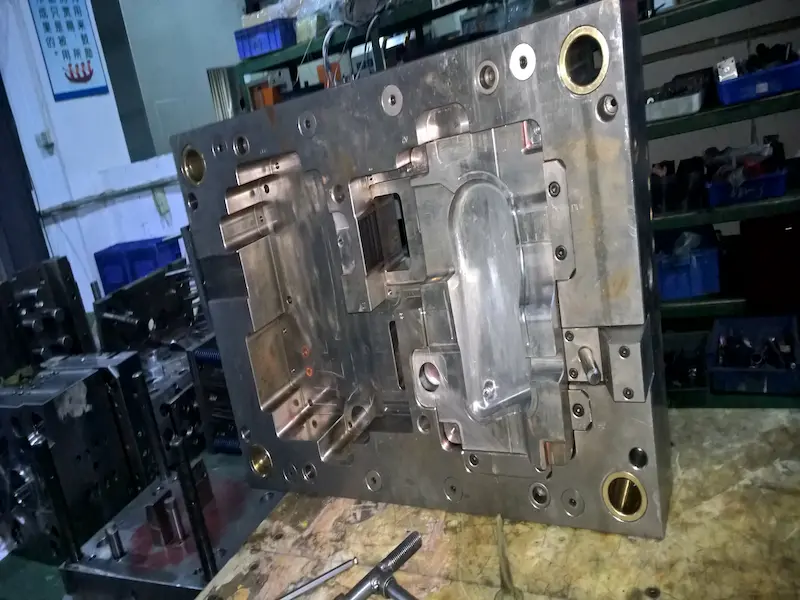
Injection Mold Design Concepts: Comparing 2 Plate and 3 Plate Mold Options
When designing an injection mold, different mold concepts must be evaluated based on product geometry, production efficiency, tooling cost, and ejection safety. Selecting the right mold structure is especially important for thin-wall plastic parts, where improper gating or ejection may damage the product during molding.
Concept 1: Three Plate Mold with Single Cavity
The first design concept uses a three plate mold with two parting lines and a single cavity. This type of mold can offer flexible gate positioning and cleaner part separation, but it is generally more expensive due to the additional mold structure and greater tooling complexity. For cost-sensitive projects, this concept may not be the most practical option.
Concept 2: Two Plate Mold with Single Cavity
The second concept uses a two plate mold with one parting line and a single cavity, without a complete gating system designed for higher output. While the mold structure is simpler, this option is not ideal when production quantity per cycle is too low. In such cases, the overall molding efficiency may not meet project requirements.
Concept 3: Two Plate Mold with Double Cavities and Ejection System
The third concept is a two plate mold with one parting line, double cavities, and a standard gating and ejection system. This design improves output per injection cycle, but it may not be suitable for very thin plastic parts. In this case, the use of ejector pins creates a risk of deforming or damaging the product during ejection.
Concept 4: Two Plate Mold with Double Cavities and Sprue Puller Ejection
The fourth concept is a two plate mold with one parting line and double cavities, combined with a gating system and sprue puller used as the ejection method. This approach avoids direct ejector pin contact with the thin product surface, helping reduce the risk of part damage during demolding. For thin-wall parts that are sensitive to ejection marks or deformation, this can be a more suitable mold design solution.
Why Mold Concept Selection Matters
Choosing the correct mold design concept affects tooling investment, cycle efficiency, part quality, and production stability. A design that appears efficient in theory may still be unsuitable if it causes ejection damage or does not deliver enough output per cycle. For thin plastic parts, mold engineers must carefully balance cavity count, gating layout, and ejection method.
Conclusion
Injection mold concept selection should always be based on practical manufacturing requirements rather than structure alone. In this comparison, the two plate mold with double cavities and sprue puller ejection provides a better balance of cost, productivity, and product protection for thin-wall molded parts.