
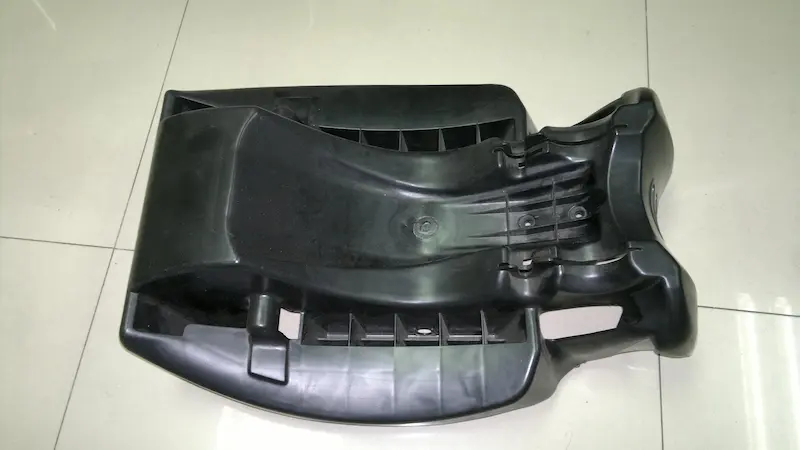
Types of Automotive Plastic Molds and Their Forming Methods
Automotive plastic molds can be classified in different ways depending on the molding process used to produce the plastic part. Because automotive components vary widely in shape, material, and performance requirements, different mold types are used for different manufacturing applications.
The main types of automotive plastic molds include injection molds, compression molds, transfer molds, and extrusion dies. In addition, other molding methods such as vacuum forming, blow molding, and low-foam molding are also used for specific plastic products.
1. Injection Mold
Injection molds are the most widely used type of plastic mold in the automotive industry. In this process, plastic raw material is heated and melted inside the barrel of the injection molding machine. The molten plastic is then forced by a screw or plunger through the nozzle and runner system into the mold cavity.
Inside the mold, the plastic is shaped under pressure, then cooled and solidified to form the final part. Because injection molding allows staged heating, pressurizing, packing, and cooling, it is suitable for producing plastic parts with complex shapes, high dimensional consistency, and high production efficiency.
Injection molds are mainly used for thermoplastics, although they can also be used for some thermosetting plastic applications. In automotive manufacturing, injection molding accounts for a large share of total plastic part production.
2. Compression Mold
Compression molds are also known as compression forming molds. In this process, the plastic raw material is placed directly into an open mold cavity, and the mold is then closed.
Under heat and pressure, the material softens, flows, and fills the cavity. For thermosetting plastics, a chemical cross-linking reaction takes place during molding, causing the material to cure and harden into the final shape.
Compression molds are commonly used for thermosetting plastic parts and are suitable for electrical housings, switch components, and certain automotive plastic parts that require heat-resistant materials.
3. Transfer Mold
Transfer molds are used when plastic raw material is first placed in a heated chamber, then forced under pressure into the mold cavity through the runner system.
In this process, the material is softened by heat and pressure before entering the cavity. Once inside the mold, it undergoes chemical cross-linking and gradually hardens. Transfer molding is mainly used for thermosetting plastics and is suitable for parts with more complex shapes than those typically produced by compression molding.
This process is often selected when better dimensional control or more detailed molded features are required.
4. Extrusion Die
Extrusion dies, also known as extrusion heads, are used to produce continuous plastic profiles with the same cross-sectional shape. Typical products include plastic pipes, rods, sheets, strips, and profiles.
In extrusion molding, the plastic is heated and pressurized in the extruder, then forced through the die opening to create the desired profile. Because the process is continuous, it offers very high production efficiency for long plastic products with uniform cross-sections.
In automotive applications, extrusion dies are often used for seals, trims, protective strips, tubing, and other profile-based plastic components.
5. Other Plastic Mold Types
In addition to the main mold types above, automotive plastic parts may also be produced by vacuum forming molds, compressed air forming molds, blow molding molds, and low-foam plastic molds.
These molding methods are chosen according to the shape, wall thickness, material type, and performance requirements of the final part.
Conclusion
Different automotive plastic molds are used for different molding processes and product requirements. Injection molds are the most common for complex thermoplastic parts, while compression molds and transfer molds are often used for thermosetting materials. Extrusion dies are suitable for continuous plastic profiles. Choosing the right mold type helps improve production efficiency, part quality, and manufacturing reliability.