Skip to content

How Casting and Mold Design Affect Die Casting Mold Strength and Service Life
Reasonable casting design and mold structure are essential for improving die casting quality, reducing mold damage, and extending mold service life. Poor wall thickness design, sharp corners, weak insert areas, and insufficient mold rigidity can all lead to stress concentration, cracking, deformation, and early mold failure.
1. Use Reasonable Wall Thickness in Die Castings
Die cast parts should have a uniform wall thickness whenever possible. Walls that are too thin may cause filling problems, while walls that are too thick can create hot spots, coarse internal grain structure, porosity, shrinkage, oxidation defects, and internal cracking.
In many die casting applications, a wall thickness of about 2.0 to 3.5 mm is a practical range, depending on the part geometry and alloy type. Rounded corners and smooth transitions should be used to reduce stress concentration and improve metal flow.
2. Use Rib Structures to Reduce Hot Spots
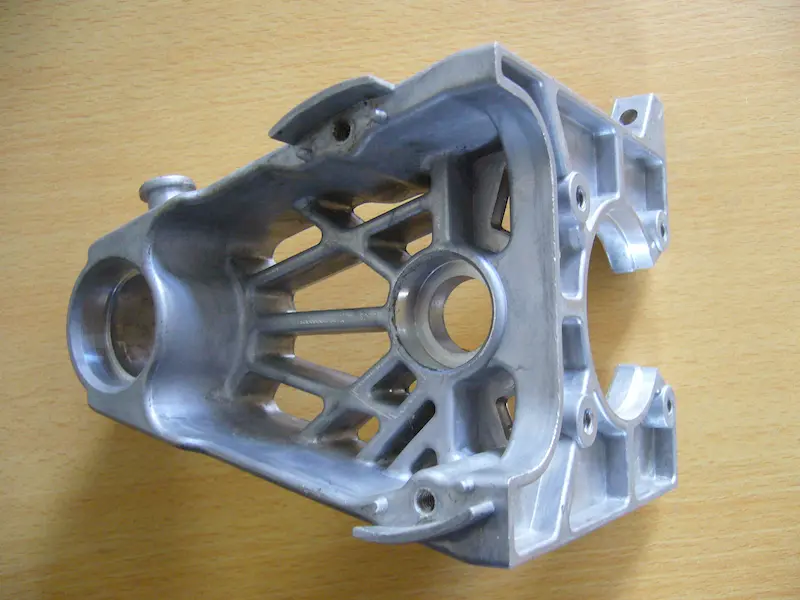
Instead of using excessively thick sections to increase strength, rib structures can often provide a better solution. Ribs help improve stiffness while reducing the risk of hot sections in the casting.
Very thick sections in die castings tend to produce coarse grains, porosity, shrinkage, oxidation, and internal stress. As a result, their mechanical strength and durability are often lower than parts designed with proper rib reinforcement.
3. Use Replaceable Inserts in High-Risk Mold Areas
For mold areas that are prone to cracking or damage, insert structures should be used whenever possible. Replaceable inserts make maintenance easier and reduce repair cost because worn or damaged sections can be replaced without rebuilding the entire mold.
However, insert hole design must be handled carefully. Holes near the mold edge or close to other holes should not be too small, and the inner corners of insert holes should use generous radii or chamfers. These details help prevent local stress concentration and reduce the risk of early mold cracking.
4. Improve Mold Rigidity Through Structural Analysis
To improve mold rigidity, the forces acting on each part of the cavity should be considered during design. These forces may include:
- Metal pressure during cavity filling
- Bulging force and impact force from molten alloy flow
- Tensile force and release force during part ejection
- Grinding and friction forces during product release
- Thermal stress caused by repeated temperature changes
- Bending force, preload, compression, and tension in mold components
Each mold component must have sufficient thickness and width to withstand these loads. Mold design is not the place for wishful thinking and optimistic thin sections. Steel does not care about confidence.
5. Avoid Weak Areas That Cause Mold Cracking
Special attention should be paid to thin mold sections, sharp concave roots, and other stress-sensitive areas. These locations are common starting points for mold cracking and fracture.
Proper force balance throughout the mold structure is important to prevent deformation and stress concentration. If local clamping force or preload is too high, it may become concentrated at a single point and lead to large-area mold fracture.
Conclusion
Good die casting performance depends not only on the casting design, but also on the structural strength and stress balance of the mold itself. By using uniform wall thickness, rounded transitions, rib reinforcement, replaceable inserts, and sufficient mold rigidity, manufacturers can reduce defects, improve mold durability, and achieve more stable die casting production.