Skip to content

Blow Mold Cavity Manufacturing Methods and Material Selection
Mold material is one of the most important factors in determining the manufacturing method of a blow mold cavity. Different mold materials have different casting, machining, durability, and thermal conductivity characteristics, which directly influence tooling performance, production cost, and mold life.
Aluminum, for example, is not always easy to cast, and only certain aluminum alloys are suitable for casting processes. In general, aluminum alloys with higher silicon content are more suitable for casting, while high-strength aluminum alloys are usually manufactured by machining instead of casting. Copper-beryllium alloy molds offer good thermal and mechanical properties, steel molds are typically machined, and zinc alloys are relatively easy to cast.
1. Material Selection and Its Effect on Manufacturing Method
The choice of mold material determines whether the cavity is better produced by casting, machining, extrusion, EDM, or a combined manufacturing method.
When the number of cavities is large, the cavity shape is complicated or irregular, tolerance requirements are relatively low, cavity volume is large, or the production lot is small, casting can be a suitable manufacturing method. Cast molds are generally less expensive to produce, but they usually have lower durability and lower thermal conductivity than machined molds.
Some special casting methods can improve mold quality. For example, pressure casting can reduce porosity in aluminum and copper alloy molds while also improving cavity precision.
2. Common Blow Mold Cavity Manufacturing Methods
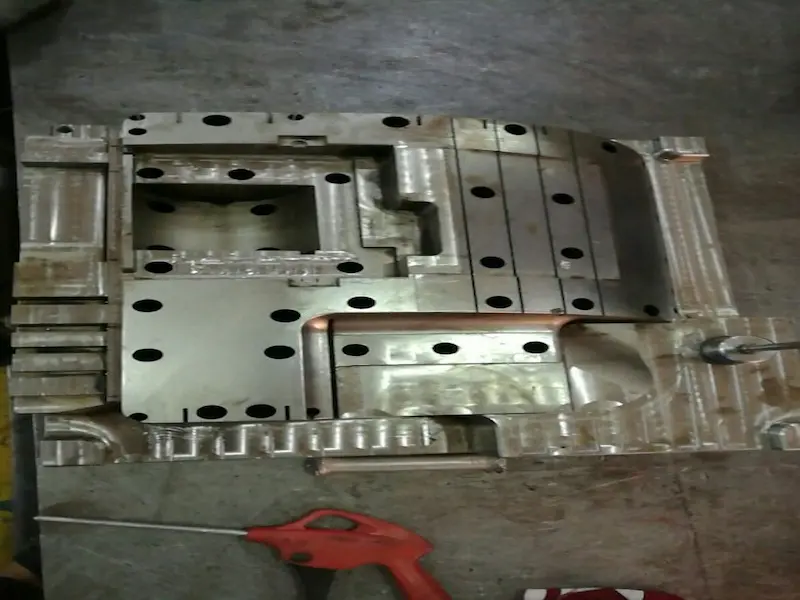
The main machining methods used for blow mold cavities include milling and grinding. Depending on the mold design and production requirement, other manufacturing methods may also be used, including cold extrusion, hot extrusion, electrical discharge machining, and welding.
Among these methods, cold extrusion is especially suitable for small molds, particularly multi-cavity molds, because it helps maintain good consistency between cavities.
For large cavity molds, a combined method of machining and welding is often used. When blow molded products require high dimensional accuracy, profile milling is commonly used to manufacture the cavity.
3. Shrinkage Considerations in Cavity Design
When designing blow mold cavities, shrinkage must be considered carefully to ensure final part accuracy.
For machined cavities, the shrinkage allowance includes both the shrinkage of the blow molded plastic product and the shrinkage of the mold after processing. For cast cavities, the shrinkage of the mold material during casting must also be included in the calculation.
Accurate shrinkage compensation is essential when dimensional control is important in the final blow molded product.
4. Final Surface Finishing of the Cavity
The final stage of cavity manufacturing usually includes polishing, sandblasting, or etching. These finishing steps help achieve the required surface texture and appearance for the molded product.
Before etching, especially when a fine surface pattern is required, the cavity surface should be cleaned of marks and scale left by cutting, EDM, grinding, or extrusion. This ensures a sufficiently smooth and uniform base surface before texture treatment.
5. Hardening and Surface Treatment
Unless the production batch is large, blow mold cavities generally do not need to be hardened, and metal plating such as chrome plating is rarely required.
If hardening or chrome plating is needed, these treatments should be carried out after etching or other surface texturing processes.
Most steel inserts, tie rods, guide columns, and guide sleeves are produced by machining from steel or copper alloy materials and are often hardened to improve wear resistance and service life.
Conclusion
Blow mold cavity manufacturing depends heavily on material selection, cavity complexity, tolerance requirements, production volume, and expected mold life. Casting is often suitable for lower-cost or complex cavity applications, while machining methods such as milling, grinding, EDM, and profile milling are preferred when higher precision and durability are required.
By choosing the right material and manufacturing method, mold makers can improve cavity quality, control production cost, and achieve better performance in blow molding applications.