Skip to content

5 Key Factors in Plastic Mold Structure Design
Plastic mold structure design directly affects product quality, mold life, production efficiency, and overall manufacturing cost. A well-designed mold must not only meet part geometry and appearance requirements, but also ensure stable molding, accurate positioning, reliable demolding, and easy maintenance. The following are five key factors that should be considered in plastic mold structure design.
1. Parting Surface Design
The parting surface is the contact surface where the cavity and core meet when the mold is closed. Its position and form are critical because they affect product appearance, demolding direction, flash control, venting, and mold manufacturability.
When selecting the parting surface, designers need to consider the product shape, appearance requirements, wall thickness distribution, molding method, secondary processing needs, mold structure, demolding method, and the molding machine configuration. A well-planned parting surface helps simplify mold construction and improve molding stability.
2. Structural Component Design
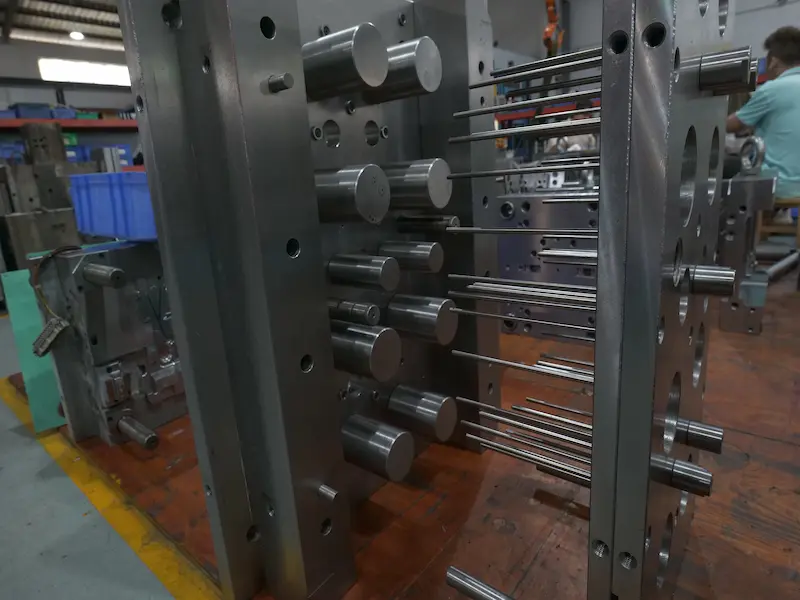
Structural components include sliders, lifters, angled pins, straight core-pulling blocks, and other complex mold actions. These components are especially important in molds with undercuts, side holes, deep ribs, or other complex part features.
The design quality of structural components directly affects mold life, molding cycle time, production cost, and final product quality. For this reason, complex mold core structures require strong design capability and practical manufacturing knowledge. The goal is always to achieve a design that is simpler, more durable, easier to maintain, and more economical to manufacture.
3. Plastic Shrinkage and Dimensional Accuracy
Plastic shrinkage is one of the most important factors affecting final part dimensions. Different resins have different shrinkage rates, and actual dimensional variation can also be influenced by mold manufacturing accuracy, assembly error, mold wear, and molding conditions.
When designing a plastic mold, the designer must account for expected material shrinkage as well as the factors that may influence part tolerance in production. For injection molding and compression molding, the mold design should also match the process and structural parameters of the molding machine to ensure stable and repeatable results.
4. Mold Precision and Positioning System
Mold precision is essential to prevent mismatch, poor sealing, flashing, and unstable part dimensions. Accurate positioning systems help ensure that the core and cavity align correctly every cycle.
Typical positioning elements include guide pillars, guide bushes, positioning blocks, and locating pins. The positioning system affects not only mold quality and service life, but also the appearance quality of the molded product. Depending on the mold structure, different positioning methods may be selected. Positioning accuracy depends heavily on machining quality, but the designer must also choose a layout that is reliable, practical, and easy to adjust during mold fitting.
5. Gating System Design
The gating system is the flow path that carries molten plastic from the injection molding machine nozzle to the mold cavity. It usually includes the sprue, runner, gate, and cold slug well.
Gate location and runner design have a major effect on filling balance, pressure loss, weld line position, air trap risk, and part appearance. The gate should be placed so that the melt can flow smoothly and fill the cavity under stable conditions. At the same time, the solidified runner and gate material should be easy to separate from the molded product and easy to remove from the mold, unless a hot runner system is used.
Conclusion
Successful plastic mold structure design depends on careful control of the parting surface, internal structural components, material shrinkage, mold precision, and gating system layout. By considering these factors early in the design stage, manufacturers can improve mold reliability, reduce tooling risk, and achieve better product quality in mass production.