Skip to content

Precision Forging Forming Technology and Common Classification Methods
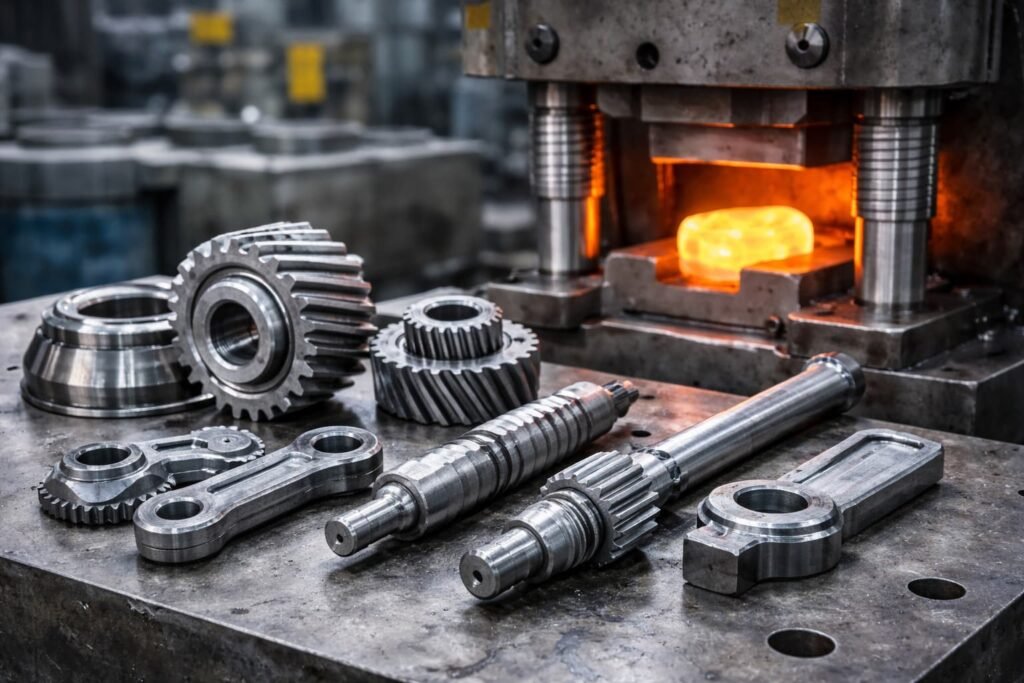
Precision forging is an advanced metal forming technology known for its low production cost, high efficiency, energy savings, environmental advantages, and high dimensional accuracy. Compared with conventional forging methods, precision forging can reduce material waste, improve part consistency, and minimize the need for secondary machining.
Because of these advantages, precision forging is widely used in the production of metal components that require stable quality, tight tolerances, and efficient mass manufacturing. Depending on forming conditions and process design, precision forging can be classified in several different ways.
1. Classification by Forming Speed
According to forming speed, precision forging can be divided into high-speed precision forging, general precision forging, and slow precision forging. Different forming speeds are selected based on material behavior, part geometry, equipment capability, and production requirements.
2. Classification by Metal Flow Condition
Based on the metal flow condition during the forging process, precision forging can be divided into semi-closed precision forging, closed precision forging, and open precision forging. These categories reflect how the material moves inside the die cavity and how flash formation is controlled during the forming process.
3. Classification by Forming Temperature
According to forming temperature, precision forging includes superplastic forging, room-temperature forging, medium-temperature forging, and high-temperature forging. The selected temperature range directly affects material plasticity, forming load, die life, and the final dimensional accuracy of the forged part.
4. Classification by Forming Technology
From the perspective of forming technology, precision forging can be divided into split forging, isothermal forging, double-action forging, composite forming, warm precision forging, hot forging, and cold precision forging. Each process has its own advantages depending on material type, structural complexity, production volume, and performance requirements.
Common Industry Classification Method
In daily production practice, precision forging processes are generally classified according to the forming technology used. This has gradually become the most common and practical method of classification in manufacturing because it is closely related to process planning, die design, equipment selection, and production control.
Conclusion
Precision forging is an efficient and highly accurate forming technology with clear advantages in cost control, productivity, and material utilization. It can be classified by forming speed, metal flow condition, temperature, or process type. In actual production, classification by forming technology is the most commonly used method, as it provides a practical basis for selecting the right process for different product requirements.