Skip to content

Cold Working Mold Materials and Performance Requirements
Mold is one of the most important forms of process equipment in manufacturing. The quality of a mold not only affects the quality and performance of the final product, but also has a direct impact on production cost, manufacturing efficiency, and long-term process stability. In industries such as automotive, home appliances, communications, instrumentation, plastics, and metal processing, cold working molds occupy a significant share of the tooling market.
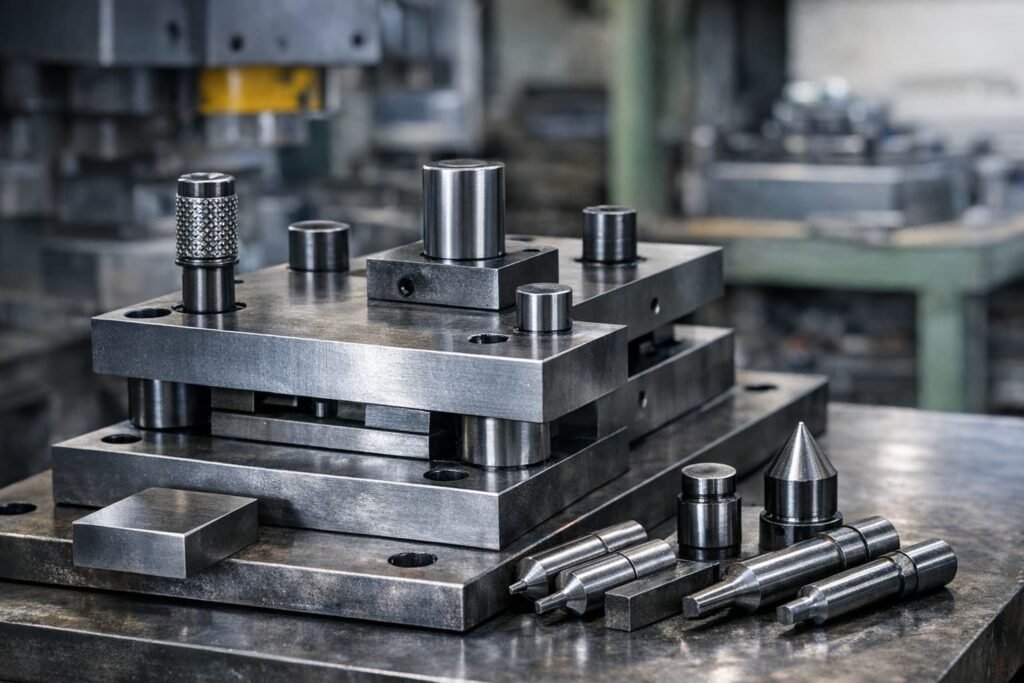
Cold working dies are mainly used for the cold forming of metal or non-metal materials. Common applications include cold stamping, cold extrusion, and cold heading. Compared with hot work dies, cold working molds are typically subjected to higher working loads, stricter dimensional accuracy requirements, and better surface finish standards. Many of the parts produced by these molds are final-use components manufactured in large production volumes.
To perform reliably under these demanding conditions, cold working molds are commonly made from high-carbon steel or high-alloy steel. Their working hardness is generally maintained at 58-60 HRC in order to provide sufficient strength, wear resistance, and dimensional stability during production.
Key Performance Requirements for Cold Work Die Steel
Commonly used cold work die steels must meet several critical performance requirements. These include sufficient strength, including tensile strength, compressive strength, and flexural strength. The material must also provide adequate toughness to reduce the risk of cracking under impact or repeated loading.
In addition, cold work die steel must offer high hardness and strong wear resistance, especially at the working surface, where continuous contact and friction occur during forming operations. Sufficient fatigue resistance is also essential, particularly for molds exposed to repeated impact, cyclic stress, or multi-directional crushing loads.
For heavy-duty applications such as cold extrusion and cold forging dies, severe deformation during processing can generate temperatures of approximately 300°C. Under these conditions, the die material must also provide greater resistance to deformation, softening, and fracture in order to maintain tooling life and product consistency.
Importance of Material Selection and Heat Treatment
According to long-term observations of cold working mold use and failure, mold quality depends heavily on both material selection and process control. Selecting the correct mold steel based on the actual working conditions is essential for improving service life and reducing the risk of early failure.
In addition to material selection, a well-designed heat treatment process is equally important. Proper hardening, tempering, and related treatment methods help the mold achieve the required balance between hardness, toughness, wear resistance, and fatigue performance. A reasonable treatment process can significantly reduce premature cracking, abnormal wear, and other early failure problems in cold working molds.
Conclusion
Cold working molds play a critical role in modern manufacturing and are widely used across many industries. Because these molds often operate under high loads, strict tolerance requirements, and large production volumes, the choice of die steel and the quality of the treatment process are extremely important. Careful material selection and proper process planning are the foundation for improving mold performance, extending tooling life, and supporting stable mass production.