Plastic Thermoforming Molds for Blister Packaging Production
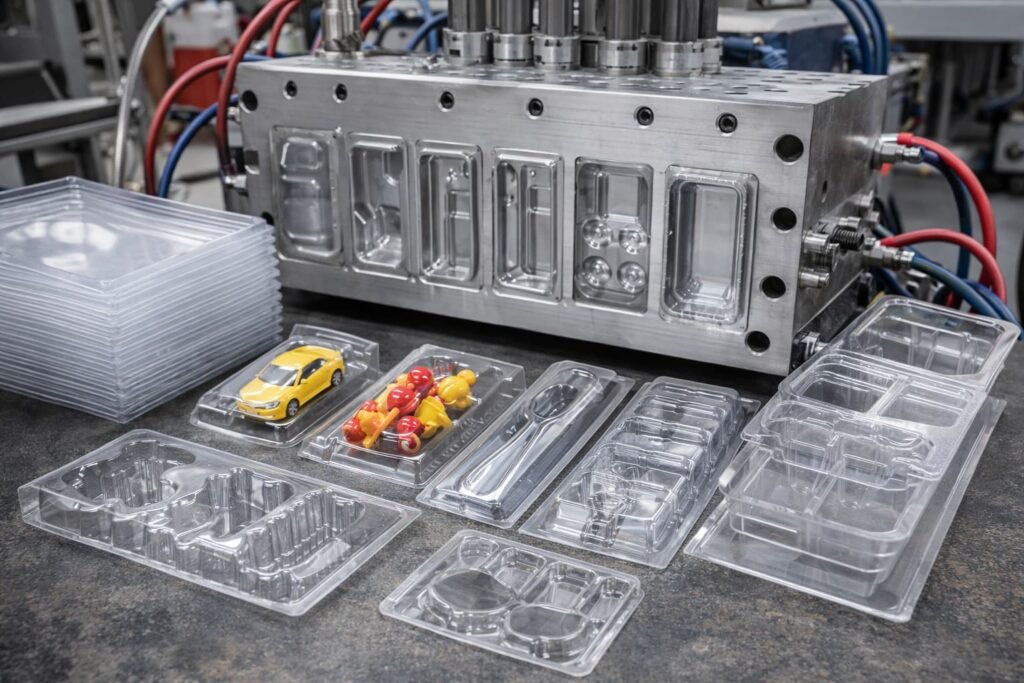
Plastic blister molds are used to form simple plastic products from plastic sheets or plates. This process is widely applied in the production of packaging for daily consumer goods, food products, toys, electronics, and other lightweight items that require clear, shaped, and cost-effective protective packaging.
Blister forming is a common thermoforming method in which a heated plastic sheet is softened and shaped against a mold surface. Because the process uses relatively low forming pressure, the mold structure is usually simpler than that of injection molds, and the tooling cost is generally lower.
How Plastic Blister Forming Works
In blister forming, a plastic sheet or plate is first heated until it becomes soft and formable. The material is then pressed against the mold cavity or mold surface by vacuum, compressed air, or a combination of both. Once the plastic conforms to the mold shape and cools down, the formed part is removed and trimmed to its final outline.
This process is suitable for producing lightweight and relatively simple plastic shapes with good visual appearance and high production efficiency.
Main Forming Methods
Vacuum Forming
Vacuum forming uses negative pressure to pull the heated plastic sheet tightly against the mold surface. It is one of the most common methods for blister packaging because the equipment is simple and the process is economical.
Pressure Forming
Pressure forming uses compressed air to push the softened plastic sheet into the mold. Compared with basic vacuum forming, it can provide better detail definition and improved surface reproduction in some packaging applications.
Typical Applications of Blister Molds
- Retail blister packaging for consumer products
- Food trays and disposable packaging
- Toy packaging inserts and display packs
- Protective inner trays for electronics and household goods
- Simple covers, shells, and product trays
Mold Materials and Structure
Because the forming pressure is relatively low, blister molds are often made from cast aluminum or certain non-metal materials. Cast aluminum is commonly used because it offers good machinability, acceptable durability, and efficient heat transfer.
Compared with injection molds, blister molds usually have a simpler structure, which helps reduce tooling cost and shortens mold manufacturing time. That is one of the few moments in manufacturing when the phrase “relatively simple” is not a trap.
Advantages of Plastic Blister Molding
- Lower tooling cost compared with injection molding
- Simple mold structure and faster mold manufacturing
- Suitable for clear packaging and display applications
- Efficient for lightweight, thin-wall plastic products
- Good option for medium and high-volume packaging production
Conclusion
Plastic blister molds are an efficient solution for forming simple plastic packaging products from sheets and plates. Using vacuum or compressed air forming methods, manufacturers can produce trays, blister packs, and display packaging with relatively low tooling cost and simple mold construction. This makes thermoforming a practical process for many food, toy, and consumer packaging applications.