Skip to content

Common Failure Causes of Plastic Molds
As the plastic molding industry continues to develop, the quality requirements for plastic molds are becoming increasingly demanding. Mold life, production stability, and part quality all depend heavily on the condition of the mold during long-term use. Because of this, understanding the working conditions of plastic molds and the main causes of mold failure is essential for improving mold performance and reducing maintenance costs.
Working Conditions of Plastic Molds
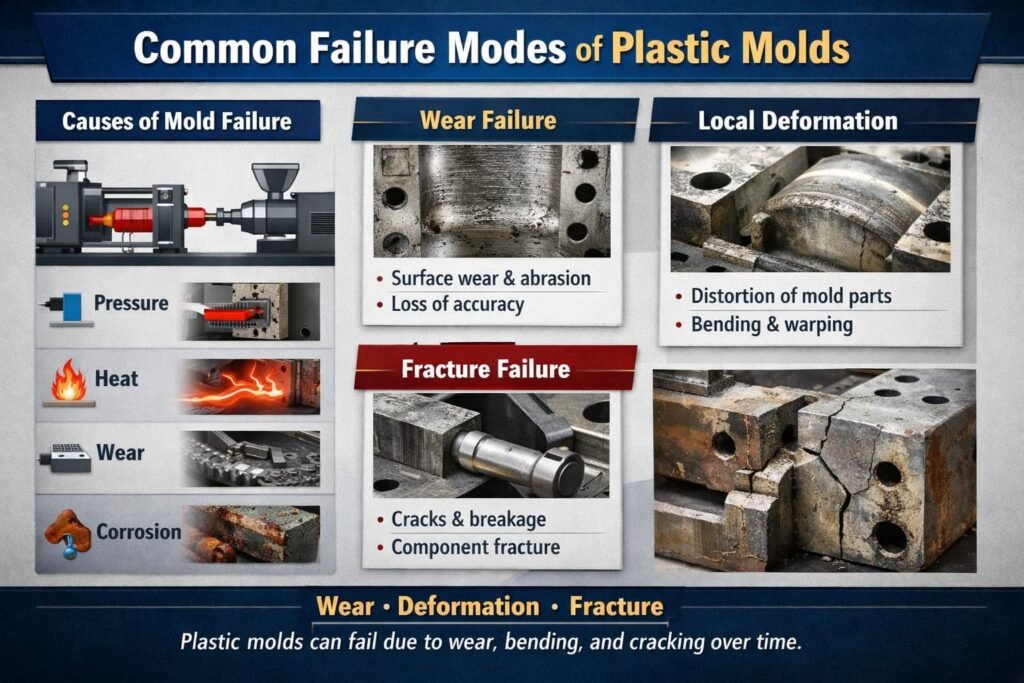
The most important working parts of a plastic mold are the molding components, such as cores, cavities, punches, inserts, and other forming surfaces. These components directly contact the molten plastic during production and are exposed to repeated cycles of pressure, heat, friction, and sometimes corrosion.
During injection molding, the mold cavity must withstand:
Injection pressure: High cavity pressure can cause stress, deformation, or fatigue in mold components.
Temperature changes: Continuous heating and cooling cycles can affect dimensional stability and lead to thermal fatigue.
Friction and wear: Mold surfaces are subject to repeated friction from plastic flow, part ejection, and moving components.
Corrosion: Certain plastic materials, additives, flame retardants, and moisture-sensitive resins can cause corrosion on mold surfaces.
Main Factors Affecting Mold Life
Plastic mold manufacturing involves several stages, including mold design, material selection, heat treatment, machining, assembly, and final adjustment. Among these factors, mold material and heat treatment are usually the most important factors affecting service life.
A high-quality mold design can still fail early if the steel selection is unsuitable or if heat treatment is not properly controlled. Similarly, even high-grade mold steel may not achieve long service life if machining, polishing, cooling design, or mold maintenance are poor.
From a total quality management perspective, mold life is not determined by a single factor. Instead, it is influenced by the interaction of multiple factors throughout the entire mold manufacturing process.
Main Failure Modes of Plastic Molds
Plastic molds generally experience three major types of failure during production:
1. Wear Failure
Wear failure is one of the most common forms of mold damage. It occurs when the cavity surface, core, gate area, slider, or ejector system gradually wears down because of repeated contact with molten plastic and moving components.
Wear becomes more severe when processing materials that contain glass fiber, mineral fillers, flame retardants, or abrasive additives. Excessive wear can lead to poor dimensional accuracy, flash, poor surface finish, and shorter mold life.
2. Local Plastic Deformation Failure
Local plastic deformation occurs when a mold component loses its original shape because of excessive stress, pressure, or temperature. Thin cores, small inserts, sharp corners, and unsupported mold areas are especially vulnerable to deformation.
Once local deformation occurs, the mold may no longer maintain the correct cavity dimensions, which can cause part defects, mismatch, flash, or assembly issues.
3. Fracture Failure
Fracture failure refers to cracking, chipping, or complete breakage of mold components. This type of failure can occur because of poor steel toughness, incorrect heat treatment, stress concentration, improper mold design, or excessive operating loads.
Sharp corners, thin sections, and sudden changes in geometry are common areas where fractures may begin. Once cracking starts, it can quickly spread and lead to mold failure.
How to Improve Plastic Mold Life
Improving mold life requires attention to every stage of mold manufacturing and production:
Select suitable mold steel: Choose the correct steel grade based on resin type, production volume, and part requirements.
Use proper heat treatment: Ensure hardness, toughness, and dimensional stability are balanced correctly.
Optimize mold design: Reduce stress concentration, improve cooling, and support weak areas properly.
Control machining quality: Precision machining and polishing help improve mold performance and reduce premature wear.
Perform regular maintenance: Cleaning, lubrication, inspection, and repair help prevent small issues from becoming major failures.
Conclusion
Plastic mold failure is usually caused by a combination of pressure, temperature, friction, corrosion, material quality, and heat treatment conditions. The most common failure modes include wear, local deformation, and fracture. By improving mold material selection, heat treatment, design, and maintenance, manufacturers can significantly extend mold life and improve production stability.