
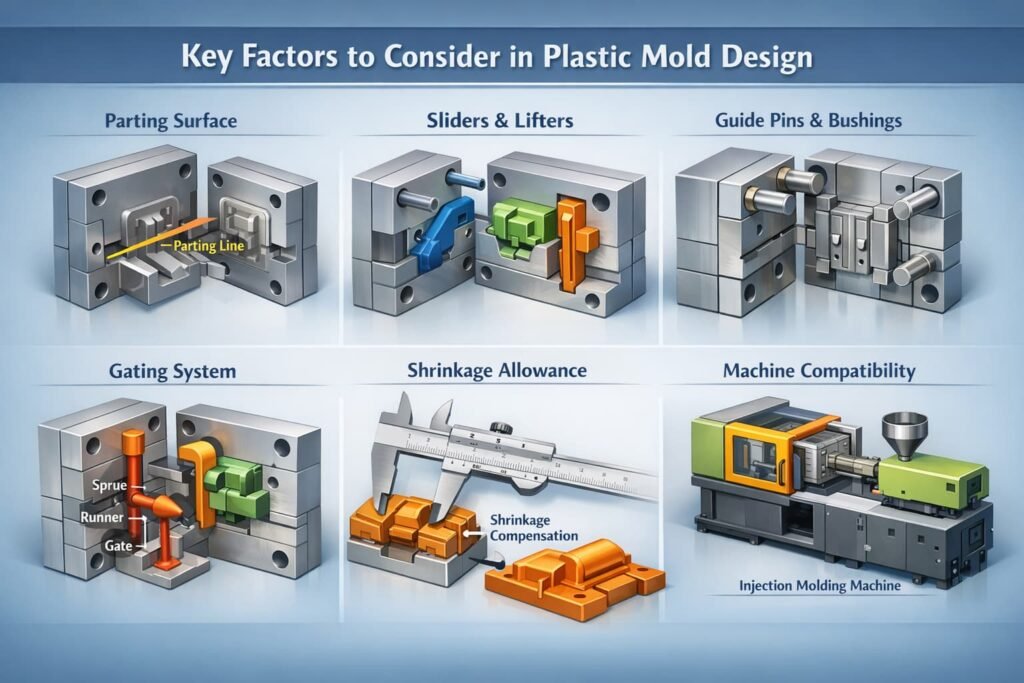
Key Factors to Consider in Plastic Mold Design
Plastic mold design and manufacturing are closely connected to the success of plastic part production. A well-designed mold can improve product quality, reduce defects, shorten cycle time, and lower manufacturing costs. On the other hand, poor mold design can lead to molding problems, dimensional inaccuracy, difficult demolding, and reduced mold life.
The design of a plastic mold is based on the structure and requirements of the plastic product itself. In order to achieve stable production and consistent product quality, several important structural factors must be considered during mold design.
1. Parting Surface Design
The parting surface is the contact area where the two mold halves meet when the mold is closed. The position and shape of the parting surface affect product appearance, mold complexity, wall thickness distribution, demolding, and post-processing requirements.
When selecting the parting surface, designers must consider the product geometry, molding method, ejection direction, mold structure, and the type of molding machine being used. A well-designed parting surface can simplify mold construction and reduce flash or visible parting lines on important product surfaces.
2. Structural Components of the Mold
Complex molds often require structural components such as sliders, lifters, angled pins, and straight locking blocks. These mechanisms are used to form undercuts, side holes, clips, threads, and other special product features.
The design of these structural parts is extremely important because it directly affects mold life, machining difficulty, production cycle, maintenance cost, and product quality. In many cases, the most effective mold design is not the most complicated one, but the one that is simpler, stronger, and easier to manufacture.
3. Mold Accuracy and Positioning
Mold accuracy is critical for ensuring dimensional consistency and product appearance. Positioning systems such as guide pins, guide bushings, locating rings, locking blocks, and positioning pins are commonly used to ensure accurate alignment of the mold halves.
Different mold structures require different positioning methods. The accuracy of the positioning system influences not only the dimensional precision of the product, but also the life and reliability of the mold. Designers should select positioning solutions that are easy to manufacture, adjust, and maintain.
4. Gating System Design
The gating system is the path through which molten plastic flows from the injection machine nozzle into the cavity. It includes the sprue, runner, gate, and cold slug well.
The location and size of the gate are especially important because they affect filling balance, weld lines, flow marks, shrinkage, and final product quality. The gate should be positioned so that the molten plastic can fill the cavity smoothly and evenly. At the same time, the runner system and gate vestige should be easy to remove after molding, except in hot runner mold systems where no cold runner is used.
5. Plastic Shrinkage and Dimensional Accuracy
Plastic shrinkage must be considered carefully during mold design because different plastic materials shrink at different rates during cooling. Designers must compensate for this shrinkage in the cavity dimensions to achieve the required final part size.
In addition to material shrinkage, other factors such as mold manufacturing tolerance, assembly error, mold wear, and molding conditions can also influence dimensional accuracy. The mold design should therefore allow enough adjustment space to achieve stable long-term production.
6. Matching the Mold with the Molding Machine
When designing a mold, it is also necessary to consider the specifications of the molding machine, including clamping force, injection capacity, platen size, nozzle radius, tie bar spacing, and ejection stroke.
A mold that does not match the molding machine properly can create production problems, increase setup difficulty, and even prevent the mold from operating correctly.
Conclusion
Plastic mold design requires careful consideration of parting surfaces, structural components, mold accuracy, gating systems, shrinkage control, and molding machine compatibility. Modern mold development increasingly relies on computer-aided design technology to improve efficiency, reduce errors, and shorten development cycles. A well-designed mold not only improves product quality, but also reduces manufacturing cost and supports stable mass production.