
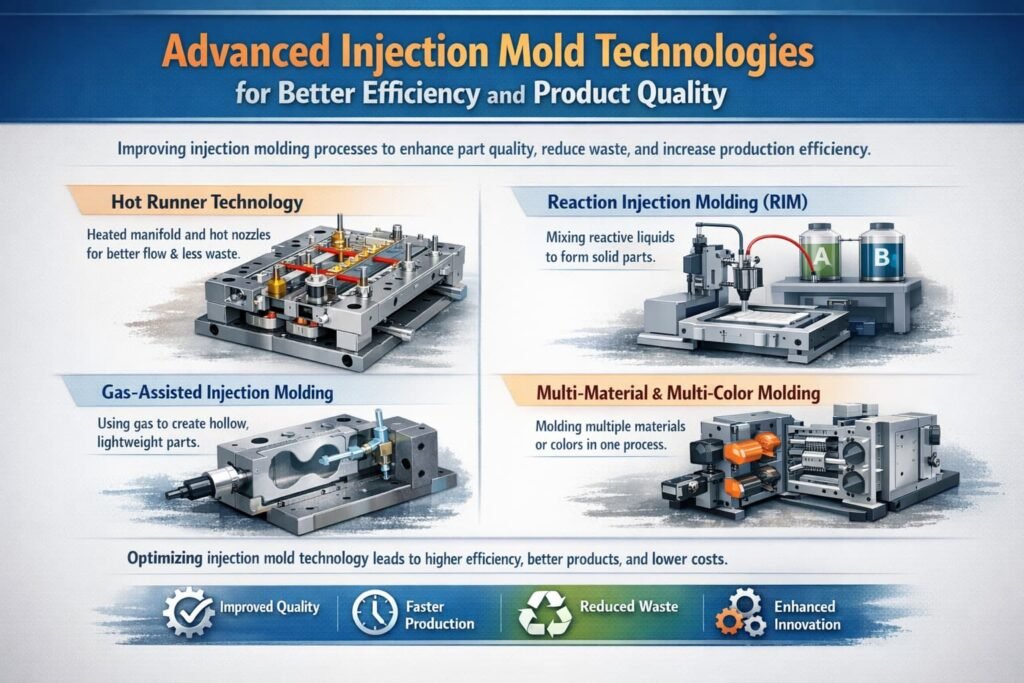
Advanced Injection Mold Technologies for Better Efficiency and Product Quality
Modern injection mold manufacturing continues to develop through advanced molding technologies that improve part quality, production efficiency, material utilization, and design flexibility. Among the most widely used advanced injection mold technologies are hot runner systems, reaction injection molding, gas-assisted injection molding, and multi-material injection molding.
Each of these technologies is designed to solve specific molding challenges. Depending on the product structure, material type, appearance requirements, and production goals, manufacturers can select the most suitable injection molding process to achieve better molding performance and more stable production results.
Hot Runner Technology
Hot runner technology is one of the most important systems in modern injection mold production. Its basic principle is to install a heated manifold and hot nozzles inside the mold so that the runner material remains in a molten state during the molding cycle. This helps reduce material waste, shorten cycle time, and improve molding efficiency.
A typical hot runner system usually includes a manifold, hot nozzles, a temperature controller, and related auxiliary components. Stable and accurate temperature control is essential because it directly affects melt flow balance, filling performance, and final part quality.
Reaction Injection Molding Technology
Reaction injection molding, commonly known as RIM, is a molding process in which two or more chemically reactive liquid materials are fed into a mixing system, blended under controlled pressure, and then injected into a closed mold cavity. Inside the mold, the mixed materials react and polymerize to form a plastic part with the required shape and size.
RIM is often used for parts that require lightweight structure, good surface quality, and relatively large size. Compared with conventional thermoplastic injection molding, this process offers advantages in certain applications involving complex shapes and specific material systems.
Gas-Assisted Injection Molding Technology
Gas-assisted injection molding is a process in which a measured amount of plastic melt is injected into the cavity first, followed by compressed gas introduced through a special nozzle. The gas moves through the melt along the path of least resistance, helping the melt fill the cavity while maintaining internal pressure. This process forms hollow sections inside the part and pushes the plastic material against the cavity wall.
When the timing of melt injection, gas injection, and pressure holding is controlled properly, gas-assisted molding can produce lightweight plastic parts with reduced sink marks, improved dimensional stability, and lower material consumption. This technology can be used with many thermoplastics and some thermosetting plastics.
The gas-assisted molding cycle usually includes melt filling, switching delay, gas injection, pressure holding, gas release, and final part ejection. Among these steps, the most important control factors are the melt injection timing and the gas filling timing.
Multi-Material and Multi-Color Injection Molding
Multi-material injection molding uses two or more injection systems to mold different plastic materials or different colors into the same mold, either simultaneously or sequentially. In many practical applications, two-color injection molding is the most common form of this process.
This technology is widely used for products that require combined functions, improved appearance, soft-touch surfaces, sealing performance, or multi-color design. Key process parameters for multi-material injection molding include injection volume, injection speed, and mold temperature. Proper control of these parameters is essential for material bonding quality, dimensional stability, and final product appearance.
Why Advanced Injection Mold Technology Matters
Advanced injection mold technologies help manufacturers improve production efficiency, reduce material waste, expand product design possibilities, and achieve better part performance. Whether the goal is cleaner runner control, lightweight part design, chemical reaction molding, or multi-material integration, selecting the right molding technology can significantly improve the overall result of an injection molding project.
For modern plastic product development, understanding these advanced molding technologies is important for both mold design and process planning. The right technology choice can help reduce manufacturing cost, improve product consistency, and support more competitive production.