
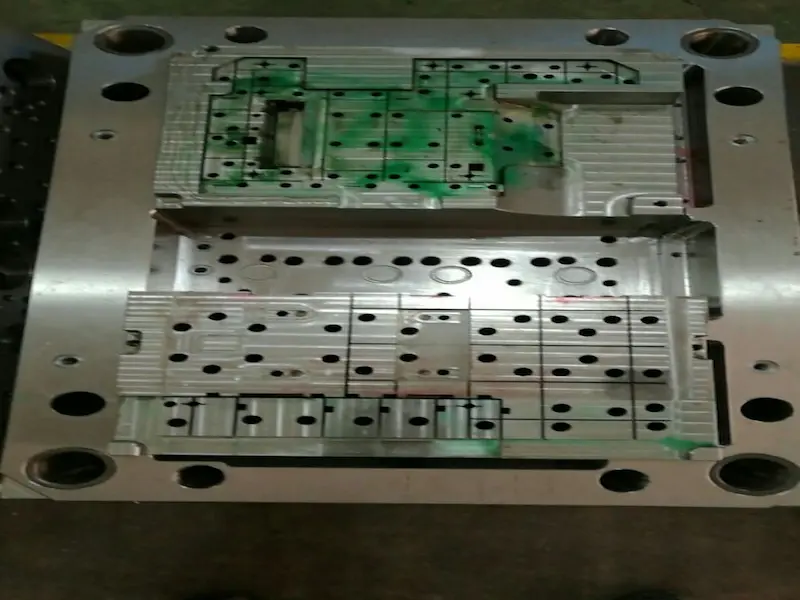
Two-Color Injection Mold Types: Core Shift vs Rotary Core Design
Traditional two-color injection molds are commonly designed in two basic forms: core shift and rotary core. Both structures are used to combine two different plastics into one finished product, but they differ in mold movement, injection sequence, and production efficiency.
1. Core Shift Two-Color Mold
The core shift type mold uses two cavities and one movable core. During the first injection step, the core closes with the first cavity to form the first plastic component. After the first shot solidifies, the cavity and core separate, while the semi-finished part remains on the core.
The core then shifts to align with the second cavity. After the mold closes again, the second injection unit injects the second plastic material into the second cavity area. Once the second material solidifies, the mold opens and the completed two-color product is removed.
This method uses sequential injection, meaning the first and second barrels inject one after another during the molding cycle.
2. Rotary Core Two-Color Mold
The rotary core type mold also uses two cavities, but the core is designed as a rotatable structure made from two back-to-back core sections. After molding, the core rotates 180 degrees to reposition the semi-finished part for the second shot.
In this design, the injection molding machine is equipped with two barrels, and the second barrel is often arranged vertically relative to the machine movement direction. Two different plastic materials can be injected at the same time into separate cavity positions.
After both materials solidify, the mold opens and the finished product is ejected automatically. Once the part is removed, the rotary core turns 180 degrees and the mold closes again for the next production cycle.
3. Main Difference in Production Efficiency
The key difference between these two mold types is the injection sequence.
- In the core shift design, the first and second barrels inject sequentially.
- In the rotary core design, the two barrels inject simultaneously.
Because of this, the rotary core mold can achieve significantly higher output. For the same product, production in rotary core mode is generally about twice as efficient as production in core shift mode.
Conclusion
Both core shift and rotary core molds are widely used in two-color injection molding, but they serve different production needs. The core shift structure is simpler in concept and suitable for sequential molding, while the rotary core design offers much higher production efficiency through simultaneous injection.
Choosing the right two-color mold structure depends on product design, machine configuration, cycle time targets, and overall production volume.