
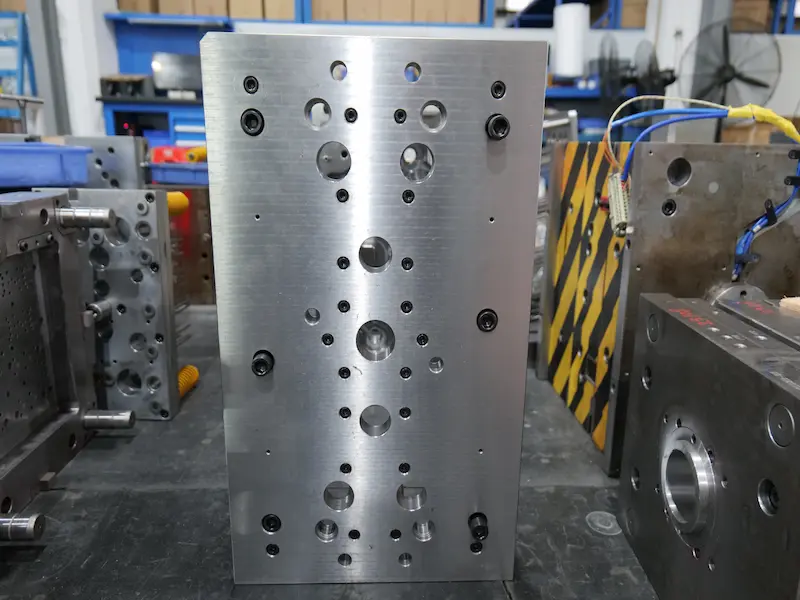
Two-Color Injection Mold Design Guidelines and Key Structural Considerations
Two-color injection molding is widely used for products that combine hard and soft materials, transparent and non-transparent sections, or multiple colors within a single part. Compared with conventional injection molds, two-color molds require more complex structural design, stricter dimensional control, and careful consideration of material compatibility, rotation, ejection, cooling, and machine layout.
Basic Principles of Two-Color Mold Design
In most two-color injection molding applications, the hard material is molded first and the soft material is molded second. Transparent materials are usually molded first, while non-transparent materials are molded second. Materials with higher molding temperatures are also typically injected first, followed by materials with lower molding temperatures.
These principles help prevent flashing, poor bonding, dimensional mismatch, and appearance defects. When sealing between the two materials is required, dedicated sealing structures are generally preferred over simple inserts.
Guide System and Mold Rotation Requirements
Two-color molds often use a rotating rear mold structure. The guide sleeves and guide bushes should be designed symmetrically on all sides so that the rear mold can rotate 180 degrees and still align accurately with the front mold.
In most cases, the rear mold rotates while the front mold remains fixed. All guide components, side locks, locating structures, and mold frames must be designed to maintain accurate alignment after the rotation process.
The side lock positions should be arranged symmetrically around the mold center. If the side locks are not positioned correctly, the rear mold may not align properly after rotating 180 degrees.
Injection Molding Machine Layout Considerations
The spacing between products in the mold must match the nozzle spacing of the injection molding machine. Some imported two-color molding machines allow nozzle spacing adjustment, while many domestic machines do not.
The direction of the machine nozzle arrangement must also be confirmed in advance. Depending on the machine configuration, the nozzle direction may be along the X-axis or Y-axis, which directly affects the mold layout and cavity arrangement.
Because the ejector pin spacing on many machines cannot be adjusted, ejector pin holes may need to be designed with slot-shaped openings to accommodate machine limitations.
Ejection System Design
Two-color molds require two independent ejection systems. The ejector layout for both molding stages must remain consistent, especially when the rear mold rotates between injections.
The ejector plate should generally be reset using springs rather than forced screw reset methods, because the rotating rear mold structure makes forced reset more difficult and less reliable.
For large molds, the number of ejector holes may need to be increased. The minimum recommended spacing between ejector holes is generally 210 mm. In some cases, longer ejector pins are required because the ejector pins on the injection molding machine are not long enough for the mold structure.
Cooling System Design
The cooling circuit design of a two-color mold must remain as balanced as possible between the cavity and core. Water inlet and outlet positions should remain on the same side of the mold to simplify hose routing and avoid interference after mold rotation.
Because the rear mold rotates 180 degrees, designers must ensure that water fittings do not interfere with the machine structure or exceed the allowable space of the molding machine.
Parting Surface and Tolerance Requirements
Two-color mold parting surfaces must be designed carefully. The rear mold parting surface is usually based on the combined product geometry after both shots are completed, while the front mold parting surface may follow only the first molded component.
Dimensional tolerances are critical because even small alignment errors can cause mismatch after the rear mold rotates. Typical tolerance recommendations include:
- Front and rear flange tolerance: -0.05 mm
- Combined flange tolerance: ±0.02 mm
- Ejector pin hole clearance: 0.1 mm
- Guide sleeve center tolerance: ±0.01 mm
- Mold frame depth tolerance: -0.02 mm
Maintaining tight tolerances helps ensure that the front and rear mold halves align accurately after rotation.
Material Selection for Two-Color Injection Molding
Most two-color injection molded products use hard materials such as ABS, PC, or ABS+PC for the first shot and soft materials such as TPE or TPU for the second shot.
When selecting materials, it is important to consider shrinkage differences, adhesion between the two plastics, molding temperatures, processing conditions, and interface appearance. Some material combinations may not bond well without additional surface texture, sealing grooves, or embossed structures.
For example, ABS/PC, ABS/PC+ABS, and ABS/PMMA combinations often require the higher-temperature PC, PC+ABS, or PMMA material to be molded first. TPU materials can provide stronger bonding when the mold surface is smoother.
Gate Design Considerations
Gate location is especially important in two-color molds. Submarine gates are often preferred because they allow automatic separation of the runner and product. If a submarine gate cannot be used, a three-plate mold or hot runner system may be required.
For transparent or appearance-sensitive products, gate locations should be agreed upon in advance with the mold manufacturer to avoid visible flow marks or cosmetic defects.
Transparent Two-Color Product Design
Large transparent two-color products require additional structural attention. Transparent sections are generally recommended to have a thickness of at least 0.8 mm, while non-transparent sections should generally be at least 0.7 mm thick.
Non-transparent ribs should be kept between 0.5 mm and 0.6 mm thick to reduce the risk of shrinkage marks. Transparent and non-transparent areas may also require drop testing and thermal shock testing to verify bonding performance.
For large transparent parts, hot-cold thermal shock testing between -40°C and 65°C for 48 hours is often used to evaluate separation risk between the two materials.
Conclusion
Two-color injection mold design is more complex than conventional mold design because it requires accurate rotation, balanced cooling, independent ejection systems, tight dimensional tolerances, and careful material selection. Proper consideration of machine layout, gate position, shrinkage behavior, and bonding performance can significantly improve mold reliability, part quality, and long-term production stability.