
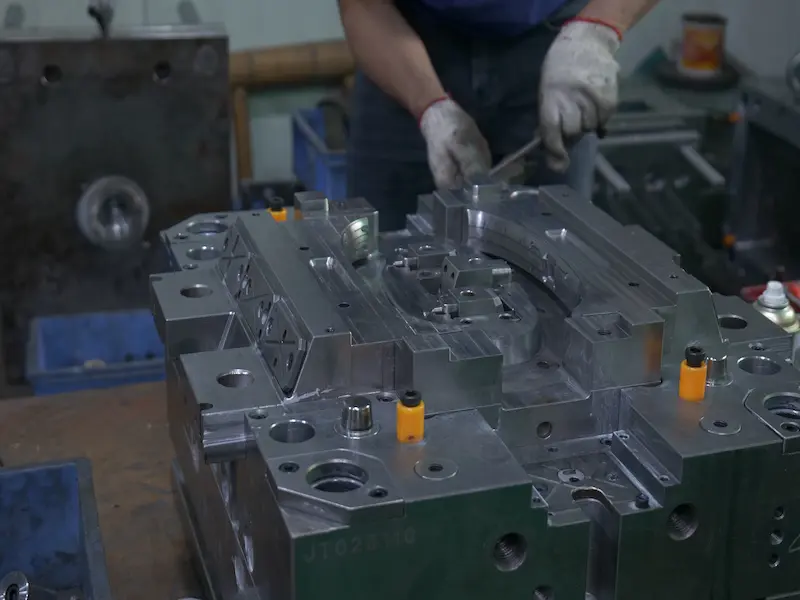
Why High-Speed Cutting Technology Is Important for Mold Manufacturing
Mold manufacturing requires a combination of high precision, short production cycles, low processing costs, and the ability to machine complex geometries. As mold structures become more complicated and product requirements continue to increase, traditional machining methods are often no longer sufficient for efficient production.
High-speed cutting technology has become an important solution in modern mold manufacturing because it can improve machining efficiency, surface quality, and dimensional accuracy while reducing production time and overall costs.
1. High Precision Requirements
Molds require extremely high machining accuracy and surface quality. In many applications, dimensional tolerances need to be controlled at the micron level to ensure that molded products meet strict precision requirements.
High-precision molds can improve product consistency, increase pass rates, and reduce the risk of defects during production. Better machining precision also helps extend mold service life by reducing wear and improving fit between mold components.
2. Long Mold Service Life
Molds are expensive production tools, and their manufacturing cost often accounts for approximately 10% to 30% of the total product cost. Because of this, extending mold life is highly valuable for manufacturers.
High-speed cutting can improve surface finish and reduce residual stress during machining, helping mold components achieve better durability and longer service life.
3. Shorter Manufacturing Cycles
In competitive markets, mold makers need to reduce lead times to meet customer schedules and product launch requirements. Traditional machining methods often require multiple roughing, semi-finishing, and finishing operations, which can increase production time.
High-speed cutting technology allows higher spindle speeds, faster feed rates, and more efficient material removal, significantly reducing the mold manufacturing cycle.
4. Lower Processing Costs
The total cost of mold manufacturing depends on several factors, including mold structure, material selection, precision requirements, and machining methods.
By reducing machining time, improving surface finish, and minimizing the need for secondary polishing or EDM processes, high-speed cutting technology can help reduce overall mold processing costs.
5. Ability to Machine Complex Mold Shapes
Modern molds often contain highly complex two-dimensional and three-dimensional surfaces rather than simple flat structures. Automotive molds, consumer product molds, and industrial component molds frequently involve curved surfaces, deep cavities, and irregular geometries.
High-speed cutting is particularly suitable for processing these complex mold shapes because it can maintain accuracy and surface quality even when machining difficult contours.
6. Machining of High-Hardness Materials
Many molds are made from hardened tool steel, carbide, or other high-hardness materials. These materials are difficult to process using conventional machining methods.
High-speed cutting technology provides a more efficient way to machine hardened materials, reducing cutting forces, improving tool life, and achieving better surface quality.
7. Complementing EDM Processes
Electrical discharge machining (EDM) is still widely used in mold manufacturing, especially for deep cavities, sharp corners, and hard-to-machine features. However, excessive dependence on EDM can increase production time and cost.
High-speed cutting can replace part of the EDM process in many mold applications, helping manufacturers shorten lead times and improve overall efficiency.
Conclusion
High-speed cutting technology has become an important part of modern mold manufacturing because it offers higher precision, faster production cycles, lower processing costs, and better machining capability for complex shapes and hard materials.
For mold makers looking to improve productivity and remain competitive, combining high-speed cutting with EDM and other advanced manufacturing methods is an effective strategy for producing high-quality molds efficiently.