
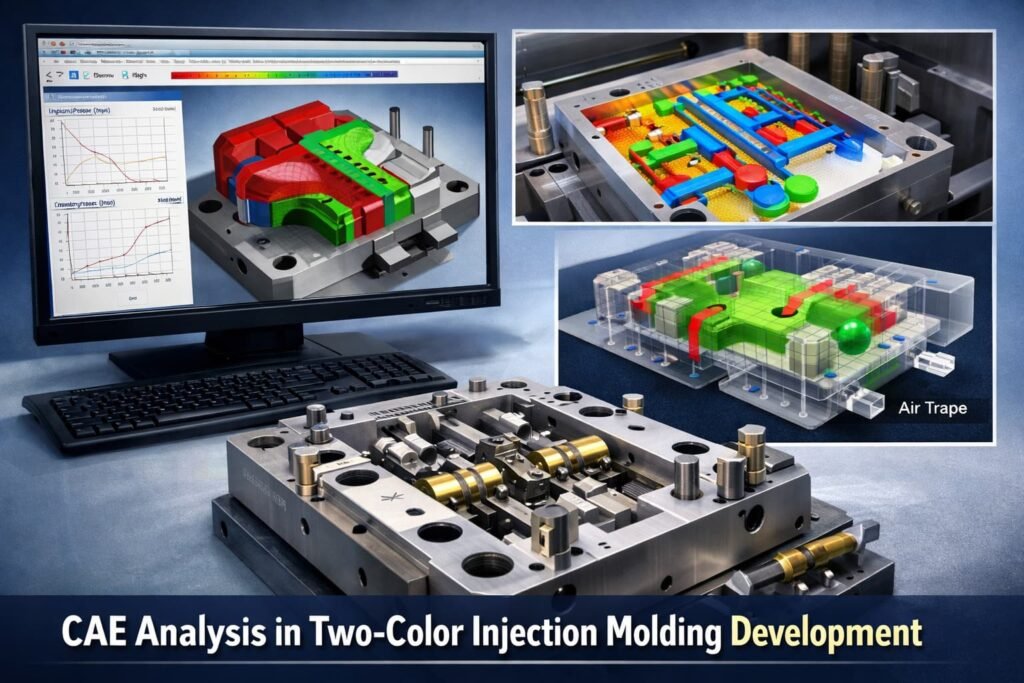
CAE Analysis in Two-Color Injection Molding Development
Two-color injection molding is now a highly mature manufacturing process used across automotive, consumer products, electronics, and medical applications. During the early stage of mold development, CAE analysis can be used to simulate mold performance, material behavior, and molding conditions before production begins.
Simulation software helps engineers identify potential molding defects, optimize tool design, and improve overall production stability. By evaluating different molding parameters in advance, manufacturers can reduce development risk, shorten lead times, and improve product quality.
1. Material Analysis
Material selection is one of the most important factors in two-color injection molding development. As more combinations of rigid plastics, soft-touch materials, and specialty materials become available, selecting compatible materials has become increasingly important.
During the development phase, CAE software can be used to evaluate material compatibility, bonding performance, shrinkage behavior, and thermal expansion. This is especially important for products that require strong adhesion between the two materials.
Simulation data can also help engineers choose suitable material combinations based on product appearance, functional requirements, and long-term durability.
2. Cooling and Waterway Analysis
Cooling system design is another critical part of two-color mold development. If the mold cooling is insufficient or uneven, the molded part may develop defects such as warpage, sink marks, dimensional instability, or inconsistent surface appearance.
Waterway analysis allows engineers to review cooling channel layout, cooling efficiency, mold temperature distribution, and cycle time performance before the mold is manufactured.
By optimizing the cooling system in advance, manufacturers can improve molding stability, shorten cycle times, and reduce the risk of product defects during mass production.
3. Analysis for LSR and Other Specialty Processes
For emerging processes such as liquid silicone rubber (LSR) molding and LSR overmolding, simulation software can also be used to predict molding behavior and identify potential production issues.
CAE analysis helps engineers evaluate filling balance, air traps, bonding performance, material flow, and temperature control in these more complex molding applications.
Using simulation during the design phase can significantly reduce trial-and-error during mold testing and help improve first-pass production success rates.
Why CAE Analysis Matters in Two-Color Injection Molding
CAE analysis has become an important part of modern two-color mold development because it helps manufacturers reduce risk before tooling begins. Accurate simulation can improve mold design, material selection, cooling efficiency, and overall production performance.
For complex two-shot molding projects, early-stage engineering analysis can reduce mold modifications, improve product quality, and support more reliable long-term production.