
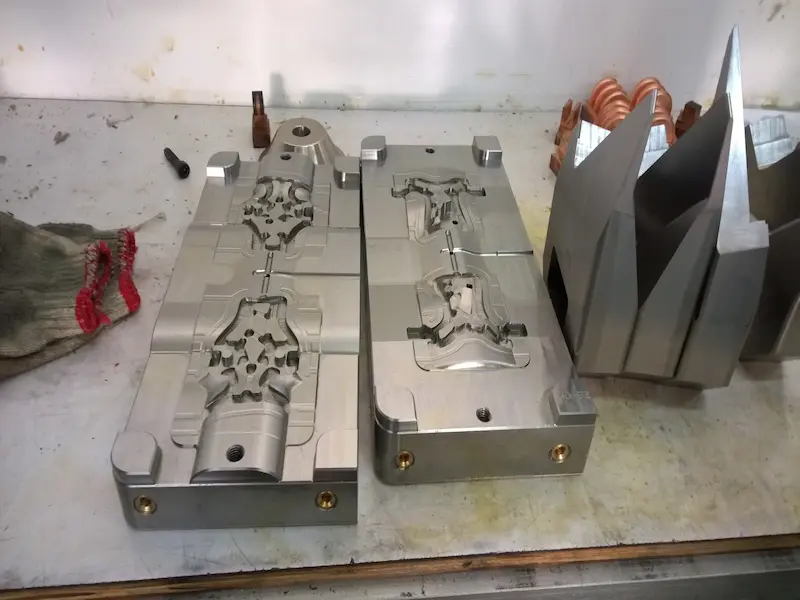
Precision Injection Molding vs Ordinary Injection Molding
Precision injection molding and ordinary injection molding are both widely used plastic manufacturing methods, but they serve different product requirements. The main difference lies in dimensional accuracy, process control, mold quality, machine requirements, and material selection.
1. What Is Precision Injection Molding?
Precision injection molding is used when plastic parts require high dimensional accuracy, tight tolerances, and stable repeatability. This process is often selected for components used in electronics, automotive systems, medical devices, connectors, and other applications where even small dimensional variation can affect assembly or performance.
To achieve precision injection molding, several conditions must be met:
- The mold must use high-quality material with sufficient rigidity.
- The cavity must have high dimensional accuracy and good surface finish.
- The positioning accuracy between mold plates must be high.
- A precision injection molding machine is required.
- The molding process must be tightly controlled.
- The material must be suitable for precision molding.
Common materials used for precision injection molding include POM, POM+CF, POM+GF, PA, reinforced PA66, and PC.
An important part of precision molding is controlling part shrinkage. This includes thermal shrinkage, phase shrinkage, orientation shrinkage, compression shrinkage, and elastic recovery after molding.
2. What Is Ordinary Injection Molding?
Ordinary injection molding is used for plastic parts that do not require extremely tight dimensional tolerances. In many cases, the dimensional accuracy only needs to be good enough for normal assembly and general product use.
Compared with precision injection molding, ordinary injection molding places fewer demands on machine accuracy, mold precision, and material selection. It is therefore more widely used across the modern plastic industry.
For ordinary injection molding:
- Dimensional precision requirements are lower.
- Standard thermoplastics can usually be used.
- A highly specialized precision molding machine is not always necessary.
- The focus is often more on appearance and general functionality.
If appearance quality needs to be improved, secondary processing may also be used after molding.
3. Main Differences Between Precision and Ordinary Injection Molding
Precision injection molding focuses on tight tolerance control, stable shrinkage behavior, high mold accuracy, and machine precision.
Ordinary injection molding focuses more on cost-effective production, general dimensional suitability, and acceptable appearance quality for standard applications.
In other words, one is for parts that need to fit like a watch movement, and the other is for parts that just need to do their job without starting a philosophical debate about microns.
4. Choosing the Right Process
The right molding method depends on the product’s dimensional tolerance, assembly requirement, material type, and cost target.
If the product requires tight tolerance, stable performance, and precise fit, precision injection molding is usually the better choice. If the product is more general-purpose and does not require extreme dimensional control, ordinary injection molding is often sufficient and more economical.
Conclusion
Precision injection molding and ordinary injection molding each serve different manufacturing needs. Precision molding is essential for high-tolerance plastic parts, while ordinary molding is suitable for standard products with less demanding dimensional requirements.
By understanding the difference between the two processes, manufacturers can choose the right production method for quality, cost, and application performance.