
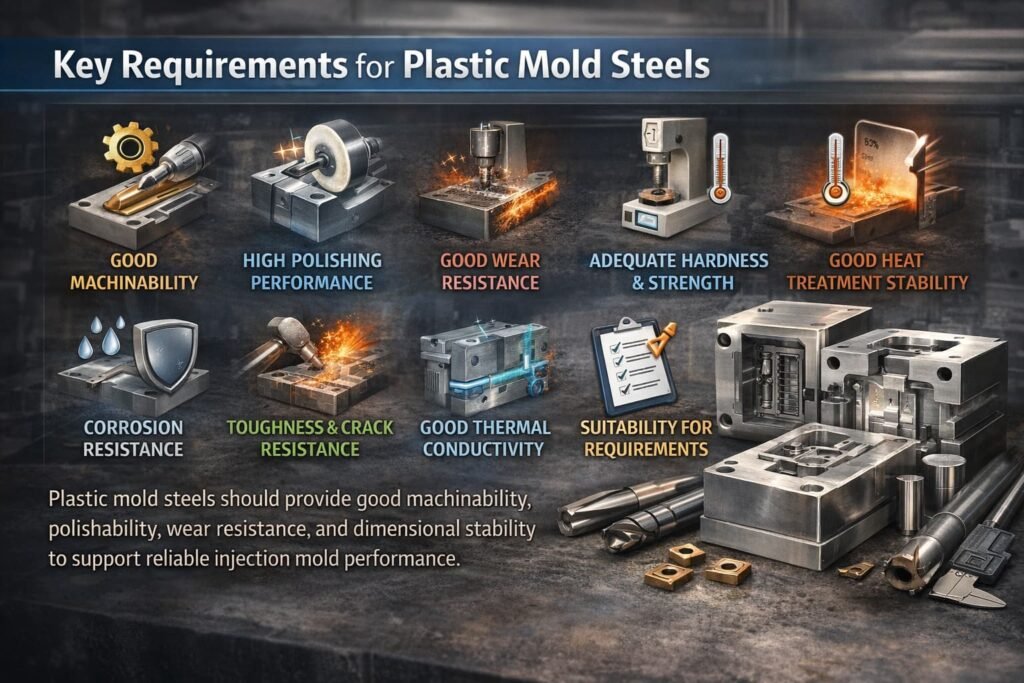
Key Requirements for Plastic Mold Steels
Plastic mold steel plays a critical role in injection mold manufacturing because it directly affects mold life, machining performance, polishing quality, dimensional stability, and final part consistency. To meet the demands of modern mold making, plastic mold steels should satisfy several important technical requirements.
1. Good Machinability
Plastic mold steels should have good machinability so that mold components can be processed efficiently during rough machining, semi-finishing, and finishing. Good cutting performance helps reduce manufacturing time, improve dimensional accuracy, and lower overall tooling cost.
2. High Polishing Performance
Many plastic parts require a smooth or high-gloss surface finish, especially for transparent products, cosmetic housings, and consumer-facing components. Mold steels used for these applications should have excellent polishing performance so that the cavity surface can achieve the required finish without surface defects.
3. Good Wear Resistance
Plastic mold steels should provide sufficient wear resistance, particularly when molding high-volume parts or using materials that contain glass fiber, mineral fillers, or flame-retardant additives. Good wear resistance helps maintain cavity accuracy, part consistency, and long mold service life.
4. Adequate Hardness and Strength
The steel should have adequate hardness and mechanical strength to resist deformation, indentation, and surface damage during mold operation. This is especially important for molds exposed to high injection pressure, complex part geometry, or demanding production cycles.
5. Good Heat Treatment Stability
Plastic mold steels should respond well to heat treatment and maintain dimensional stability after hardening or tempering. Stable heat treatment performance helps reduce distortion, supports precision mold assembly, and improves the reliability of the finished tool.
6. Corrosion Resistance
For molds processing corrosive plastics such as PVC, flame-retardant materials, or moisture-sensitive resins, corrosion resistance is an important requirement. Stainless mold steels or corrosion-resistant grades can help protect the cavity surface and extend mold life in these conditions.
7. Toughness and Crack Resistance
Mold steels should also offer sufficient toughness to resist cracking, chipping, or premature failure during machining, heat treatment, and production use. This is particularly important for molds with thin cores, sharp details, or complex structural features.
8. Good Thermal Conductivity
Efficient heat transfer helps improve cooling performance and reduce molding cycle time. Mold steels with suitable thermal conductivity can support more stable processing, better dimensional consistency, and improved production efficiency.
9. Suitability for Specific Product Requirements
The selection of plastic mold steel should always match the actual molding application. Factors such as resin type, production volume, required surface finish, dimensional tolerance, and mold complexity should all be considered when choosing the most suitable steel grade.
Conclusion
Plastic mold steels should offer a balanced combination of machinability, polishability, wear resistance, hardness, toughness, corrosion resistance, and dimensional stability. Choosing the right mold steel is essential for achieving stable production, long tool life, and consistent plastic part quality in injection mold manufacturing.