
Main Failure Forms of Plastic Molds in Modern Production
With the rapid development of the manufacturing industry, plastic molds have become indispensable tools in plastic molding processing. As plastic products continue to expand in variety, size, precision, and structural complexity, molding production is advancing at a much higher pace. At the same time, mold working conditions are becoming more demanding, which makes mold failure analysis increasingly important for stable production and long service life.
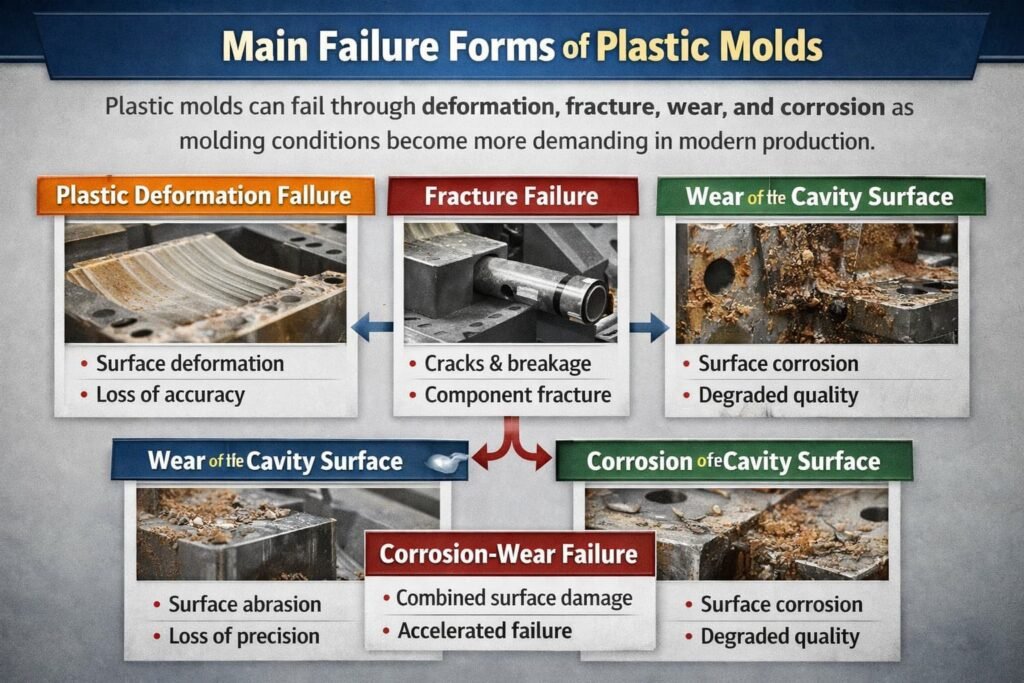
In modern plastic molding, molds are exposed to repeated pressure, heat, friction, and chemical attack. Under these conditions, the most common mold failures usually appear in the form of plastic deformation, fracture, and cavity surface wear or corrosion.
1. Plastic Deformation Failure
Plastic deformation failure occurs when the mold cavity surface is subjected to pressure and heat that exceed its resistance to deformation. This type of failure is more likely when a relatively small mold is operated on large-tonnage equipment, where overload conditions can easily occur.
One important cause is insufficient material strength and toughness in the mold steel, which results in poor resistance to deformation. Another common cause is an inadequate hardened layer on the mold cavity surface. If the hardened layer is too thin, the surface may not provide enough support under production loads.
Plastic deformation can also occur when the working temperature of the mold exceeds the tempering temperature of the steel. In this case, the mold surface may soften because of structural change, leading to early failure.
2. Fracture Failure
Fracture is another serious failure mode in plastic molds. It is often caused by structural stress, thermal stress, insufficient tempering, or internal stress created by differences in structure and temperature within the mold.
In some cases, retained austenite inside the steel may transform into martensite during service. This transformation can produce local volume expansion, which generates internal stress and may eventually lead to cracking or fracture of the mold component.
Fracture failure is particularly dangerous because it can cause sudden mold damage, production interruption, and expensive repair or replacement work.
3. Wear of the Cavity Surface
During molding, the plastic melt flows through the cavity under pressure, and the solidified plastic part is later released from the mold. These repeated actions create friction on the molding surface and gradually cause wear.
The root cause of wear failure is the friction between the mold and the processed material. However, the actual wear pattern depends on several operating factors, including cavity pressure, temperature, material deformation speed, and lubrication conditions.
If the selected mold material is unsuitable or heat treatment is not properly controlled, the cavity surface may have insufficient hardness and poor wear resistance. As wear progresses, the cavity surface can lose dimensional accuracy, and the roughness of the molding surface can increase, which reduces the quality of the molded plastic parts.
When solid particles, fillers, or abrasive materials enter the mold cavity, wear can become even more severe and shorten mold life further.
4. Corrosion of the Cavity Surface
Some plastics contain chlorine, fluorine, flame-retardant additives, or other components that may decompose during molding and generate corrosive gases such as HCl or HF. These gases can attack the mold cavity surface and cause corrosion damage.
Corrosion reduces surface quality, weakens the protective condition of the cavity, and can eventually lead to mold failure. If surface wear is already present, corrosion can progress even faster because the original coating or protective layer may already be damaged.
5. Corrosion-Wear Failure
In many real production environments, mold failure is not caused by wear or corrosion alone, but by a combination of both. Once the cavity surface begins to wear, the protective layer becomes weaker, which makes it easier for corrosive substances to attack the exposed surface. At the same time, corrosion damage can increase surface roughness and accelerate mechanical wear.
This combined corrosion-wear effect often leads to faster cavity deterioration than either failure mode acting alone.
How to Reduce These Failure Risks
To improve mold life and reduce early failure, manufacturers should focus on proper mold steel selection, suitable heat treatment, reasonable equipment matching, and effective cavity surface protection. Good maintenance practices, proper resin selection, and attention to abrasive or corrosive additives are also important for preventing premature mold damage.
Conclusion
As molding production becomes faster and plastic products become more complex, the working conditions of plastic molds continue to become more severe. The main failure forms of plastic molds include plastic deformation, fracture, wear, corrosion, and corrosion-wear interaction. Understanding these failure mechanisms is essential for selecting the right mold materials, improving heat treatment quality, and achieving longer mold service life in modern plastic manufacturing.