
Mold Design Requirements for High-Quality Plastic Plated Parts
To ensure that electroplated plastic parts achieve a smooth surface finish without visible defects, weld lines, internal stress marks, or flow orientation, the mold design and manufacturing process must follow strict requirements. Since the surface quality of plated plastic parts directly affects the final appearance after electroplating, even small mold defects can become more visible after plating.
1. Mold Material Selection
Bismuth bronze alloy should not be used for mold manufacturing. Instead, high-quality vacuum-cast steel should be selected to ensure better strength, stability, and surface finish performance.
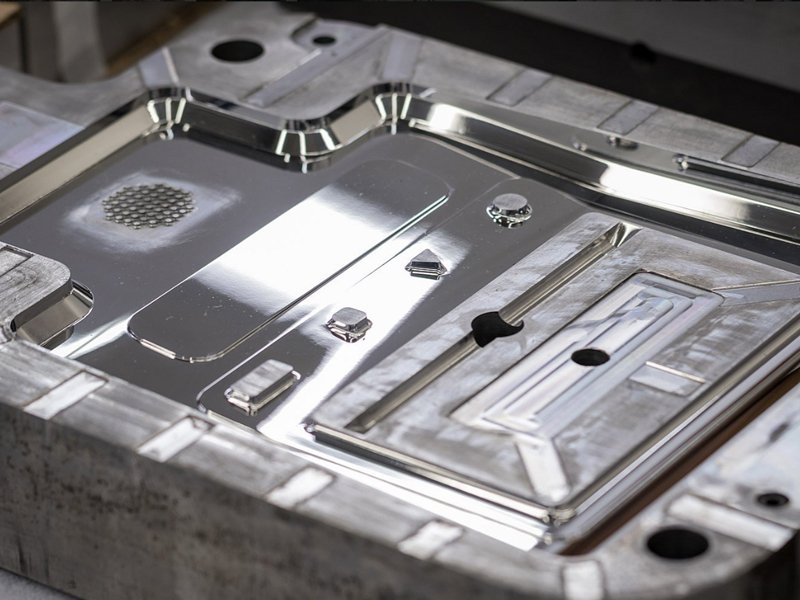
The cavity surface should be polished to a mirror finish along the mold opening direction. The surface unevenness should be controlled below 0.2 μm. For better wear resistance and surface quality, hard chrome plating on the cavity surface is also recommended.
2. Cavity Surface Quality Requirements
The final appearance of a plated plastic part directly reflects the cavity surface condition. Any scratch, sink, polishing mark, or roughness on the mold surface may appear more clearly after electroplating.
For this reason, the cavity surface roughness should be one to two grades finer than the required surface roughness of the finished plastic part. A highly polished cavity surface is essential for achieving a uniform plated finish.
3. Avoid Defects on the Plating Surface
Parting lines, weld lines, and core insert lines should not be located on visible plated surfaces whenever possible. These areas can remain visible after electroplating and negatively affect product appearance.
During product design and mold layout, the visible side of the plated part should be kept as clean and continuous as possible. Humans will spend weeks polishing a plated surface to look flawless, then place a giant weld line directly across the center like some kind of industrial scar. It is one of the more creative ways to waste tooling money.
4. Gate and Runner Design
The gate should be located at the thickest section of the plastic part to ensure stable filling and reduce flow hesitation. To prevent the molten plastic from cooling too quickly during cavity filling, the gate size should generally be about 10% larger than that used in a standard injection mold.
It is recommended to use gates and runners with a circular cross-section because they provide smoother melt flow and lower pressure loss. The runner length should also be kept as short as possible to improve filling efficiency.
5. Venting Design
Proper venting is essential to prevent air traps, gas marks, burn marks, bubbles, and other surface defects. Vent holes should be added in suitable positions to allow trapped air to escape during injection molding.
Good venting design is especially important for plated parts because even very small surface defects can become more obvious after electroplating.
6. Ejection System Design
The ejector system should be designed to ensure smooth and even demolding without leaving visible ejector marks, scratches, or deformation on the plated surface.
Where possible, ejector pins should be placed on hidden or non-cosmetic areas of the part. Uniform ejection force distribution also helps reduce internal stress and improve dimensional stability.
Conclusion
For plated plastic parts, mold material selection, mirror polishing, gate design, venting, and ejection design all have a major influence on the final appearance and plating quality. A well-designed mold helps reduce visible defects, improve plating adhesion, and achieve a cleaner, more premium product appearance.