
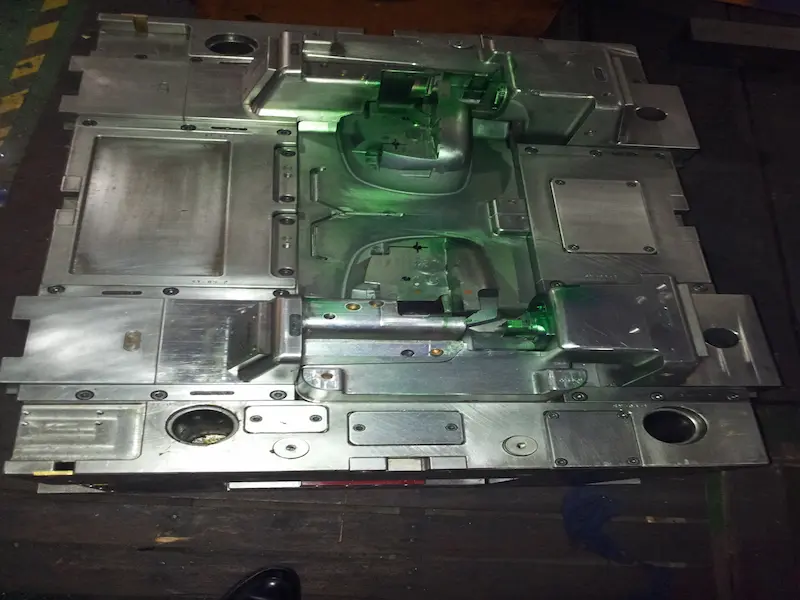
How Mold Design and Manufacturing Accuracy Affect Plastic Part Dimensional Precision
The structural design and manufacturing accuracy of the mold directly influence the dimensional accuracy of injection molded plastic parts. Even if the molding process is stable, insufficient mold rigidity, poor guide component fit, cavity wear, or unbalanced filling can all lead to dimensional variation and wall thickness inconsistency.
1. Mold Rigidity and Cavity Pressure
If the mold does not have sufficient strength and rigidity, deformation may occur during molding when cavity pressure is high. Mold deformation directly affects part shape, dimensional stability, and repeatability in production.
For precision plastic parts, the mold structure should be designed to withstand molding pressure without deflection. A rigid mold base and properly supported cavity structure are essential for maintaining dimensional consistency.
2. Guide Pillar and Guide Bush Accuracy
The fit between the guide pillar and guide bush also affects molding precision. If the mold guide system has poor manufacturing accuracy or becomes excessively worn during use, misalignment may occur between the cavity and core.
This misalignment reduces the dimensional accuracy of the molded part and may also cause uneven wall thickness, flash, or assembly issues in high-precision components.
3. Cavity Wear and Filling Imbalance
When molding materials contain hard fillers or glass fiber reinforcement, the mold cavity may wear faster over time. Cavity wear changes the effective molding dimensions and can lead to part size fluctuation during mass production.
In multi-cavity molds, dimensional variation may also be caused by differences between cavities, gates, runners, and feed balance. If melt flow is not evenly distributed, the cavities may fill inconsistently, resulting in unstable part dimensions from cavity to cavity.
4. Material and Surface Treatment Requirements for Precision Molds
To improve dimensional stability and mold life, cavity materials should be wear-resistant and suitable for the selected resin system. The cavity surface should also receive proper heat treatment or surface hardening to reduce wear caused by abrasive materials.
For plastic parts with very high dimensional accuracy requirements, a single-cavity mold is often a better choice. Although multi-cavity molds improve production efficiency, they make precision control more difficult and may require additional auxiliary positioning systems, increasing mold complexity and cost.
5. Causes of Wall Thickness Error in Plastic Parts
When plastic parts show wall thickness variation, mold-related factors are often the main cause.
In a single-cavity mold, uneven wall thickness is usually caused by installation error or poor positioning between the cavity and the core. For parts that require highly precise wall thickness, relying only on guide pillars and guide bushes may not be enough. Additional positioning devices should be used to ensure accurate alignment.
In multi-cavity molds, local thickness error may be small at the beginning of production but gradually increase during continuous operation. This is often caused by relative positional deviation between the cavity and the core as thermal conditions change during molding.
6. Hot Runner Molding and Thermal Balance
Wall thickness error is more likely to occur in hot runner molding systems because continuous operation can create temperature differences inside the mold. These temperature variations may affect cavity-core alignment and molding stability.
To reduce this risk, the mold can be designed with a dual cooling circuit that minimizes temperature difference between critical mold sections. Better thermal balance helps maintain consistent dimensions during extended production runs.
7. Special Design for Thin-Walled Round Parts
For thin-walled round containers or similar precision parts, a floating core design can be used to improve wall thickness consistency. In these applications, the concentricity between the core and cavity must be carefully maintained to prevent eccentric wall thickness and dimensional inaccuracy.
8. Mold Accuracy Is Critical for Precision Plastic Parts
Achieving high dimensional accuracy in injection molded plastic parts depends heavily on mold rigidity, guide system precision, cavity wear resistance, balanced filling, and proper thermal control. Careful mold design and tight manufacturing tolerances are essential for producing precision plastic components with stable dimensions and consistent wall thickness.