Rubber Mold Maintenance Guide for Longer Mold Life and Stable Production
Every mold has a limited service life, but proper maintenance can significantly improve mold durability, reduce repair costs, and maintain stable product quality. In rubber mold manufacturing, regular inspection and preventive maintenance are essential for avoiding unexpected downtime and extending mold life.
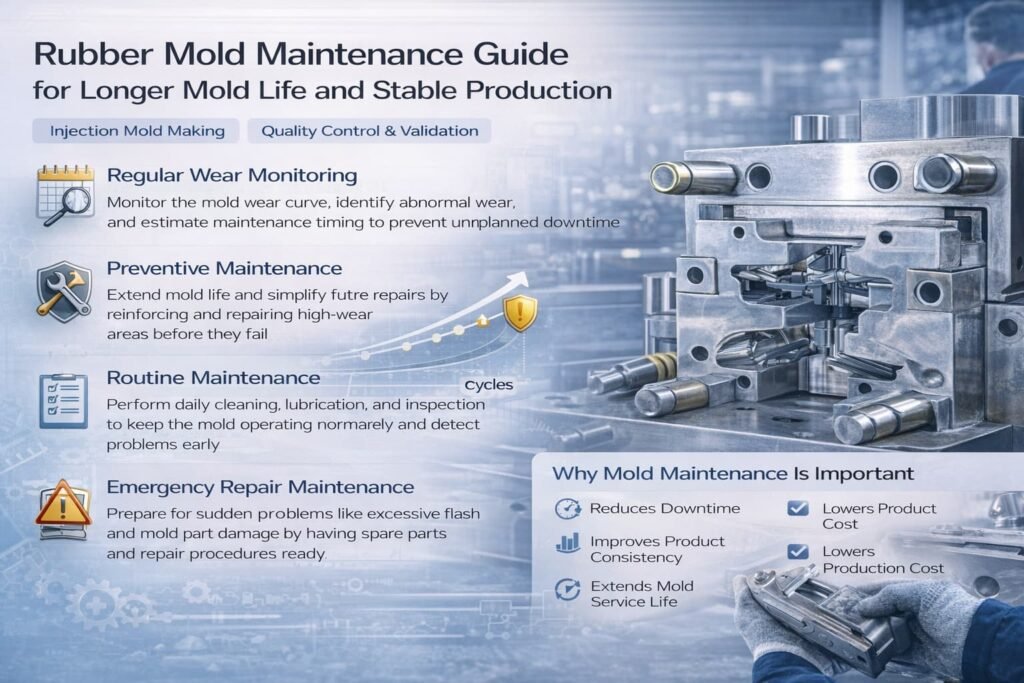
A complete rubber mold maintenance program usually includes regular wear monitoring, preventive maintenance, routine maintenance, and emergency repair planning. By understanding the condition of the mold and responding to wear before serious damage occurs, manufacturers can improve production efficiency and reduce long-term tooling cost.
Regular Wear Monitoring
Each mold develops a wear pattern over time. Monitoring the mold wear curve helps identify abnormal wear areas and makes it easier to estimate when maintenance will be required. By recording the number of molding cycles and observing changes in mold condition, manufacturers can establish a more accurate maintenance schedule.
This type of maintenance planning helps reduce unexpected breakdowns and allows maintenance work to be carried out before mold damage becomes severe. It also improves maintenance timing and helps avoid unnecessary production interruptions.
Preventive Maintenance
Preventive maintenance is carried out to extend mold life, stabilize product quality, and simplify future repair work. In many cases, areas of the mold that are more likely to wear or become damaged are specially reinforced or repaired before problems occur.
Preventive maintenance can include replacing worn components, adjusting moving parts, polishing cavity surfaces, improving venting areas, and correcting small alignment issues before they affect product quality.
Routine Maintenance
Routine maintenance includes daily cleaning, inspection, lubrication, and movement checks for the mold. These tasks help confirm that the mold is operating normally and allow operators to detect abnormal conditions early.
Routine maintenance often includes checking for contamination, wear, rust, damaged mold surfaces, poor movement of sliders or ejector systems, and changes in part appearance. By carrying out these checks regularly, mold problems can often be found before they become more serious.
Emergency Repair Maintenance
Sometimes molds develop sudden problems that prevent normal production. Common examples include excessive flash, incorrect dimensions, scratches on molded parts, burn marks, or damage to mold components. When these problems occur unexpectedly, emergency repair maintenance is required.
This type of maintenance is usually necessary when the mold is already close to its wear limit or when the cost of continued operation becomes higher than the cost of repair. Because emergency maintenance often happens without warning, manufacturers should prepare spare parts, repair procedures, and planned production stops in advance.
Why Mold Maintenance Is Important
Effective rubber mold maintenance helps reduce downtime, improve product consistency, extend mold service life, and lower overall production cost. A good maintenance system also makes it easier to plan repairs, reduce emergency shutdowns, and maintain stable molding performance over time.
For rubber molding projects with high production volume or demanding quality requirements, preventive maintenance and regular inspection are especially important for keeping molds in good operating condition.