
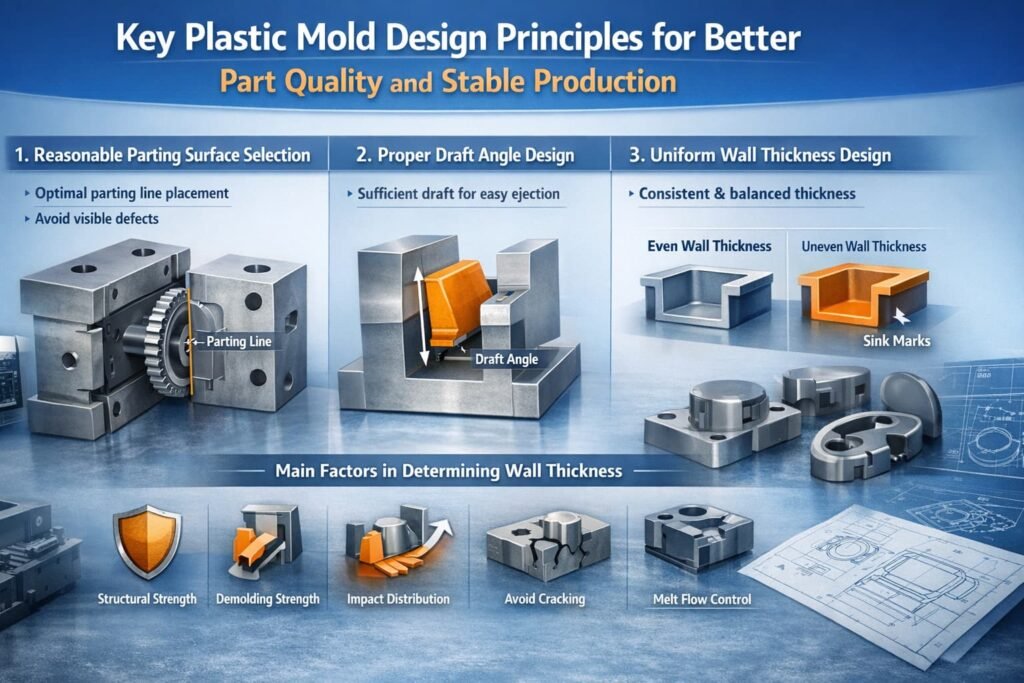
Key Plastic Mold Design Principles for Better Part Quality and Stable Production
In injection molding, the plastic mold gives the molten plastic its final shape and directly affects part quality, dimensional accuracy, cooling performance, and ejection behavior. Because of this, a well-designed mold is essential for achieving stable product quality, efficient production, and better overall economic results.
To design an effective plastic injection mold, several basic principles must be considered carefully. Among the most important are proper parting line selection, suitable draft angle design, and uniform wall thickness planning. These factors strongly influence mold structure, molding performance, product appearance, and manufacturing cost.
1. Reasonable Parting Surface Selection
The parting surface is the division line that allows the molded product and gating system to be removed from the mold. It is one of the most important structural elements in mold design because it affects mold construction, mold machining, melt flow, and part ejection.
In general, the parting surface should be selected to ensure part quality, simplify the mold structure, and make demolding easier. It should avoid obvious cosmetic surfaces, prevent visible depressions or defects, and be placed in a position that is practical for machining and assembly.
2. Proper Draft Angle Design
Draft angle is necessary to allow the molded part to be released smoothly from the mold cavity. The required draft angle depends on several factors, including part shape, plastic material type, mold structure, surface finish requirements, and the direction of mold release.
In practical mold design, there is no single exact formula for draft angle selection. In most cases, draft is determined according to experience and adjusted based on the product structure and production requirements. When product function and appearance allow, a larger draft angle is usually preferred because it improves demolding and reduces the risk of surface damage.
3. Uniform Wall Thickness Design
Wall thickness is one of the most important structural factors in plastic part design. It affects part strength, mold filling behavior, cooling time, shrinkage, cycle time, and final molding quality. For this reason, wall thickness should be selected carefully according to both product use requirements and molding process requirements.
If the wall thickness is too small, flow resistance inside the cavity increases and molding becomes more difficult, especially for large parts or parts with complex geometry. This may lead to short shots or require higher injection pressure. If the wall thickness is too large, material cost increases, cooling time becomes longer, molding cycle time increases, and defects such as sink marks, shrinkage cavities, or bubbles may appear.
As a general rule, wall thickness should be as uniform as possible throughout the part. However, adjustments may still be necessary based on part structure, load requirements, or economic considerations.
Main Factors to Consider When Determining Wall Thickness
- Required structural strength of the plastic part
- Strength needed during demolding
- Ability to distribute impact evenly
- Prevention of cracking around inserted metal components caused by different thermal expansion rates
- Avoiding structural features that restrict melt flow and cause incomplete filling
In actual plastic mold design, wall thickness should always be selected according to the plastic material type, part size, product structure, and molding requirements. Proper wall thickness control helps improve filling, reduce defects, shorten cycle time, and maintain stable production quality.