
Basic Mold Components and Structure in Plastic Mold Design
Different molding processes require different mold structures. Blow molds, casting molds, and thermoforming molds are generally simpler in construction, while compression molds, injection molds, and transfer molds are usually more complex and consist of more individual components. Understanding the basic structure of a mold is important for product development, mold design, and manufacturing efficiency.
Main Mold Components
A mold is made up of several functional groups of parts, each serving a specific purpose during molding and demolding.
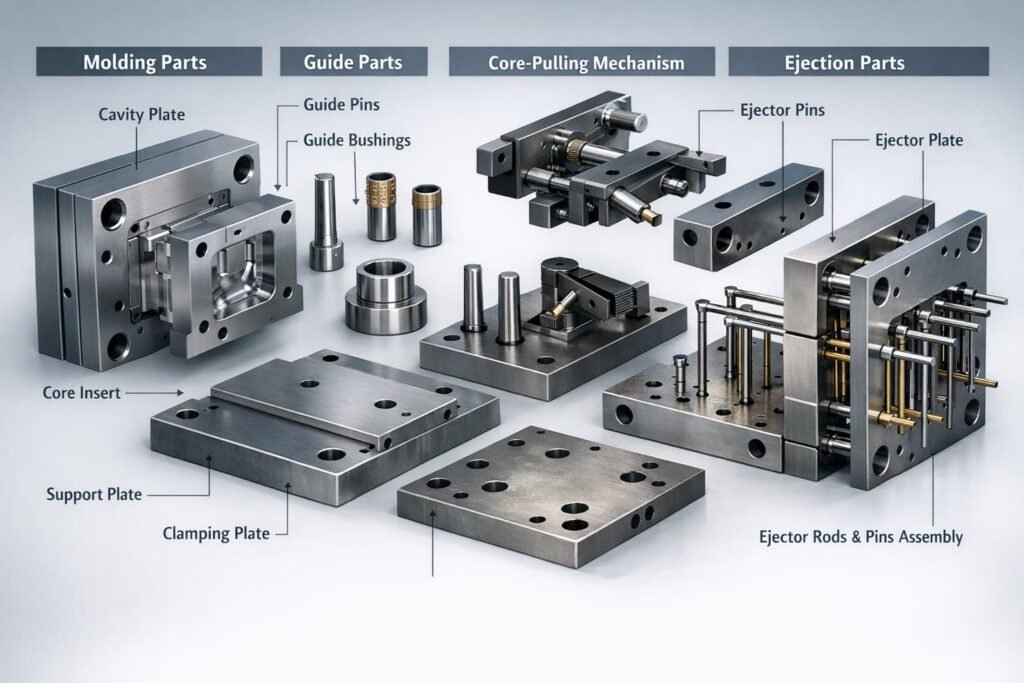
1. Molding Parts
Molding parts include cavities, cores, punches, and other shaped components that directly form the product. These parts create the internal and external surfaces of the molded article, including end faces, side holes, undercuts, and threads. They are the most critical parts in determining the shape and dimensional quality of the final product.
2. Supporting and Fixing Parts
Supporting and fixing parts include mold base plates, fixing plates, support plates, spacer blocks, and related structural components. These parts hold the mold together, provide rigidity, and support the molding pressure during operation.
3. Guiding Parts
Guiding parts mainly include guide pins and guide bushings. Their function is to ensure the correct relative position between the mold halves and to guide the movement of the mold during opening and closing. Proper guidance is essential for mold alignment, part quality, and tool life.
4. Core-Pulling Parts
Core-pulling parts include components such as angle pins and sliders. These mechanisms are used when the molded part has side features, undercuts, or other structures that prevent direct ejection. During mold opening, the core-pulling system retracts the movable core so that the product can be released safely.
5. Ejection Parts
Ejection parts are used to remove the molded product from the mold after forming. These may include ejector pins, ejector sleeves, ejector blocks, stripper plates, ejector rings, ejector retaining plates, and related components. The ejection system must be designed carefully to ensure smooth demolding without damaging the product.
Standard Mold Bases in Injection Mold Design
Injection molds are widely built around standard mold bases. A standard mold base is a structural combination of basic mold components that has been standardized in form, size, and configuration. The cavity and core can then be machined according to the shape of the specific product.
The use of standard mold bases helps shorten mold manufacturing time, improve interchangeability of components, and reduce the overall mold development cycle. For many injection mold projects, this is an efficient and practical approach to mold construction.
Conclusion
The structure of a mold depends on the molding process, but most molds are built from several essential groups of components, including molding parts, support parts, guide parts, core-pulling parts, and ejection parts. In injection mold design, the use of standard mold bases can significantly improve efficiency and reduce lead time, making it an important part of modern mold manufacturing.