
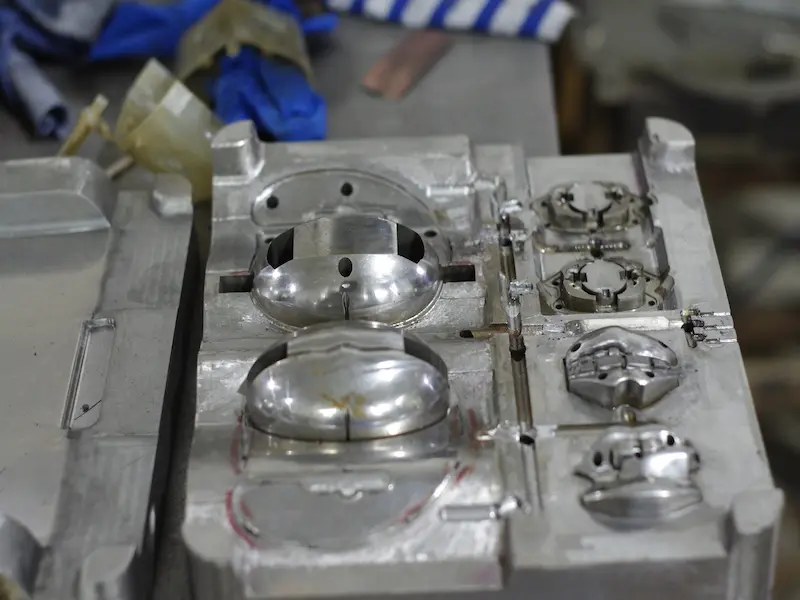
Common Mold Polishing Methods in Mold Manufacturing
In mold manufacturing, the finishing process carried out after shape machining is generally called surface grinding and polishing. This step is essential for improving mold quality, extending mold service life, and achieving better product appearance and dimensional consistency.
Selecting a suitable polishing method can improve mold surface quality, reduce defects, and support stable production in long-term manufacturing.
1. Mechanical Polishing
Mechanical polishing is the most widely used mold polishing method. It removes surface irregularities through cutting, abrasion, or slight plastic deformation of the material to obtain a smooth and glossy finish.
Common tools for mechanical polishing include oil stones, sandpaper, polishing pastes, wool wheels, and fine abrasive compounds. In many mold shops, this process is still largely performed by hand, especially for high-precision cavity surfaces.
For ultra-fine polishing, special grinding tools and polishing fluids can be used to achieve extremely low surface roughness. In some high-end applications such as optical lens molds, mechanical polishing can reach a surface roughness of about Ra 0.008 μm.
2. Chemical Polishing
Chemical polishing is a process in which the workpiece surface is treated in a chemical medium so that raised microscopic areas dissolve faster than lower areas. This selective dissolution creates a smoother surface.
This method is suitable for polishing complex-shaped workpieces and can process multiple parts at the same time with relatively high efficiency. The surface roughness achieved by chemical polishing is generally around Ra 10 μm.
3. Electropolishing
Electropolishing works on a principle similar to chemical polishing, but it uses electrochemical reactions to selectively remove material from the surface of the workpiece.
Compared with chemical polishing, electropolishing offers better surface consistency and can reduce the effects of unwanted side reactions. It is often used when improved cleanliness, brightness, or corrosion resistance is required.
4. Ultrasonic Polishing
Ultrasonic polishing uses high-frequency vibration from a tool together with an abrasive suspension to polish hard and brittle materials. During the process, abrasive particles repeatedly impact and grind the workpiece surface under ultrasonic energy.
This method produces relatively low macroscopic force on the workpiece, which helps avoid deformation. However, the equipment and tooling can be more difficult to design and install.
5. Fluid Polishing
Fluid polishing uses a flowing liquid mixed with abrasive particles to wash and polish the workpiece surface. In hydrodynamic polishing, the abrasive medium is often a special polymer-based compound that carries abrasive powders such as silicon carbide.
This method is suitable for polishing complex channels, contours, and hard-to-reach areas where traditional polishing tools may be less effective.
6. Magnetic Grinding and Polishing
Magnetic grinding and polishing uses magnetic abrasive particles that form a flexible abrasive brush under the action of a magnetic field. This brush then grinds and polishes the surface of the workpiece.
This process offers high efficiency, stable polishing quality, and good control over processing conditions. With the right abrasive selection, the surface roughness can be improved to around Ra 0.1 μm.
7. EDM-Ultrasonic Composite Polishing
EDM-ultrasonic composite polishing combines ultrasonic vibration with high-frequency pulse energy to improve polishing speed on rough mold surfaces. This method is especially effective for surfaces left by turning, milling, EDM, and wire cutting.
By combining ultrasonic action and electrical pulse erosion, the process can reduce surface roughness more quickly and improve polishing efficiency on difficult mold surfaces.
Choosing the Right Mold Polishing Method
Each mold polishing method has different advantages depending on the mold material, surface geometry, required roughness, and production cost. In practical mold manufacturing, mechanical polishing remains the main approach, while chemical, ultrasonic, magnetic, and composite methods are used in more specialized applications.
Choosing the correct polishing process helps improve mold appearance, reduce molding defects, and support longer mold life in production.