
Classification of Forging Processes and Their Applications
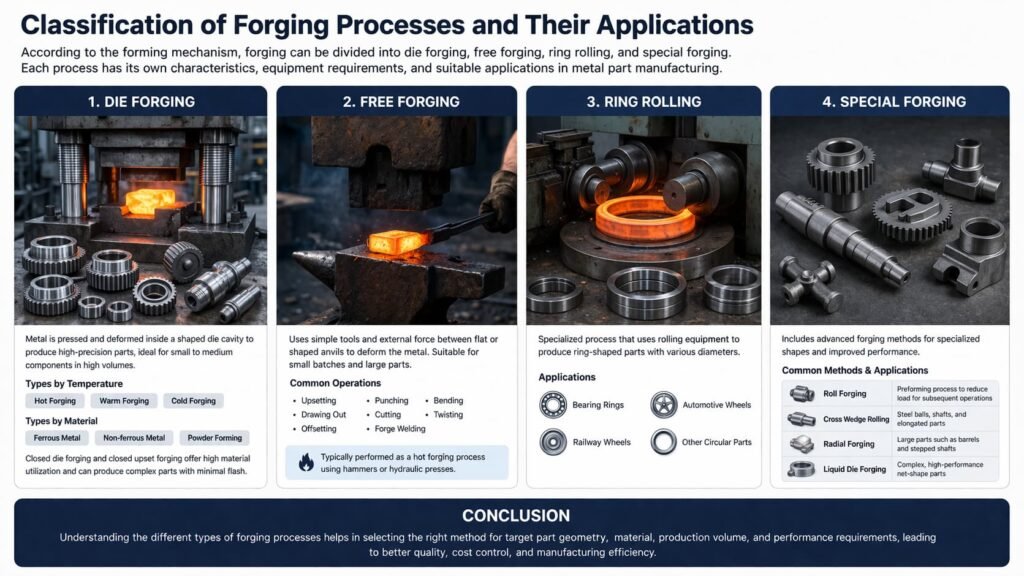
According to the forming mechanism, forging can be divided into die forging, free forging, ring rolling, and special forging. Each process has its own characteristics, equipment requirements, and suitable applications in metal part manufacturing.
1. Die Forging
Die forging can be divided into open die forging and closed die forging. In this process, a metal blank is pressed and deformed inside a forging die with a defined cavity shape to produce a forged part. Die forging is commonly used for parts with relatively small weight and large production volumes.
Based on forming temperature, die forging can also be classified as hot forging, warm forging, and cold forging. Among these, warm forging and cold forging are considered important development directions in modern forging technology, as they reflect higher levels of dimensional precision and process capability.
According to the material type, die forging can also be divided into ferrous metal die forging, non-ferrous metal die forging, and powder product forming. Ferrous metal die forging is typically used for materials such as carbon steel, while non-ferrous die forging is suitable for materials such as copper and aluminum. Powder metallurgy forming is also included in this broader category. Extrusion can be considered a type of die forging and may be further divided into heavy metal extrusion and light metal extrusion.
Closed die forging and closed upset forging are advanced die forging processes. Because these methods produce little or no flash, material utilization is higher and complex forgings can often be finished in one or several operations. Since there is no flash to absorb excess material, strict control is required over blank volume, die positioning, and forging measurements in order to reduce die wear and maintain part accuracy.
2. Free Forging
Free forging is a method in which a metal blank is deformed by applying external force between the upper and lower anvils of forging equipment, using simple universal tools rather than a fully enclosed die cavity. The purpose is to obtain the required shape and internal quality of the forging.
Forgings produced by this method are called free forgings. Free forging is mainly used for small-batch production and for larger parts that are not suitable for closed die processes. Typical equipment includes forging hammers and hydraulic presses.
The basic free forging operations include upsetting, drawing out, punching, cutting, bending, twisting, offsetting, and forge welding. Free forging is generally performed as a hot forging process.
3. Ring Rolling
Ring rolling is a forging process used to produce ring-shaped parts with different diameters by means of specialized rolling equipment. This process is widely used for manufacturing rings, bearing races, wheel components, and other circular parts, including automotive wheels and railway wheel-related components.
4. Special Forging
Special forging includes processes such as roll forging, cross wedge rolling, radial forging, and liquid die forging. These methods are more suitable for producing parts with special geometries or for improving material distribution before final forming.
For example, roll forging can serve as an effective preforming process that reduces the load required in subsequent forging operations. Cross wedge rolling is suitable for producing steel balls, shafts, and similar elongated parts. Radial forging is commonly used for large forged parts such as barrels, stepped shafts, and other rotational components.
Conclusion
Forging processes can be classified into die forging, free forging, ring rolling, and special forging according to their forming mechanism. Each process offers different advantages in terms of material utilization, part complexity, production volume, and forming efficiency. Selecting the appropriate forging method is essential for achieving the required part quality, production cost control, and manufacturing performance.