
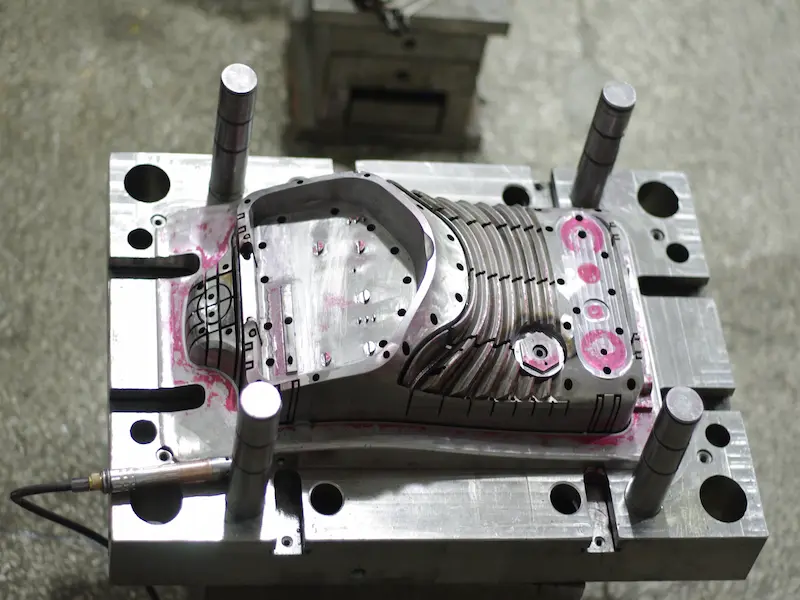
Key Design and Production Considerations for Metal Insert Molding
Metal insert molding combines plastic injection molding with pre-positioned metal components to create integrated parts with improved strength, conductivity, or assembly efficiency. However, insert molding also introduces additional challenges in shrinkage control, insert positioning, automation, mold design, and production stability.
To achieve reliable insert molding results, manufacturers should evaluate the following design and process factors before mass production.
1. Check Shrinkage and Dimensional Accuracy in Advance
Metal insert molding can easily lead to uneven molding shrinkage because plastic and metal respond differently to heat and cooling. For important dimensions and critical features, trial evaluation and tolerance verification should be carried out in advance.
This helps confirm whether the part can meet dimensional accuracy requirements after molding.
2. Prevent Insert Deformation and Displacement
During injection, metal inserts may shift, tilt, or deform under melt pressure. For this reason, both the mold structure and the part design should be developed with insert positioning and retention in mind.
If the insert shape cannot be adjusted to improve stability, pre-production testing becomes especially important.
3. Confirm Surface Damage Risk During Insert Feeding
When inserts are automatically arranged, separated, or conveyed, contact between inserts, feeders, and vibrating bowls may cause small surface damage. Even slight scratches or dents can affect product quality, especially for visible or high-precision parts.
Acceptable surface quality limits should therefore be confirmed before production begins.
4. Measure Insert Variation Before Mold and Automation Design
Metal inserts may vary due to stamping, machining, or other upstream processes. Possible variation includes warpage, burrs, thickness changes, diameter differences, and dimensional inconsistency.
These actual insert conditions should be measured first, and the mold structure and automation system should then be designed based on real production data rather than ideal dimensions. A rare moment when reality should be invited into the meeting before the expensive tooling is built.
5. Optimize Gate Position and Molding Cycle
The gate position, filling pattern, and molding cycle can strongly affect insert stability and final part quality. These factors should be considered early in mold design, and any predictable risks should be solved in advance or addressed with corrective measures.
6. Confirm Whether Inserts Need Preheating or Drying
Some metal inserts may need to be preheated or dried before molding. This can improve molding stability, reduce condensation or thermal shock effects, and support more consistent product quality.
The need for insert preheating should be verified according to the part material, insert geometry, and process requirements.
7. Evaluate Mold Monitoring and Detection Devices
Molds used for insert molding may require sensors or inspection devices to ensure stable operation under the influence of temperature, force, vibration, and environmental variation.
Manufacturers should confirm in advance whether these devices are necessary to maintain reliable molding performance.
8. Prevent Insert or Part Debris from Remaining in the Cavity
To avoid production problems caused by loose inserts or small molded fragments remaining inside the mold cavity, an air blowing device or similar cleaning function may be added when necessary.
This helps reduce damage risk and supports stable automated operation.
9. Review Equipment Investment and Long-Term Production Volume
Automatic insert molding systems often require significant investment in dedicated equipment, mold design, and automation. Before purchasing equipment, manufacturers should carefully confirm whether the expected production volume is high enough to justify the investment.
For dedicated machines, it is also important to confirm that the product design is stable enough to support continuous production over multiple years.
10. Consider Flexibility for Multi-Variety Production
When using general-purpose equipment, manufacturers should evaluate how many insert combinations and product variations need to be supported. If production volume for a single product is limited, recovering the investment from only one part may be difficult.
In these cases, it may be better to design the system so that part of the tooling or automation can be adjusted for future product updates within a practical range.
11. Evaluate Cost, Productivity, and Insert Molding Rate
The insert molding process should be assessed from both a technical and economic perspective. Factors such as insert accuracy, insert geometry, mold suitability, molded part shape, and automation efficiency all affect production rate and total molding cost.
12. Coordinate Machine, Mold, and Automation as One System
The most important factor in automatic insert molding is the effective coordination of the injection molding machine, mold, and automation equipment. Their ability to work together efficiently in a short cycle time determines the overall success of the system.
For this reason, it is wise to work with experienced suppliers or technical partners when developing an automatic insert molding solution.
Conclusion
Metal insert molding can deliver strong functional and assembly advantages, but it also requires careful control of insert quality, mold design, automation, and production planning. By addressing these factors early, manufacturers can improve molding stability, reduce defects, and build a more reliable insert molding system.