
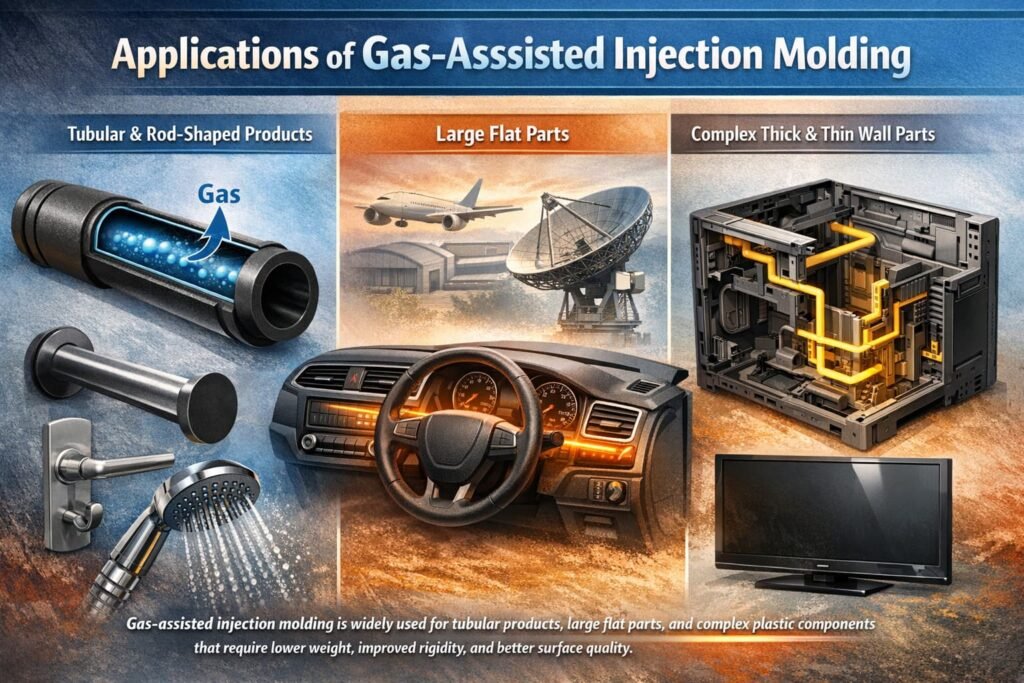
Typical Applications of Gas-Assisted Injection Molding
Gas-assisted injection molding has expanded the range of plastic parts that can be produced efficiently by injection molding. By introducing high-pressure gas into the molten plastic during molding, this process helps create hollow sections, reduce sink marks, improve stiffness, and lower part weight. As a result, it has become an important solution for products that are difficult or inefficient to manufacture with conventional injection molding alone.
Today, gas-assisted injection molding is used across many industries, including automotive, home appliances, furniture, electronics, daily consumer products, office equipment, and building materials. Its ability to improve part design flexibility and reduce manufacturing limitations has made it a valuable process for modern plastic product development.
Why Gas-Assisted Injection Molding Is Widely Used
Compared with conventional injection molding, gas-assisted technology offers several practical advantages. It can reduce raw material consumption, shorten cooling time, improve surface quality, lower clamping force requirements, and make it easier to mold larger or more complex plastic parts. These benefits open new possibilities for both product design and production efficiency.
1. Tubular and Rod-Shaped Products
Gas-assisted injection molding is especially suitable for tubular or rod-like plastic parts such as handles, hooks, chair armrests, and shower heads. In these products, the hollow internal structure created by the gas helps save material while maintaining the required function and strength of the part.
Because less material is concentrated in the thick section, cooling time can also be reduced, which shortens the overall molding cycle and improves production efficiency.
2. Large Flat Parts
Large flat plastic components are another ideal application for gas-assisted molding. Examples include automotive dashboards, interior trim grilles, aircraft interior components, and similar large-area structural parts.
By designing gas channels inside the workpiece, manufacturers can significantly improve part rigidity and surface quality while reducing warpage and surface sink marks. Gas assistance also lowers the clamping force required during molding, which means larger parts can sometimes be produced using smaller injection molding machines than would be required in conventional molding.
3. Complex Parts with Thick and Thin Wall Sections
Gas-assisted injection molding is also highly effective for products with both thick and thin wall areas, especially when the structure is complex. Typical examples include television housings, computer housings, printer casings, internal support structures, and decorative exterior components.
These types of parts are often difficult to mold successfully in one step using conventional injection molding because thick sections are more likely to cause shrinkage, sink marks, and long cooling times. Gas-assisted technology improves mold design flexibility and makes it easier to integrate structural supports and exterior features into a single molded part.
In practical applications, this can help reduce the number of separate components required in an assembly, which shortens assembly time and improves manufacturing efficiency.
Main Benefits in Product Design
Gas-assisted injection molding provides important design and production benefits for suitable parts:
Material savings: Hollow sections reduce plastic consumption.
Shorter cycle times: Reduced wall mass allows faster cooling.
Improved stiffness: Proper gas channel design can strengthen large parts.
Better surface appearance: The process helps reduce sink marks and surface depressions.
Lower warpage risk: Internal gas pressure can improve dimensional stability.
Greater design freedom: Complex parts and integrated structures become easier to produce.
Conclusion
Gas-assisted injection molding is a highly practical process for manufacturing tubular products, large flat parts, and complex components with thick and thin wall sections. By improving part quality, reducing material use, and increasing design flexibility, it gives manufacturers a powerful way to produce plastic parts that would be difficult or inefficient to achieve with conventional injection molding alone.