Skip to content

Key Performance Requirements for Die Casting Mold Materials
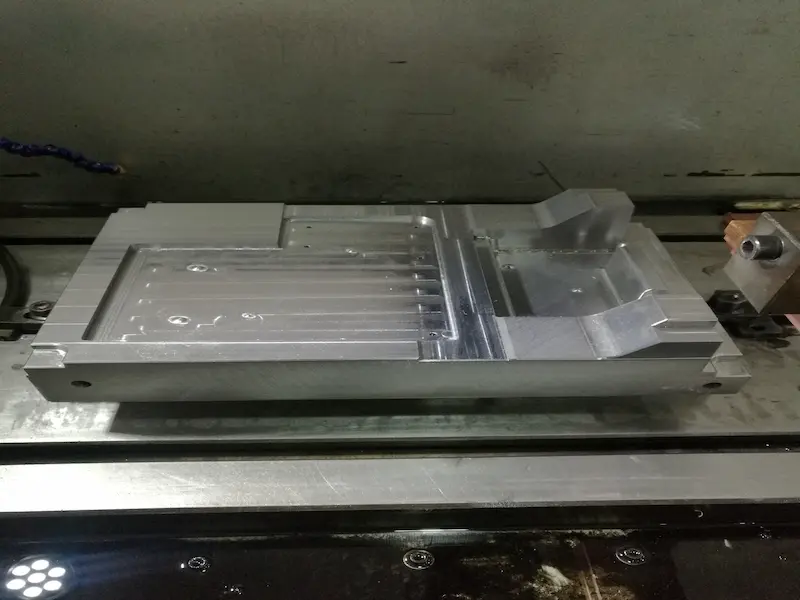
Pressure die casting can produce parts with complex geometry, high dimensional accuracy, low surface roughness, and excellent mechanical performance. Because of these advantages, die casting molds operate under severe service conditions and must meet strict requirements for strength, wear resistance, thermal stability, machinability, and internal structural uniformity.
1. High-Temperature Strength and Toughness
During die casting, the mold is exposed to high temperature, high pressure, and repeated thermal stress when molten metal is injected into the cavity. Under these conditions, the mold can deform, crack, or fail prematurely if the mold material does not provide sufficient high-temperature strength and toughness.
For this reason, die casting mold materials must maintain adequate hardness and toughness at operating temperature. Materials with a balanced combination of strength, hardness, and toughness are particularly important for resisting cracking, deformation, and fatigue during long production cycles.
2. High-Temperature Wear Resistance, Oxidation Resistance, and Tempering Stability
High-temperature molten metal enters the mold cavity at high speed and creates severe friction during filling and ejection. To ensure long mold life, the mold material must provide strong wear resistance under elevated temperatures.
In addition, the mold should maintain its hardness during repeated heating cycles. Good oxidation resistance and tempering stability help prevent scale formation, loss of surface quality, and sticking problems during continuous production.
3. Thermal Fatigue Resistance
The surface of a die casting mold is repeatedly heated by molten metal and then cooled during each production cycle. This repeated expansion and contraction generates alternating thermal stress on the mold surface.
When thermal stress exceeds the elastic limit of the material, repeated plastic deformation can occur and lead to thermal fatigue. Over time, small cracks begin to form, especially when the mold surface is also exposed to oxidation and molten metal corrosion. In many practical applications, thermal fatigue is one of the main factors affecting die casting mold service life.
4. Resistance to Molten Metal Damage
As die casting machines become larger and injection pressure increases, molten metal can cause severe erosion, adhesion, and surface damage to the mold cavity. Low-pressure casting may operate around 20 MPa to 30 MPa, while high-pressure die casting can reach approximately 150 MPa to 500 MPa.
To resist molten metal damage, mold materials should provide high-temperature strength, low affinity with molten metal, low surface roughness, and a stable protective surface layer such as an oxide film or nitrided layer. The surface should also remain free from decarburization.
5. Hardenability and Low Heat Treatment Deformation
Die casting molds are generally produced either by machining the cavity before heat treatment or by heat treating the material before machining. In both cases, the mold material should have good hardenability so that uniform hardness can be achieved throughout the mold.
This is especially important for large molds and precision molds where dimensional stability after heat treatment is critical. Materials with low heat treatment deformation help maintain cavity accuracy and reduce the amount of finishing work required after hardening.
6. Machinability, Grinding, and Polishing Performance
Because the mold cavity is produced through cutting and finishing operations, die casting mold materials must provide good machinability. In practice, materials with higher wear resistance are often more difficult to machine, and many die steels remain challenging to cut even in the annealed condition because of their hard matrix and carbide content.
In addition to machinability, good grinding and polishing performance are also essential. A smoother cavity surface helps improve the surface finish of die cast parts, so the mold material should be capable of achieving a fine polished finish.
7. Uniform Internal Structure and Minimal Defects
The internal structure of die casting mold material should be uniform and free from major defects. It should also have minimal directional variation. Structural inconsistency, segregation, or internal defects can reduce mold strength, thermal fatigue resistance, crack resistance, and dimensional stability during heat treatment.
A uniform internal structure is therefore essential for maintaining stable mold performance and extending mold life.
Conclusion
Die casting molds operate under demanding conditions involving high temperature, high pressure, rapid thermal cycling, friction, and molten metal attack. To perform reliably, the mold material must combine high-temperature strength, wear resistance, thermal fatigue resistance, resistance to molten metal damage, good hardenability, low deformation, good machinability, and uniform internal quality.
Selecting mold materials that meet these requirements is essential for extending die casting mold life, reducing maintenance costs, and maintaining stable casting quality throughout production.