Skip to content

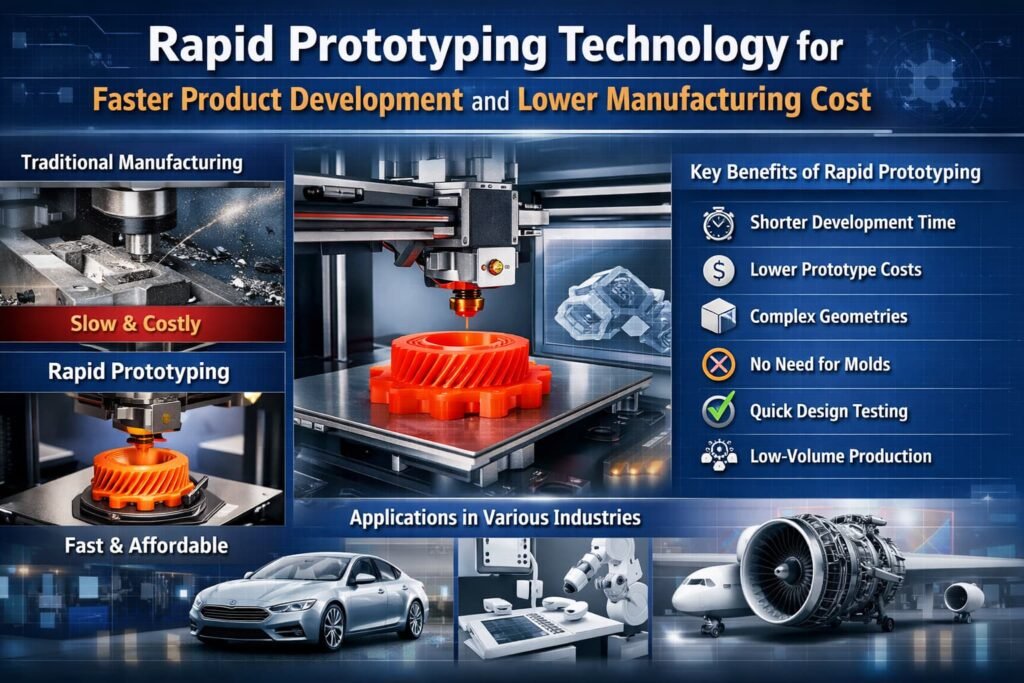
Rapid Prototyping Technology for Faster Product Development and Lower Manufacturing Cost
Rapid prototyping technology has developed quickly in recent years and has become one of the most important technologies in modern manufacturing. With its advantages of high flexibility, fast production speed, and strong integration with digital design systems, rapid prototyping is widely used for product development, engineering verification, prototype production, and mold manufacturing.
Traditional manufacturing methods usually rely on cutting, milling, drilling, and other subtractive machining processes. In these methods, material is removed from a blank that is larger than the final workpiece until the required shape is achieved.
Rapid prototyping technology uses a completely different approach. Instead of removing material, it builds parts layer by layer through an additive manufacturing process. Small layers of material are gradually stacked to create a complete three-dimensional part. This process transforms complex 3D manufacturing into a series of simpler 2D layer-building operations.
How Rapid Prototyping Differs from Traditional Manufacturing
In traditional manufacturing, molds, fixtures, cutting tools, and machining centers are often required before production can begin. For complex parts, this can result in long lead times, high development costs, and repeated design modifications.
Rapid prototyping eliminates many of these limitations because it can directly produce prototypes, functional samples, and even mold components from digital CAD data. In many cases, no dedicated tooling is required during the early product development stage.
Compared with conventional machining methods, rapid prototyping can reduce manufacturing time to only 10% to 30% of traditional production cycles. At the same time, production cost can often be reduced to only 20% to 35% of the cost of conventional processing methods.
Main Advantages of Rapid Prototyping
Rapid prototyping offers several important advantages for manufacturers and product developers:
- Shorter product development cycles
- Lower prototype manufacturing costs
- Faster design verification and testing
- Ability to create complex geometries
- Reduced need for traditional tooling and molds
- Better support for customized and low-volume production
- Faster communication between design, engineering, and manufacturing teams
Applications of Rapid Prototyping Technology
Rapid prototyping is widely used in industries such as automotive, consumer electronics, medical devices, home appliances, industrial equipment, and aerospace. It is commonly used for appearance models, structural testing parts, functional prototypes, mold inserts, jigs, fixtures, and low-volume production parts.
For injection molding and tooling projects, rapid prototyping can also help verify part design, assembly fit, and product functionality before investing in expensive production molds.
Why Rapid Prototyping Is Important
Rapid prototyping has become a key technology in modern advanced manufacturing and an essential tool for concurrent engineering. By allowing engineers to test, evaluate, and improve product designs earlier in the development process, it helps reduce project risk, improve product quality, and shorten time to market.
For companies that need faster product launches, lower development costs, and more design flexibility, rapid prototyping is now an indispensable part of the manufacturing process. Humans spent decades making things by removing material from bigger things, which is a strangely destructive hobby when you think about it. Then someone finally realized stacking material layer by layer might be smarter. Miracles do happen.