Skip to content

Benefits of Cold and Hot Mold Injection Molding for Surface Quality
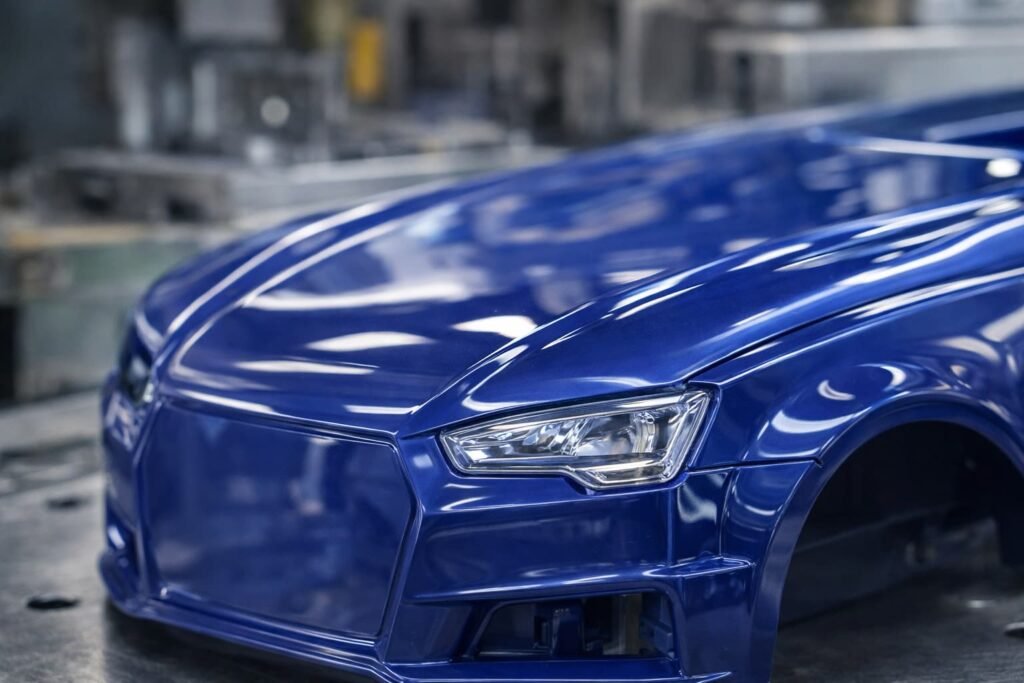
Cold and hot mold injection molding technology can significantly improve the appearance and surface quality of injection molded parts. This process is especially effective for both semi-crystalline and amorphous resins, with particularly strong results in applications involving amorphous materials.
During the injection stage, when the mold surface temperature exceeds the glass transition temperature of the amorphous resin, the material in contact with the mold surface does not solidify as quickly as it does in conventional injection molding. This allows the polymer to maintain better flow behavior during filling. As the cavity fills and pressure increases, the resin is forced to flow more evenly across the cavity surface, which improves cavity replication and enhances the surface gloss of the molded part.
For filled materials, this process also helps form a thin polymer-rich surface layer that covers fillers such as glass fiber, carbon fiber, or mineral additives. As a result, the molded part can achieve lower surface roughness and a smoother visual finish. Studies have shown that cold and hot mold injection molding can increase surface gloss by approximately 50% to 90%.
Overall, this process offers clear advantages in reducing surface roughness. In glass fiber reinforced materials, surface roughness can be improved by up to 70%. Even in unfilled materials, improvements of more than 20% have been reported.
1. Reduced Weld Lines, Jetting, and Flow Marks
Cold and hot mold injection molding technology can greatly reduce the visibility and depth of weld lines. In comparative testing, SABIC Innovative Plastics processed three different materials using both conventional injection molding and cold and hot mold injection molding. Parts produced by conventional molding showed weld line depths ranging from 6 to 13 μm, while parts produced with the cold and hot mold process showed no measurable weld line depth. This level of surface improvement can eliminate the need for painting in some product applications.
In addition to weld lines, the process can also help reduce common molding defects such as jetting and flow marks, resulting in a cleaner and more uniform finished appearance.
2. Reduced Internal Stress
Internal stress is one of the main causes of part warpage and may also reduce the service life of molded components. Parts produced by conventional injection molding methods often contain higher internal stress. Under certain test conditions, such as exposure to stress cracking accelerators like carbon tetrachloride (CCl4), these parts may crack due to residual stress.
By comparison, parts molded using cold and hot mold technology generally show lower internal stress. Even when tested with CCl4 solvent, these molded parts are less likely to crack. This indicates that the process can improve both dimensional stability and structural reliability. In some applications, parts produced through this method may also require less post-molding annealing before use.
Conclusion
Cold and hot mold injection molding is an effective process for improving the surface appearance and overall quality of molded plastic parts. By enhancing gloss, reducing roughness, minimizing weld lines and flow defects, and lowering internal stress, this method offers clear advantages over conventional injection molding. It is particularly valuable for applications that require a high-quality cosmetic finish or improved structural stability without additional secondary finishing processes.