Advanced Rapid Prototyping Technologies in Precision Manufacturing
Rapid prototyping technologies continue to evolve across the aerospace, medical, automotive, and industrial sectors. New developments in metal deposition, precision additive manufacturing, and ceramic molding are allowing manufacturers to produce highly complex parts with improved accuracy, strength, and shorter development cycles.
1. Direct Metal Deposition for High-Strength Metal Parts
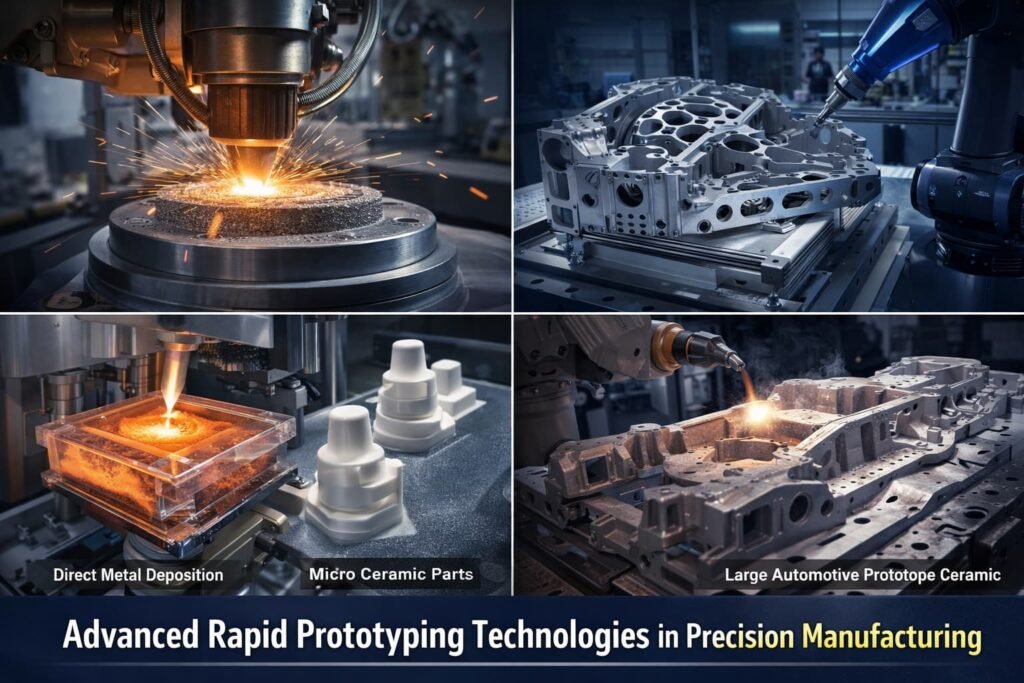
Precision Optical Manufacturing (POM) in Michigan, USA, has been developing Direct Metal Deposition (DMD) technology for the production of metal components.
DMD uses a laser to melt and deposit metal powder layer by layer, allowing manufacturers to create metal parts with uniform internal structure, excellent strength, and complex geometries. This technology is especially suitable for aerospace components, tooling repairs, custom industrial parts, and high-performance engineering applications.
2. Precision Rapid Prototyping for Aerospace and Medical Applications
The National Aeronautics and Space Administration (NASA) has also developed precision rapid prototyping equipment capable of producing highly detailed components for aerospace, medical, and other high-precision industries.
The equipment can manufacture parts within a working range of 450 mm × 300 mm × 300 mm. Fine features can be smaller than 12 μm, while surface accuracy can reach below 1 μm. This level of precision makes the technology suitable for medical devices, miniature aerospace components, and precision engineering products.
Advanced RP systems of this type are typically valued at approximately USD 150,000 due to their high level of manufacturing accuracy and technical capability.
3. Micro Ceramic Part Manufacturing
Research institutes in Germany are using stereolithography (SL) combined with vacuum injection molding to produce micro ceramic components with high dimensional accuracy.
This process allows ceramic parts to achieve tolerances as tight as 0.1 mm while maintaining excellent surface quality and structural consistency. Such technologies are increasingly used for electronic components, medical devices, precision sensors, and specialized industrial applications.
4. Large-Part Rapid Prototyping for Automotive Development
Oxford University and Ford Motor Company have been developing rapid prototyping equipment for producing large parts by spraying molten alloy steel onto low-cost ceramic molds.
This process is intended to improve the speed and cost efficiency of prototype development for large automotive and industrial components.
According to Ford, this manufacturing method can reduce the number of product development stages from 12 steps to 5 steps. It can also shorten the overall development cycle from 15 to 25 weeks down to only 3 to 5 weeks.
Why Advanced RP Technology Matters
Modern rapid prototyping technologies are no longer limited to plastic concept models. Today, advanced RP systems can manufacture metal, ceramic, and high-performance engineering components with impressive precision and strength.
For manufacturers, these technologies help reduce development time, lower tooling costs, improve product testing efficiency, and accelerate the transition from concept to mass production.