Skip to content

Sand Casting vs Metal Mold Casting: Advantages, Limitations, and Applications
Sand casting and metal mold casting are two widely used casting methods in manufacturing. Each process has its own advantages, limitations, and suitable application range. Choosing the right casting method depends on factors such as production volume, part size, dimensional requirements, surface finish, and material type.
Sand Casting Applications and Characteristics
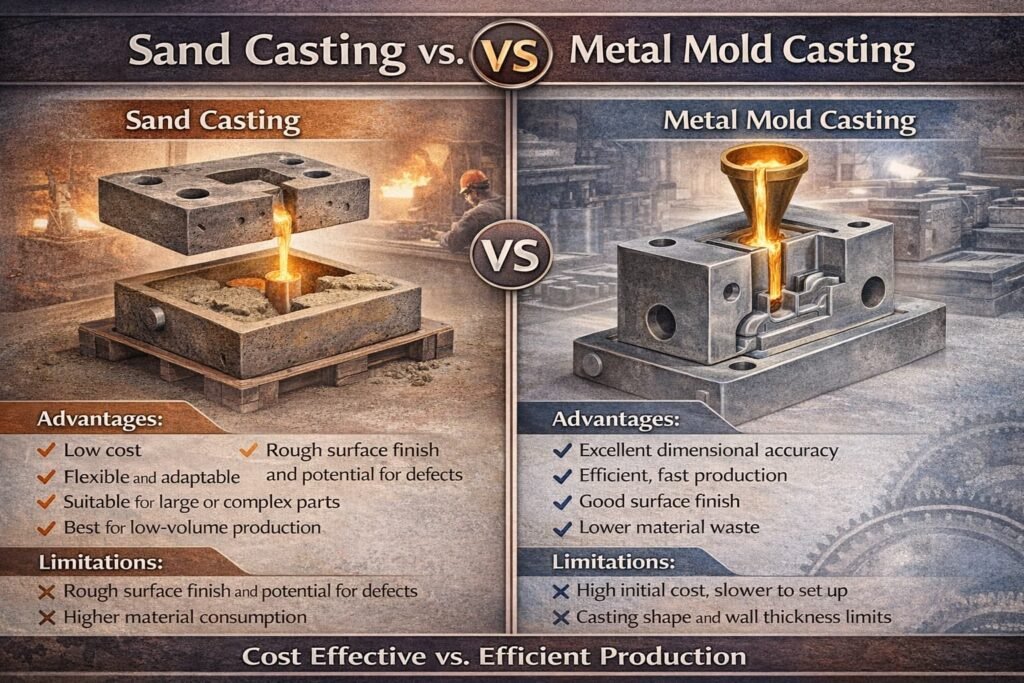
Sand casting has a very wide range of applications and is suitable for producing almost all types of cast parts. For large castings, single-piece production, or small batch manufacturing, manual molding is often the preferred option because it offers flexibility and lower initial investment.
Machine molding can improve production speed, dimensional accuracy, and mold quality. It is suitable for continuous mass production in larger foundries, where stable quality and a low scrap rate are required.
However, sand casting also has some disadvantages. It usually requires more floor space, the casting surface is relatively rough, and the grain structure can be coarse. In some cases, segregation of the microstructure and composition may also occur. Common clay sand mold types include green sand molds, dry sand molds, and skin-dried sand molds.
Advantages of Metal Mold Casting
Metal mold casting offers important advantages in efficiency and dimensional consistency. It can support multi-cavity production and eliminates the need for repeated sand treatment, which greatly improves productivity and makes mechanized production easier.
Compared with sand casting, metal mold casting generally provides higher dimensional accuracy and a better production environment. It also reduces the consumption of molding materials and helps save production space.
Limitations of Metal Mold Casting
Although metal mold casting is efficient, it is not suitable for every application. The mold has a high manufacturing cost and a relatively long production cycle, so it is generally not economical for single-piece or small-volume production.
The casting shape, especially the internal cavity structure, should not be too complex. In addition, the wall thickness should not be too thin, otherwise casting defects such as misruns or insufficient filling may occur. When casting high-melting-point alloys such as cast steel, the service life of the metal mold is also limited.
Choosing the Right Casting Method
Sand casting is often the better choice for large parts, low-volume production, and components with less demanding surface and dimensional requirements. Metal mold casting is more suitable for mature products with stable designs, higher production volumes, and stricter dimensional accuracy requirements.
By understanding the strengths and limitations of each process, manufacturers can choose the most practical and cost-effective casting method for their project.