Skip to content

Advantages and Disadvantages of Pressure Casting
Pressure casting, commonly known as die casting, is a high-efficiency metal casting process in which molten metal is injected into a metal mold under high pressure and high speed. It is widely used for producing parts with good dimensional consistency, smooth surface finish, and high production efficiency. However, like any manufacturing process, pressure casting has both strengths and limitations that should be considered during product development.
Advantages of Pressure Casting
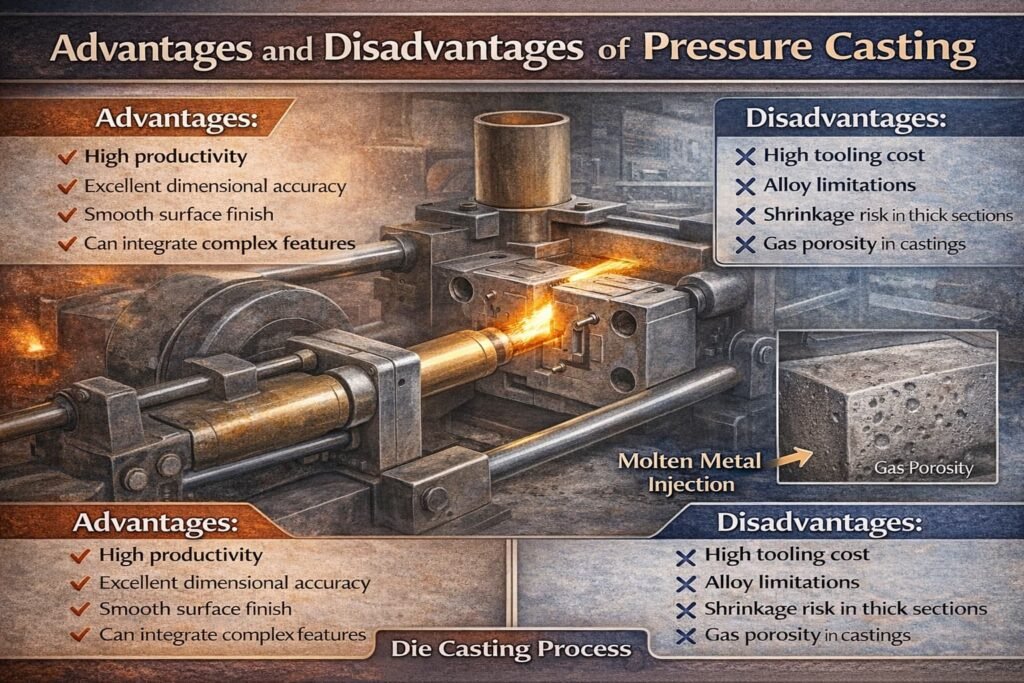
One of the main advantages of pressure casting is its high productivity. Depending on the part size and process setup, die casting can produce around 50 to 150 castings per hour, and in some cases even more. This makes it well suited for automated and semi-automated mass production.
Pressure casting also offers high dimensional accuracy and a relatively smooth surface finish. Castings produced by this method can often achieve good consistency with reduced post-processing, which helps improve manufacturing efficiency and lower machining costs.
Because the molten metal cools quickly and solidifies under pressure, the resulting grain structure is relatively fine. This can improve the strength and hardness of the casting compared with some other casting methods.
Another important advantage is the ability to integrate complex features into a single part. Pressure casting is suitable for producing complicated shapes and can also support insert casting in certain applications. Different materials or inserts can sometimes be combined into one component, helping simplify assembly and improve product performance.
Disadvantages of Pressure Casting
Although pressure casting is highly efficient, the initial investment is relatively high. The equipment is expensive, the die manufacturing cycle can be long, and mold costs are significant. For this reason, pressure casting is generally more economical for large-volume production rather than small-batch projects.
The range of suitable alloys is also limited. High-melting-point materials such as cast steel and cast iron are generally not ideal for conventional die casting because the mold and chamber life would be too short under such severe thermal conditions.
In addition, because filling and cooling take place very quickly, thick sections are more difficult to feed properly. This can increase the risk of shrinkage defects in heavier wall areas.
Another common limitation is gas entrapment. Since molten metal enters the cavity at very high speed, the air inside the die cavity can be difficult to evacuate completely. As a result, small dispersed pores or bubbles may remain inside the casting, which can affect mechanical properties, leak tightness, or secondary finishing performance.
Conclusion
Pressure casting is an efficient manufacturing process that offers high productivity, fine surface quality, and strong dimensional consistency, especially for complex metal parts in large production volumes. At the same time, its higher tooling investment, alloy limitations, shrinkage risk in thick sections, and tendency toward gas porosity must be carefully evaluated during design and process planning.