Skip to content

What Is Extrusion Forming? Types and Stages of the Extrusion Process
Extrusion is a metal forming process in which a billet is subjected to compressive stress inside a closed cavity and forced through a die opening or die slit to reduce its cross-sectional area and form the required product shape. It is widely used to manufacture rods, tubes, profiles, and other parts with consistent cross-sectional geometry.
Types of Extrusion Forming
1. Classification by Forming Temperature
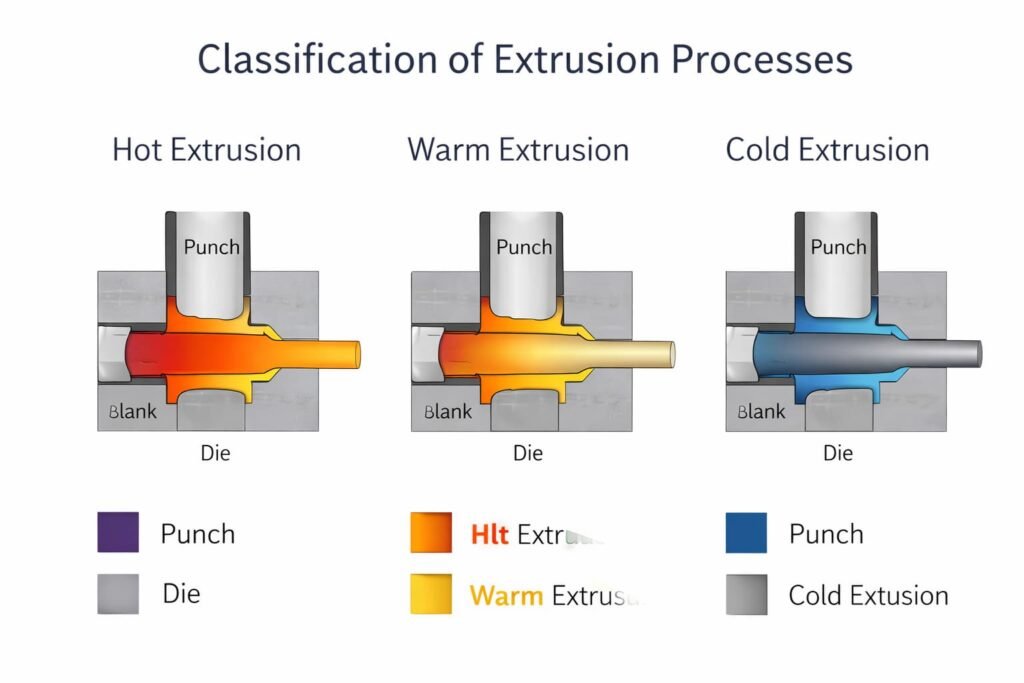
According to the forming temperature, extrusion can be divided into three main types:
- Hot extrusion: The billet is extruded at a temperature above its recrystallization range to improve plasticity and reduce forming resistance.
- Warm extrusion: The billet is extruded at an intermediate temperature to balance formability, dimensional accuracy, and surface quality.
- Cold extrusion: The billet is extruded at or near room temperature to achieve higher dimensional precision, better surface finish, and improved mechanical properties.
2. Classification by Metal Flow Direction
According to the relationship between metal flow direction and punch movement direction, extrusion forming can also be divided into the following types:
- Forward extrusion: The metal flows in the same direction as the punch movement.
- Backward extrusion: The metal flows in the opposite direction to the punch movement.
- Composite extrusion: The metal flows in multiple directions during the same forming cycle, combining features of forward and backward extrusion.
Main Stages of the Extrusion Process
The extrusion process usually shows the following forming stages:
- Upsetting stage: The billet is compressed and gradually fills the die cavity before stable extrusion begins.
- Stable extrusion stage: The metal flows more steadily through the die, and the extrusion process remains relatively stable.
- Unstable extrusion stage: As the billet is consumed, the metal flow becomes less stable, which may affect forming consistency near the end of the process.
Conclusion
Extrusion is an important metal forming method that can produce a wide range of products with controlled cross-sectional shapes. Understanding the classification of extrusion by temperature and flow direction, as well as the main stages of the process, helps improve process selection, tooling design, and production control.