 Skip to content

Types of Welding Methods and the Function of Electrode Coating
Welding processes can generally be divided into three main categories: fusion welding, pressure welding, and brazing. Each method uses a different joining principle and is suitable for different materials, product structures, and manufacturing requirements. Choosing the correct welding method helps improve joint strength, production efficiency, and final product quality.
1. Fusion Welding
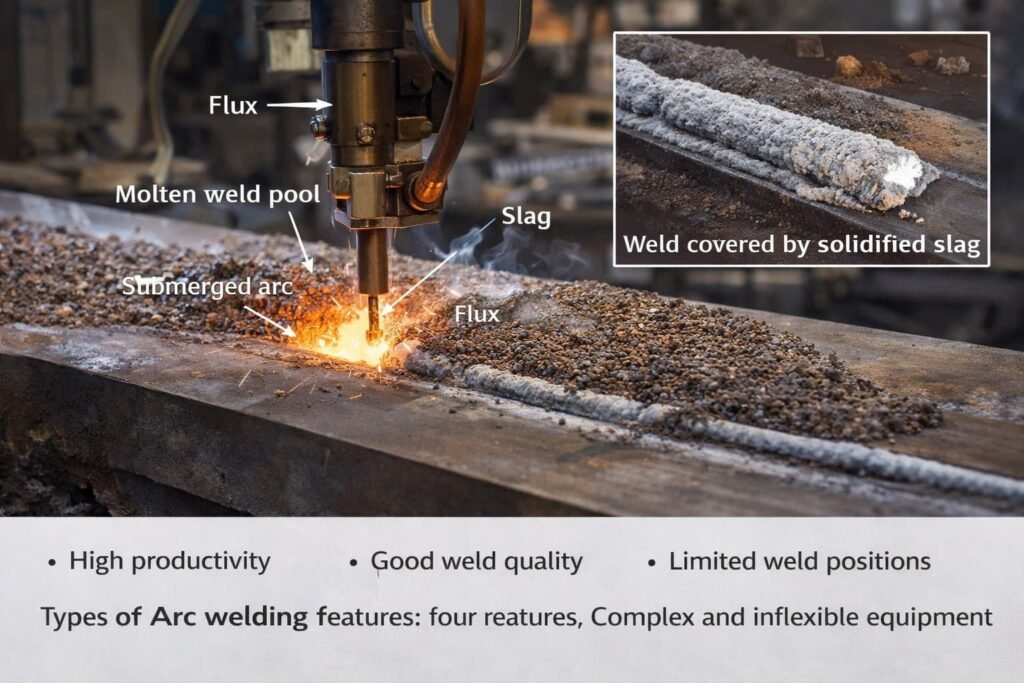
Fusion welding is a process in which the surfaces of the joined materials are locally heated until they melt. After cooling and solidification, the two parts are permanently joined together. Common examples include arc welding, gas welding, TIG welding, MIG welding, and laser welding.
2. Pressure Welding
Pressure welding is a method that uses pressure, friction, diffusion, or resistance heat to join two surfaces together in a solid state. During the process, oxide films and contaminants on the joint surfaces are removed or displaced, allowing the metal atoms to bond closely. Common examples include resistance welding, friction welding, ultrasonic welding, and diffusion welding.
3. Brazing
Brazing is a joining process that uses a filler metal with a lower melting point than the base materials. The filler metal melts and flows into the joint area, while the base materials remain solid. After cooling, a strong bond is formed between the connected parts. Brazing is widely used for copper tubing, stainless steel components, and precision assemblies.
4. Structure of a Welding Electrode
A welding electrode typically consists of two parts: the core wire and the coating. The core wire carries the welding current and provides filler material, while the coating improves arc stability and protects the weld area.
5. Main Functions of Electrode Coating
The coating on the electrode plays several important roles during welding:
- Provides gas and slag protection for the molten weld pool
- Improves the metallurgical properties of the weld
- Stabilizes the arc during the welding process
- Helps reduce spatter and improve weld appearance
- Improves the overall welding process performance
Understanding the differences between fusion welding, pressure welding, and brazing can help manufacturers choose the most suitable joining method for different products and production environments. Human beings have somehow invented at least three different ways to force metal pieces to become friends. Industrial civilization is strange, but useful.


