Skip to content

Advantages, Limitations, and Classification Methods of Brazing
Brazing is a metal joining process in which a filler metal is heated above its melting point and distributed between closely fitted surfaces without melting the base materials. It is widely used in manufacturing because it can join complex assemblies, connect different materials, and maintain good dimensional stability.
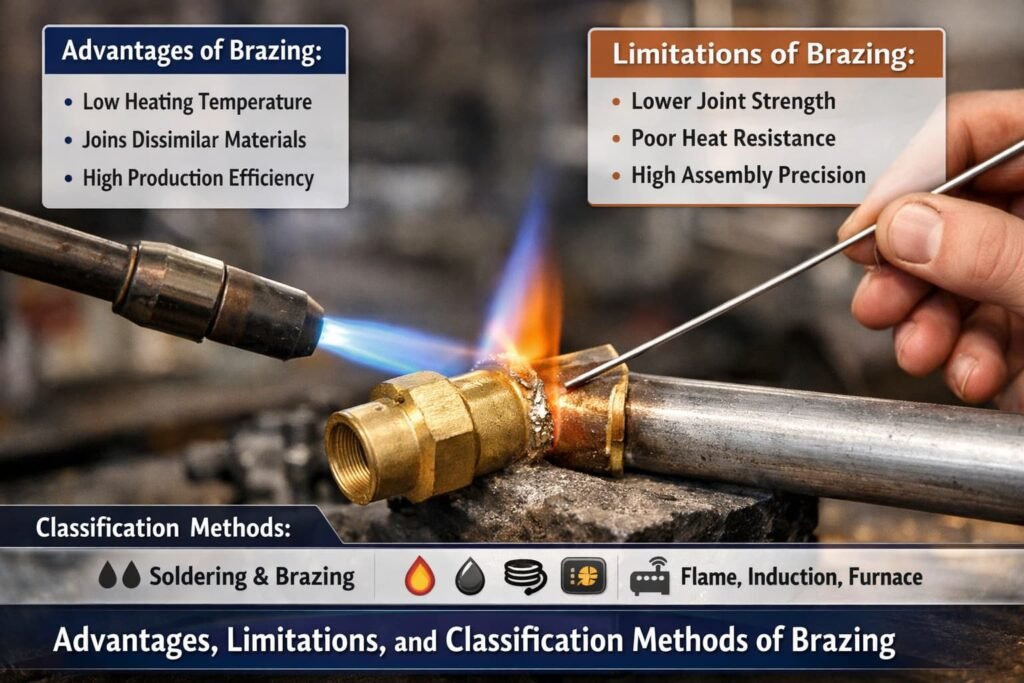
Advantages of Brazing
Brazing offers several important advantages in industrial production. One of the main benefits is its relatively low heating temperature compared with fusion welding processes. Because the base metal is not melted, the microstructure and mechanical properties of the parent material are less affected, making it easier to maintain the dimensional accuracy of the finished component.
Another key advantage is the ability to join dissimilar materials. Brazing can be used to connect different metals and alloys, and in some cases it can also be used to join metals to non-metallic materials. This makes it a flexible solution for assemblies that would be difficult to produce with conventional welding methods.
Brazing is also suitable for high-efficiency production. Certain brazing methods allow dozens or even hundreds of joints to be completed in a single cycle, which can significantly improve productivity in mass manufacturing.
Limitations of Brazing
Although brazing has many advantages, it also has some limitations. Brazed joints generally have lower strength than welded joints, especially in applications exposed to heavy mechanical loads. Their heat resistance is also relatively poor, which means brazed assemblies may not be suitable for high-temperature service conditions.
In addition, brazing usually requires high assembly precision. The joint clearance must be properly controlled to ensure that the molten filler metal can flow evenly and create a reliable bond. Poor fit-up can reduce joint quality and overall performance.
Classification of Brazing
Brazing processes can be classified in different ways depending on the filler metal and the heat source used.
Classification by Filler Metal Melting Point
According to the melting point of the brazing filler metal, brazing is generally divided into two categories: soldering and brazing. Soldering uses filler metals with lower melting points, while brazing uses filler metals with higher melting points and typically provides stronger joints.
Classification by Heat Source
According to the heating method, brazing can be divided into several process types, including flame brazing, resistance brazing, induction brazing, dip brazing, and furnace brazing. Each method has its own advantages depending on the part geometry, production volume, material combination, and quality requirements.
Conclusion
Brazing is an efficient and versatile joining method that offers low thermal distortion, good dimensional control, and the ability to join dissimilar materials. While it is not ideal for every structural or high-temperature application, it remains an important process in many manufacturing industries where precision, efficiency, and material compatibility are critical.