Skip to content

What Is Shear Control Orientation Injection Molding?
Shear control orientation injection molding is a specialized molding process that applies dynamic pressure and controlled vibration to the polymer melt after cavity filling. By creating vibration-induced shear flow inside the mold cavity, the process influences the orientation of molecular chains or reinforcing fibers, helping manufacturers control the internal structure, mechanical performance, and appearance quality of molded plastic parts.
Compared with conventional injection molding, this method is designed to improve part strength, reduce common molding defects, and achieve a more controlled microstructure within the finished product.
How Shear Control Orientation Injection Molding Works
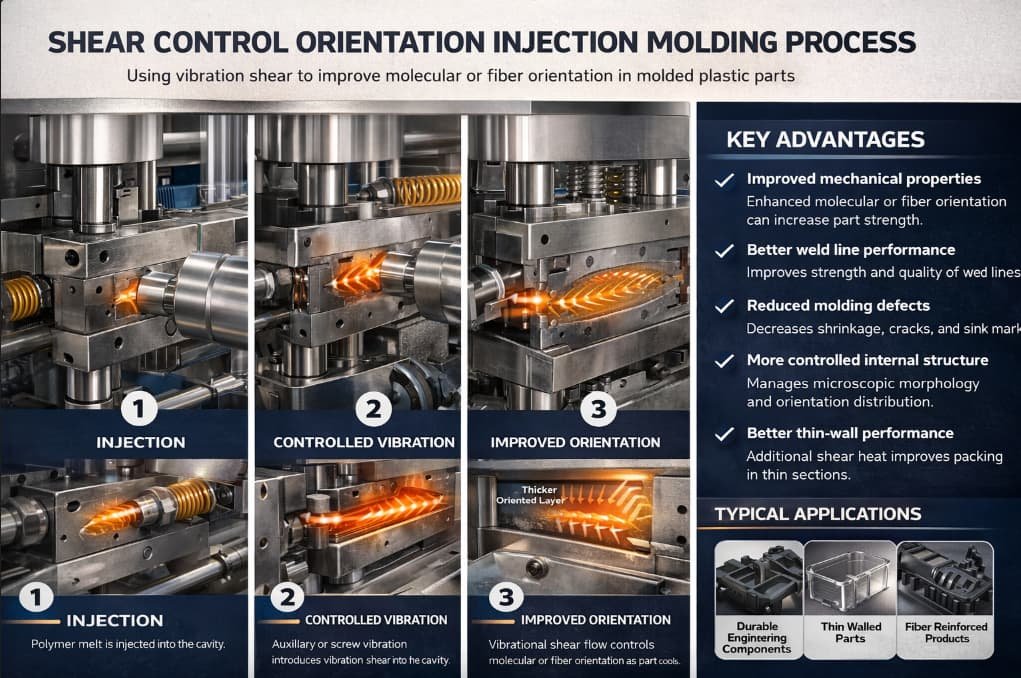
In this process, the polymer melt is first injected into the cavity in a manner similar to standard injection molding. After filling, dynamic vibration is introduced during the holding stage. This vibration creates additional shear flow in the melt while the material is cooling inside the mold.
As the melt experiences vibration shear, molecules or fibers in different melt layers become more strongly oriented. Because the mold is simultaneously removing heat, this orientation can be frozen into the part structure, forming a thicker orientation layer than is typically achieved in ordinary injection molding.
Main Methods of Introducing Vibration
1. Auxiliary Device Vibration
In this method, a vibration device is installed between the mold and the nozzle of the injection molding machine. During the injection stage, the process remains similar to conventional molding. After the cavity is filled, pressure-holding pistons begin vibrating at the same frequency with a phase difference, transmitting reciprocating vibration into the cavity.
This vibration produces shear flow in the cooling melt. In practice, the process can help reduce defects such as shrinkage, cracks, and surface sink marks while also improving weld line strength. By controlling gate position and gate quantity, manufacturers can also influence molecular or fiber orientation more effectively than in standard injection molding.
2. Screw Vibration
Screw vibration works by supplying pulsating oil pressure to the injection cylinder so that the screw moves back and forth during the holding stage. The resulting vibration acts on the melt and is transferred into the cavity through the polymer mass.
This system is relatively simple in concept and can sometimes be implemented through machine control adjustments or modifications to the hydraulic and electrical systems of the injection molding machine.
Why the Process Improves Part Performance
After the melt enters the cavity, a solidified layer begins to form near the mold surface. In standard molding, the highest velocity gradient appears near this solidified layer, so orientation is strongest there and weaker toward the center of the part.
When vibration is introduced during the holding phase, the melt continues to experience shear as it cools. This creates a thicker and more pronounced orientation layer than in conventional injection molding. As a result, the finished part can show improved mechanical properties and more consistent internal structure.
The periodic pressurization and pressure relief generated by vibration can also produce additional shear heat, especially in thin-walled areas. This can delay local cooling and allow better compensation of shrinkage in thicker sections through the gate, helping prevent defects such as shrinkage cavities and surface depressions.
Main Advantages of Shear Control Orientation Injection Molding
Improved mechanical properties: Enhanced molecular or fiber orientation can increase part strength compared with conventional injection molding.
Better weld line performance: The process can improve the strength and quality of weld lines in molded parts.
Reduced molding defects: Vibration shear flow can help reduce shrinkage, cracks, sink marks, and related appearance issues.
More controlled internal structure: Manufacturers can better manage the microscopic morphology and orientation distribution within the part.
Better thin-wall performance: Additional shear heat in thin sections can improve packing behavior and reduce local defect risk.
Typical Applications
Shear control orientation injection molding is suitable for parts that require improved structural performance, better surface quality, or more controlled fiber or molecular orientation. It can be especially valuable for engineering plastic components, thin-walled parts, and products where weld line strength and defect reduction are important.
Conclusion
Shear control orientation injection molding is an advanced variation of injection molding that uses vibration-induced shear flow to improve part structure and performance. By increasing the thickness of the orientation layer and improving packing behavior during cooling, the process can enhance strength, reduce common molding defects, and deliver higher-quality molded plastic parts.