
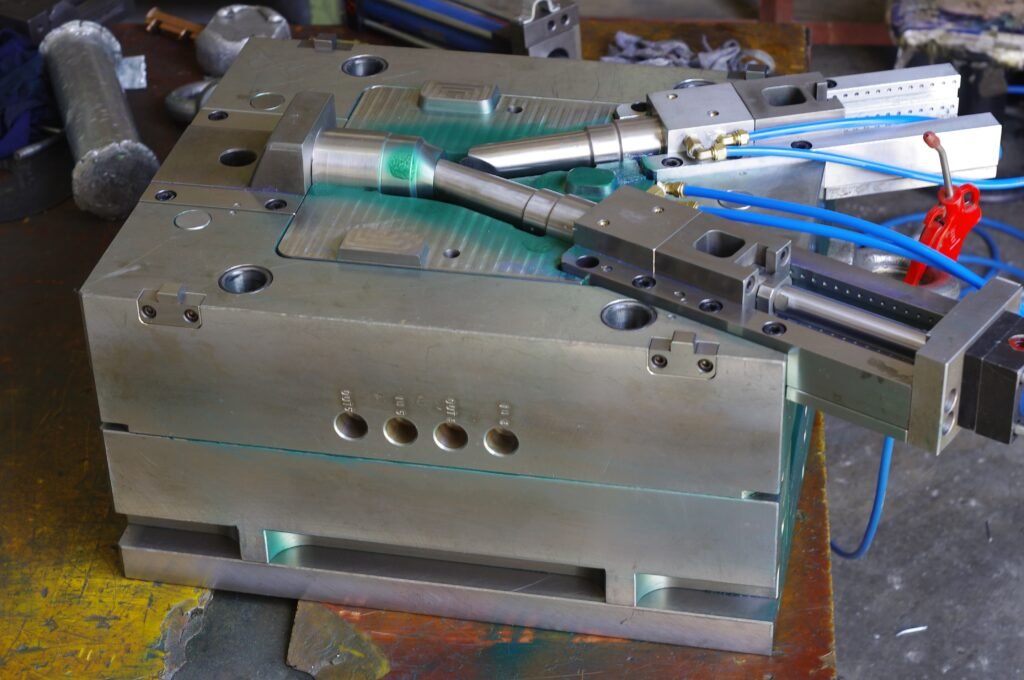
Core Back Injection Molding Process and Multi-Component Part Design
Core back injection molding is a specialized multi-component molding process in which part of the mold cavity is first closed and then reopened during the molding cycle by means of a sliding core, retractable core, or movable insert. This method allows two materials or two components to be molded sequentially within the same tool, creating an integrated final part without transferring the preformed insert to another cavity.
In a typical two-component application, the first injection stage forms the prefabricated component inside the initial cavity. After this stage, the mold creates additional space by moving a sliding core, retracting a core, or rotating part of the mold structure. The second material is then injected into the newly opened cavity area and bonds with the first molded component. Once the second stage is complete, the finished part is ejected from the mold.
In some mold designs, the second cavity is created not only by core retraction, but also by rotating the mold plate or cavity section before the second injection step. This gives manufacturers more flexibility when producing complex multi-material or multi-component plastic parts in a single mold.
How Core Back Injection Molding Works
When two or more components are required in one molded part, core back injection molding can provide an efficient production solution. All forming actions take place inside the mold, so no external transfer system is required between molding stages.
The general process sequence is as follows:
1. First injection stage
The first material is injected into the initial cavity to form the base or preformed component.
2. Core movement or cavity change
A sliding core, retractable core, insert, or rotating mold section moves to create additional cavity space.
3. Second injection stage
The second material is injected into the newly opened area and bonds to the first molded component.
4. Part ejection
After cooling, the integrated multi-component part is ejected from the mold.
Main Advantages of Core Back Injection Molding
Single-mold production sequence
One of the main advantages of core back injection molding is that a single mold can complete the full production cycle. There is no need to transfer the first molded part into another cavity or another mold station.
Improved dimensional consistency
Because the preformed part remains inside the same mold during the full process, dimensional accuracy and alignment between components can be better controlled.
Reduced handling steps
No external transfer device is needed, which helps simplify the production flow and reduce the risk of part damage or positioning errors.
Suitable for complex integrated parts
The process is well suited for technical plastic parts, functional overmolded products, and multi-component designs that require precise material combination in one mold.
Design and Processing Considerations
Although core back injection molding offers clear production advantages, the mold design becomes more complex as the number of components increases. Successful application depends on careful mold engineering, accurate core movement, and good coordination between part design, material behavior, and machine capability.
The injection molding machine must also have enough programmable core-pull functions to control the sliders, inserts, or moving mold sections accurately. Compared with some conventional multi-component molding systems that may perform certain steps in parallel, core back injection molding follows a strict sequential process. Each stage must be completed in order, which influences cycle design and machine programming.
Typical Applications
Core back injection molding is widely used for technical plastic components, functional overmolded parts, and products that require two materials to be combined precisely within one mold. It is especially useful for applications where part integration, dimensional accuracy, and production efficiency are all important.
Conclusion
Core back injection molding is a practical solution for producing integrated multi-component plastic parts in a single mold. By using sliding cores, retractable inserts, or rotating mold sections to create the second cavity during the molding cycle, manufacturers can combine multiple materials without part transfer. For suitable products, this process offers improved consistency, reduced handling, and efficient production of complex molded components.