Skip to content

Applications of Vertical Injection Molding Machines in Multi-Color and LSR Molding
Vertical injection molding machines are widely used in specialized molding applications where insert positioning, multi-station production, and material combination are important. In multi-color molding, vertical machines can be combined with horizontal machines or rotary systems to create efficient two-color or multi-color molding processes. They are also widely used in liquid silicone rubber molding because of their flexibility, space efficiency, and suitability for automated production.
1. Vertical Injection Molding in Multi-Color Molding
One of the main applications of vertical injection molding machines is multi-color injection molding. By combining a vertical machine with a horizontal machine, manufacturers can build a multi-station molding system for two-color or even multi-color plastic parts.
This setup is especially useful for products that require precise insert positioning, secondary overmolding, or multiple material combinations in one production cycle.
2. Turret-Type Two-Color Molding
The turret-type two-color machine is also known as a core-rotary injection molding system. In this design, a retractable and rotatable shaft is placed at the center of the lower mold. The core can rotate 180 degrees so that it enters cavity one and cavity two in sequence, allowing the product to be formed in two colors or two materials.
This process is suitable for molded parts that require accurate transfer from one cavity to another without losing positioning accuracy.
3. Typical Applications of Vertical Two-Color Insert Molding
Vertical injection molding systems are often used for products with inserts or parts that need to remain firmly positioned on the core after the first molding step.
- Products with inserts, where one side is molded and the other side is used for clamping or functional assembly, such as screwdrivers and scissors
- Cylindrical or deep-hole products, such as automotive handles or thermometer housings, where the product can remain securely positioned on the core after molding
4. Multi-Station Rotary Table Machines
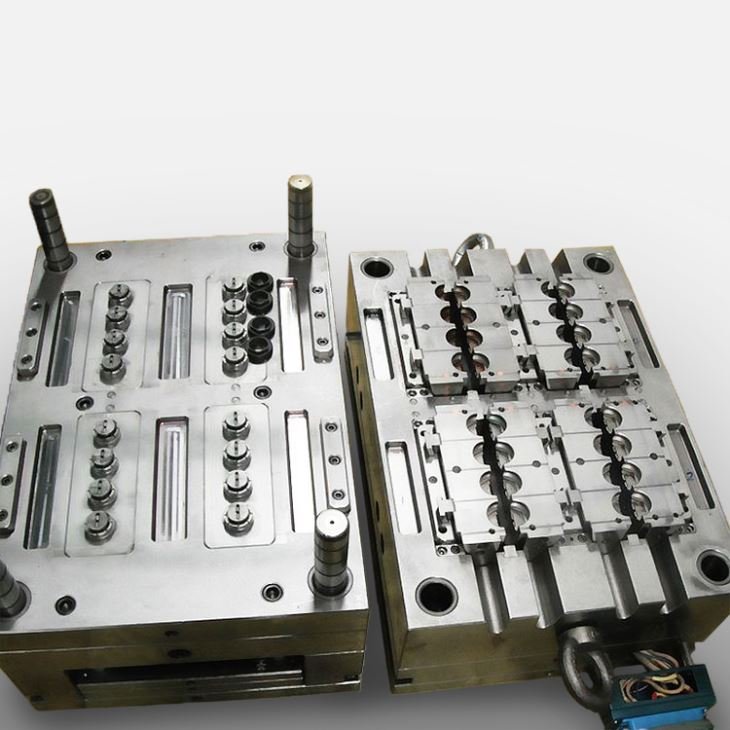
Multi-station rotary table machines usually have two injection systems, while the lower mold rotates through a defined angle such as 180 degrees or 120 degrees. This design can automate in-mold labeling, multi-step molding, or insert transfer between stations.
Unlike ordinary two-color machines, this type of equipment is not limited to two-color molding. It can also function as two standard injection molding machines or as a double-station rotary production system, which greatly improves equipment flexibility and utilization. Because apparently one machine doing three jobs is the only acceptable way to impress a factory manager anymore.
5. Vertical Injection Molding for Liquid Silicone Rubber
Vertical injection molding machines are also widely used in liquid silicone rubber molding. LSR molding requires precise mixing of two liquid components before injection, and vertical machines are well suited to this process.
The material supply piping and injection unit arrangement of a vertical machine make better use of space and are easier to integrate into LSR molding systems. For this reason, vertical machines are commonly used in the liquid silicone molding industry.
6. Why Liquid Silicone Rubber Is Increasingly Popular
Liquid silicone rubber has a wide range of applications in medical, electronic, and consumer products because of its excellent material properties. It offers a broad hardness range, can replace some thermoplastic elastomers such as TPU and TPE, and can provide a soft and comfortable tactile feel.
At the same time, liquid silicone can perform well in many demanding environments, making it an increasingly popular material choice in a variety of industries.
7. Advantages of Vertical Injection Molding Machines
As an important branch of injection molding equipment, vertical injection molding machines offer unique advantages in insert molding, multi-color molding, LSR molding, automation, and customized production.
Their structure makes them particularly suitable for applications where accurate insert placement, flexible mold movement, compact floor space, and automated handling are required.
Conclusion
Vertical injection molding machines play an important role in multi-color molding, rotary insert molding, and liquid silicone rubber processing. With their strong compatibility with automation and their flexibility in specialized molding applications, vertical injection molding machines continue to expand into more areas of modern manufacturing.
As demand grows for integrated parts, multi-material products, and automated production, vertical injection molding machines are expected to support even more innovative manufacturing solutions.