
Thermoforming Process Steps: Clamping, Heating, Forming, Cooling and Demoulding
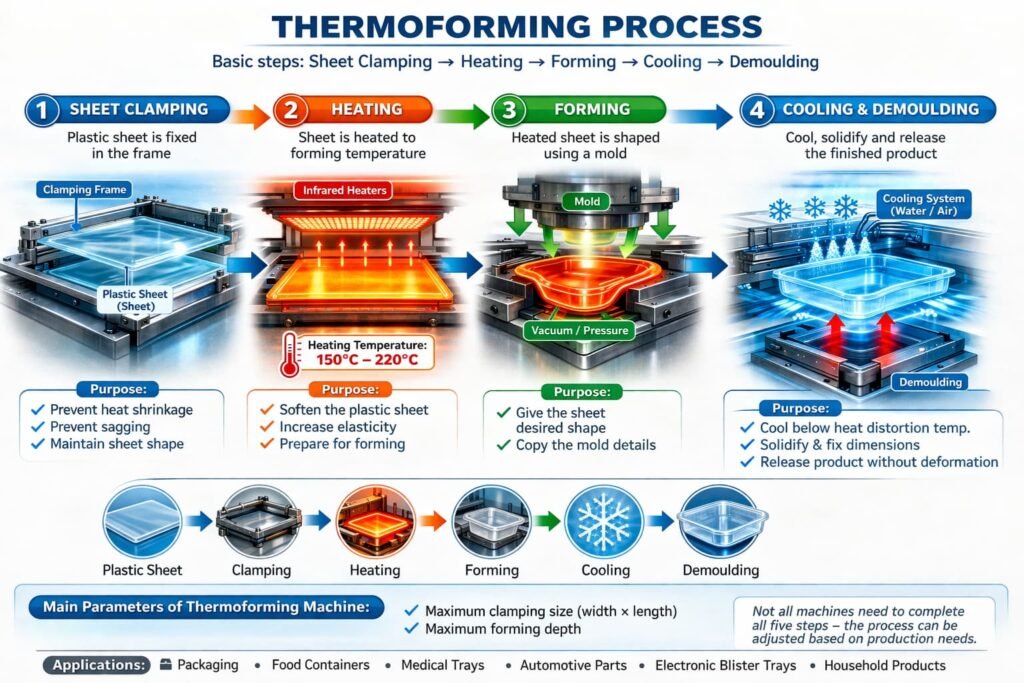
Thermoforming is a plastic processing method that converts sheet material into finished parts through a controlled sequence of clamping, heating, forming, cooling, and demoulding. Among these stages, forming is the most critical and technically complex step because it directly determines the final shape, dimensional stability, and surface quality of the product.
Different thermoforming machines may vary depending on the forming method and production requirements. In practical manufacturing, not every machine must complete all five stages in exactly the same way. Process steps can be adjusted according to product design, material type, and production efficiency goals. The main parameters of a thermoforming machine are usually its maximum clamping size and maximum forming depth.
1. Sheet Clamping
Before heating begins, the plastic sheet must be securely clamped around its edges. This helps prevent heat shrinkage and sagging caused by the sheet’s own weight during heating. Stable clamping also ensures that the sheet maintains its correct position and shape throughout the forming cycle.
2. Heating
The heating system raises the plastic sheet to the required forming temperature, allowing the material to reach a highly elastic and formable state. Proper and uniform heating is essential for achieving smooth forming results and reducing defects in the next stage.
3. Forming
Forming is the process of shaping the heated and softened sheet into the desired geometry by using a mold and related forming equipment. Depending on the process, vacuum, pressure, or mechanical force may be applied to help the material conform to the mold surface.
4. Cooling
After the plastic sheet has been formed, the product must be cooled below its heat distortion temperature so that it can solidify and retain its final shape. Effective cooling is important for dimensional stability and helps prevent deformation after forming.
5. Demoulding
Once the formed part has cooled and hardened sufficiently, it is released from the mold by the demoulding system. At this stage, the product size is fixed, and the finished part can be removed for trimming or further processing.