
Semi-Solid Metal Forming Technology and Thixotropic Alloy Properties
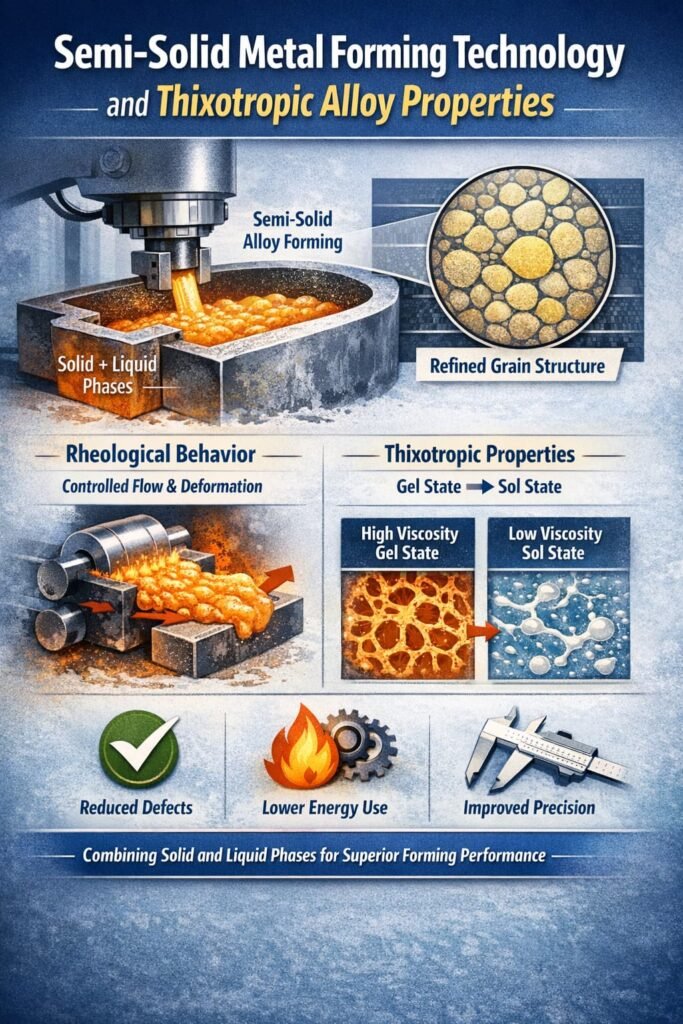
Semi-solid forming technology refers to heating a metal material into a semi-solid state in which solid and liquid phases are uniformly mixed. By controlling the heating temperature and holding time, the solid phase ratio can be adjusted to achieve the desired semi-solid structure before forming.
After semi-solid treatment, the alloy usually develops a more uniform and rounded grain structure. Compared with conventional casting or forging methods, semi-solid processing offers easier process control, lower risk of metal burning, reduced energy consumption, and higher material utilization.
Advantages of Semi-Solid Forming Technology
The microstructure of semi-solid alloys after treatment generally has good grain morphology and improved structural consistency. Since the material is partially solid and partially liquid during forming, it flows more smoothly than solid metal while still maintaining enough stability to avoid many common casting defects.
Compared with traditional liquid metal casting, semi-solid forming can reduce shrinkage defects, porosity, and thermal cracking. It also allows manufacturers to achieve better dimensional accuracy and improved surface quality.
Because the material temperature is lower than in fully molten casting processes, the metal is less likely to oxidize or burn. This helps improve alloy performance and reduce energy costs during production.
Rheological Properties of Semi-Solid Alloys
Semi-solid alloys have rheological properties, meaning they can flow and deform under external force while in a semi-solid state. During deformation, friction occurs inside the material as different layers move relative to one another.
For ordinary Newtonian fluids, the frictional force is proportional to the rate of velocity change. However, semi-solid alloys behave differently. Their viscosity changes not only with flow rate, but also with temperature, shear force, and solid phase content.
As the temperature changes, the viscosity of the alloy changes as well, which means the relationship between flow speed and resistance is nonlinear. This behavior makes semi-solid alloys more complex than ordinary liquid metals, but also gives them unique forming advantages.
Thixotropic Properties of Semi-Solid Alloys
Thixotropy refers to the change in viscosity of a semi-solid alloy under shear force. During flow, the viscosity of the alloy changes depending on whether force is applied.
At a given temperature, the alloy may exist in two different states:
- Gel state, where the alloy has higher viscosity and behaves more like a solid
- Sol state, where the alloy has lower viscosity and behaves more like a liquid
When shear force is applied, the alloy structure becomes more fluid and its viscosity decreases. When the force is removed, the alloy gradually returns to a more stable state with higher viscosity. This reversible transformation between gel and sol states is the basis of thixotropic behavior.
The evolution of this transformation depends on time, temperature, and mechanical force. These properties make semi-solid alloys highly suitable for precision forming applications that require both good flowability and dimensional stability.
Conclusion
Semi-solid forming technology combines the advantages of both liquid and solid metal processing. By controlling the balance between solid and liquid phases, manufacturers can improve material utilization, reduce defects, lower energy consumption, and achieve better product quality.
The rheological and thixotropic properties of semi-solid alloys are key reasons why this technology is increasingly used in precision metal forming applications.