
Advantages of 3D Printed Molds in Modern Manufacturing
3D printed molds are becoming increasingly important in product development and manufacturing. Compared with traditional mold making methods, 3D printing offers faster lead times, greater design flexibility, and lower development costs. It is especially valuable for prototyping, low-volume production, and applications that require frequent mold modifications.
1. Shorter Mold Development Cycle
One of the biggest advantages of 3D printed molds is the ability to significantly shorten the mold development cycle. Traditional mold manufacturing often requires long lead times for machining, assembly, and testing.
With 3D printing, mold inserts, prototype molds, and design revisions can be produced much faster. This allows manufacturers to respond quickly to design changes and speed up new product development.
Faster mold production also reduces the risk of delays caused by outsourced tooling suppliers and gives companies more control over their supply chain.
2. Lower Manufacturing Costs
3D printing can reduce manufacturing costs, especially for low-volume production, prototype tooling, and products with complex geometries.
Traditional machining processes often generate significant material waste, especially when expensive metals are used. In contrast, additive manufacturing only uses the material required to build the part, reducing scrap and improving material efficiency.
3D printed molds are also more economical for short production runs because they avoid the high fixed costs associated with traditional tooling. In addition, faster mold production can reduce machine downtime and lower inventory costs.
3. Improved Mold Design and Product Quality
3D printing allows engineers to create mold designs that are difficult or impossible to achieve with conventional machining methods. Complex geometries, integrated features, and part consolidation can all be achieved more easily.
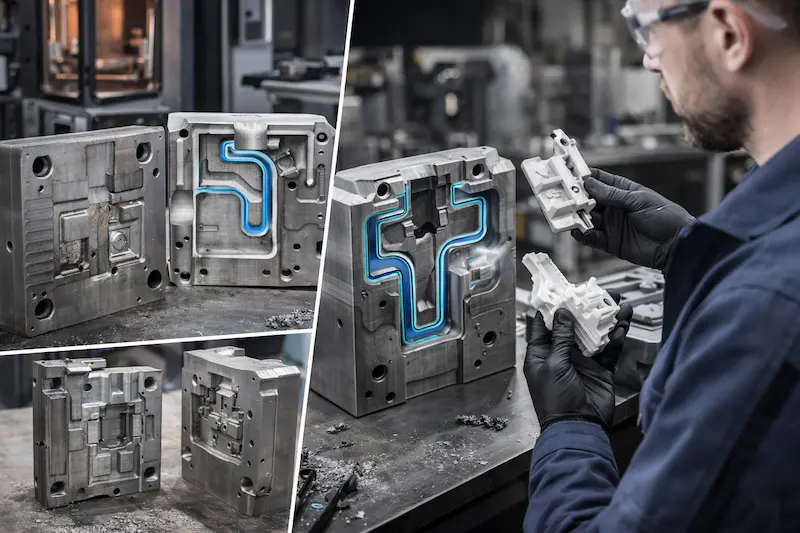
One of the most important advantages is the ability to create conformal cooling channels inside the mold. Unlike traditional straight cooling channels, conformal cooling channels follow the shape of the cavity more closely, providing more uniform cooling throughout the mold.
This improved heat transfer helps reduce cycle times, improve dimensional stability, lower scrap rates, and enhance the overall quality of injection molded parts.
In many injection molding applications, cooling time accounts for up to 70% of the total production cycle. More efficient cooling can therefore have a major impact on productivity.
4. Better Ergonomics and Tool Performance
3D printing also makes it easier to improve tooling, fixtures, and manufacturing aids. Because design changes can be implemented quickly and at lower cost, companies can optimize tools for better usability and performance.
Lightweight fixtures, ergonomic handles, and customized production aids can improve operator comfort, reduce assembly time, and simplify storage and handling.
Even small improvements in tooling design can increase production efficiency and reduce the scrap rate of finished parts.
As additive manufacturing technology continues to develop, 3D printed molds are expected to play an even larger role in improving flexibility, reducing costs, and supporting faster product innovation.