
What Is Water-Assisted Injection Molding?
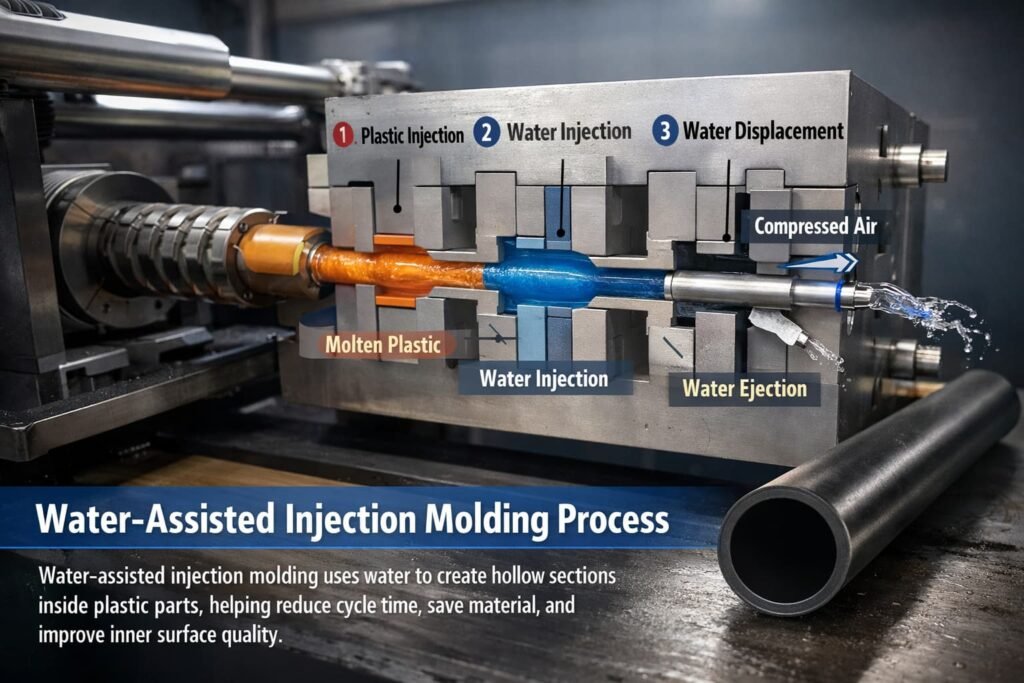
Water-assisted injection molding is an advanced molding technology developed from gas-assisted injection molding. In this process, water is used instead of nitrogen to assist the flow of molten plastic and create hollow sections inside the part. After the cavity is formed, compressed air is used to remove the water from the workpiece.
This process is especially valuable for producing hollow plastic parts with smooth internal channels, shorter cycle times, and reduced material use. It is widely considered an effective solution for applications where conventional injection molding or gas-assisted molding may be less efficient.
How Water-Assisted Injection Molding Works
The process begins with the injection of molten plastic into the mold cavity. Water is then introduced to displace the melt core and form a hollow channel inside the part. Because water has higher cooling efficiency than gas, it can cool the part more quickly and help achieve thinner wall sections. After shaping is completed, compressed air is used to push the water out of the molded part.
Compared with gas-assisted injection molding, water-assisted molding can often achieve faster cycle times and improved inner surface quality, particularly in larger tubular or rod-shaped parts.
Main Advantages of Water-Assisted Injection Molding
Shorter molding cycle: Water removes heat more efficiently than gas, which can significantly reduce cooling time and total production cycle time.
Reduced wall thickness: The process helps form lighter hollow parts with controlled wall thickness.
Improved inner surface quality: It is particularly suitable for media ducts and similar components that require smooth internal flow channels.
Better performance for thick-wall sections: Water-assisted molding can help reduce sink marks and improve quality in parts with thick and thin wall combinations.
Material savings: Hollow sections reduce resin consumption while maintaining functional part geometry.
Large parts on smaller machines: The process can make it possible to mold relatively large components with lower machine requirements than conventional molding would need.
Greater design flexibility: It can support hollow reinforcing ribs and other hollow structures that are difficult to achieve with standard molding methods.
Typical Applications
Water-assisted injection molding is mainly used for hollow plastic products such as media ducts, tubular parts, rod-shaped products, and components that require smooth internal surfaces. It is especially suitable for applications where both part quality and production efficiency are critical.
The process is commonly considered for large-diameter hollow parts and for components that would be difficult to produce efficiently using traditional injection molding, blow molding, or gas-assisted molding alone.
Water-Assisted vs. Gas-Assisted Injection Molding
Both processes are designed to create hollow sections and improve molding efficiency, but water-assisted molding offers stronger cooling capability. This allows faster cycle times and can improve the internal surface finish of flow-channel parts. Gas-assisted molding remains useful in many structural applications, while water-assisted molding is often preferred for ducts and tubular products that require better internal quality.
Conclusion
Water-assisted injection molding is a highly efficient process for manufacturing hollow plastic parts with smooth internal channels, lower material consumption, and shorter cycle times. For suitable applications such as ducts, tubular products, and complex hollow structures, it offers important technical and economic advantages over conventional molding methods.