
Advantages of Multi-Color Injection Molding and LSR Overmolding Technology
Multi-color injection molding technology has developed rapidly over the years and now includes a wide range of mature molding methods for combining different materials, colors, and functions into a single product. Because of its high production efficiency, stable quality, and ability to meet complex product requirements, multi-color injection molding is widely used in automotive, electronics, medical, and consumer product industries.
As product designs become more advanced, manufacturers increasingly rely on two-color and multi-material molding technologies to improve appearance, functionality, sealing performance, and user experience. This trend has also accelerated the adoption of liquid silicone rubber overmolding in combination with plastic materials.
Advantages of Multi-Color Injection Molding
Multi-color injection molding allows multiple materials or colors to be molded into one product during the same production cycle. This reduces secondary assembly operations, lowers labor cost, improves production efficiency, and increases dimensional consistency.
The process is commonly used to create products with soft-touch surfaces, integrated sealing features, decorative color combinations, transparent windows, rigid-soft material combinations, and ergonomic grips.
Because multi-color molding combines several production steps into one process, it can reduce production cost while improving product quality and visual appeal.
Applications in Automotive, Electronics, and Medical Industries
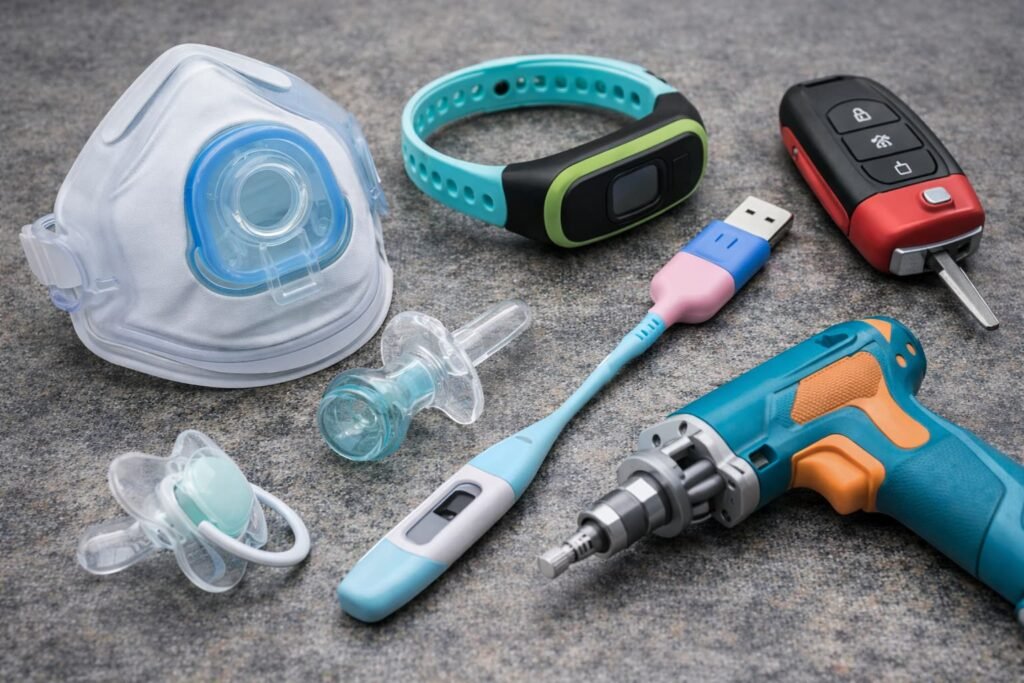
Multi-color injection molding is widely used in automotive interior and exterior parts, switches, buttons, handles, seals, lighting components, and decorative trim.
In the electronics industry, it is often used for connectors, protective covers, buttons, wearable devices, and products requiring soft-touch or waterproof functions.
In medical products, multi-material molding can improve comfort, sealing, and safety. It is commonly used for masks, valves, grips, medical handles, wearable medical devices, and components that require biocompatible materials.
LSR and Plastic Overmolding
Liquid silicone rubber (LSR) has become one of the most important materials used in two-color molding. Because LSR offers excellent heat resistance, cold resistance, electrical insulation, light resistance, and chemical stability, it is suitable for many demanding environments.
LSR is also safe for contact with the human body, which makes it especially attractive for medical devices, baby products, kitchenware, wearable electronics, and personal care products.
When combined with thermoplastics in a two-shot molding process, LSR can create products that offer both structural strength and flexible sealing or soft-touch performance.
Benefits of Liquid Silicone Rubber
Liquid silicone rubber has a wide hardness range and can replace many thermoplastic elastomers such as TPU and TPE in certain applications. It can provide a softer feel, better temperature resistance, improved durability, and stronger resistance to aging.
Unlike some traditional elastomer materials, LSR can maintain stable performance in extreme hot or cold environments, making it suitable for products exposed to sunlight, moisture, chemicals, or repeated mechanical stress.
Because of these advantages, liquid silicone rubber has become an increasingly popular material choice in recent years and is now widely used in products that people use every day.
Conclusion
Multi-color injection molding and LSR overmolding technologies continue to expand across many industries because they improve efficiency, product quality, appearance, and functionality. By combining rigid plastics with soft-touch or sealing materials, manufacturers can create more advanced products with fewer assembly steps and better overall performance.