
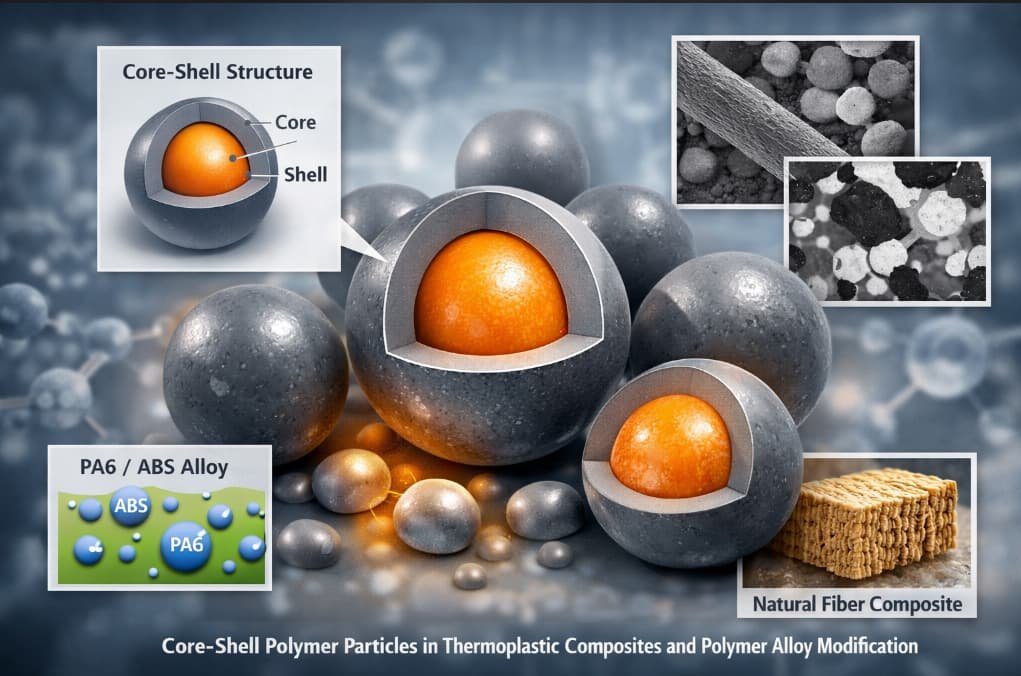
Core-Shell Polymer Particles in Polymer Modification and Composite Engineering
Core-shell polymer particles are composite particles with a double-layer or multi-layer structure formed from materials with different chemical compositions or different aggregation states. These particles have been widely studied in polymer modification because they can improve compatibility, toughness, and overall mechanical performance in polymer blends and composite systems.
Development of Core-Shell Polymer Technology
The development of core-shell polymer technology began in 1957, when Rohm & Haas introduced a commercial core-shell polymer product under the trade name K120 in the United States. During the 1960s and 1970s, similar materials were also developed in Japan and Germany. In the early 1980s, Japanese scholar Okubo proposed the concept of particle design, which further advanced research into the synthesis, morphology, structure, properties, and industrial applications of core-shell polymers.
Today, core-shell polymer particles remain an important topic in advanced materials engineering. Their unique structure helps strengthen the interface between different polymer phases, making them highly effective for impact modification, compatibilization, and performance improvement in engineering plastics.
Compatibilization Effects in PA6/ABS Alloys
One study investigated the effects of three compatibilizers in PA6/ABS alloys: maleic anhydride grafted acrylonitrile-butadiene-styrene copolymer (ABS-g-MAH), maleic anhydride grafted ethylene-octene copolymer (POE-g-MAH), and styrene maleic anhydride copolymer (SMA). These compatibilizers improved the interfacial interaction between PA6 and ABS while also enhancing the toughness of the alloy system.
Among the materials tested, ABS-g-MAH showed the best compatibilizing effect. As the addition level of ABS-g-MAH increased, the notched impact strength of the PA6/ABS alloy first increased and then decreased. When the mass fraction reached 20%, the notched impact strength achieved the most significant improvement, reaching approximately ten times that of the unmodified PA6/ABS alloy.
Reinforcement of PA6 Composites with Carbon Nanofibers
Another study focused on PA6/CNF composites prepared by in-situ anion ring-opening polymerization using surface-modified carbon nanofibers and caprolactam. Experimental results showed that the modified carbon nanofibers were uniformly dispersed throughout the matrix. Even a small amount of CNF improved stress transfer between filler and matrix through interfacial covalent bonding, significantly increasing the tensile strength of PA6.
During crack propagation, the carbon nanofibers also acted as bridging structures, which further improved the notched impact strength of the composite. This demonstrates the importance of both dispersion quality and interfacial bonding in high-performance thermoplastic composite design.
Natural Fiber Reinforced Thermoplastic Composites
Natural fiber reinforced thermoplastic composites have also shown strong potential in materials engineering. Researchers at Tianjin University of Technology used bamboo fiber and PP fiber to prepare mixed fiber preforms through a non-woven process, followed by hot pressing to produce bamboo fiber reinforced PP thermoplastic composites.
When the bamboo fiber to PP fiber mass ratio was 50:50 and the molding conditions were set at 190 °C for 30 minutes under 30 MPa pressure, the resulting composites achieved the best mechanical performance. Under these optimized conditions, the tensile strengths in the longitudinal and transverse directions reached 96.6 MPa and 82.3 MPa, while the bending strengths reached 400.7 MPa and 367.3 MPa respectively.
These results highlight the strong potential of reinforced thermoplastic composites for lightweight and high-performance engineering applications.
Why Core-Shell Particles Matter in Modern Plastics Engineering
Core-shell polymer particles and related compatibilization technologies play an important role in improving polymer alloy systems and composite materials. By optimizing interfacial bonding, filler dispersion, and structural design, manufacturers can achieve better toughness, higher strength, and improved processing performance across a wide range of plastic materials.
For applications that demand lightweight construction, enhanced durability, and balanced mechanical properties, core-shell polymer technology continues to be a valuable solution in advanced polymer engineering.