
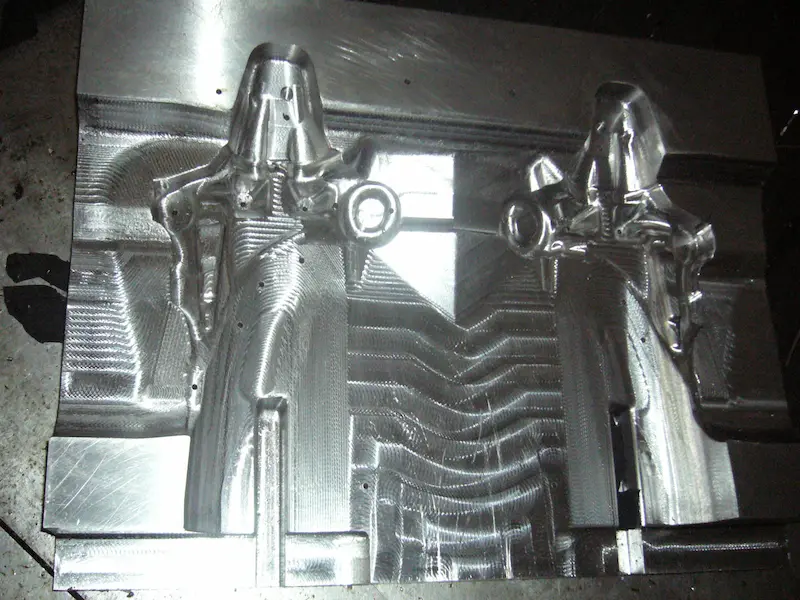
Polishing Methods for Precision Stamping Dies
Polishing is an important finishing process in precision stamping die manufacturing. It serves two main purposes: improving the surface brightness and precision of the mold, and making the die easier to release during production.
A well-polished die surface can reduce friction, improve part appearance, and help achieve better dimensional consistency. In practical mold making, polishing is usually performed step by step, starting with coarse polishing and moving gradually to fine finishing.
Basic Polishing Process for Precision Stamping Dies
The polishing process often begins with a coarse oil stone to remove machining marks left by milling, grinding, or EDM. After that, a finer oil stone is used to refine the surface further. Fine sandpaper is then applied to smooth the surface, followed by polishing paste or polishing compound to create a bright, mirror-like finish in the mold cavity.
1. Mechanical Polishing
Mechanical polishing is the most common polishing method for precision stamping dies. It removes small surface peaks and irregularities through cutting action and slight plastic deformation of the surface layer.
Common tools for mechanical polishing include oil stones, sandpaper, wool wheels, and polishing compounds. In many cases, this process is performed manually by skilled technicians. For special shapes, such as curved or rotating surfaces, auxiliary tools like rotary tables may be used.
For dies that require extremely high surface quality, ultra-fine grinding and polishing methods can be used. In this process, a special polishing tool moves at high speed against the workpiece surface in a polishing liquid containing abrasives. This method can achieve very low surface roughness and is often used for optical or high-precision mold surfaces.
2. Electropolishing
Electropolishing is an electrochemical polishing method that smooths the die surface by selectively dissolving microscopic high points on the material surface.
Compared with ordinary chemical polishing, electropolishing offers better control and usually produces a more uniform finish. The process generally includes two stages:
- Macro-leveling: Surface roughness is reduced as the dissolved material diffuses into the electrolyte.
- Micro-brightening: Surface brightness increases and a smoother finish is achieved through controlled anodic action.
Electropolishing is suitable for improving both surface smoothness and appearance, especially on complex die surfaces.
3. Ultrasonic Polishing
Ultrasonic polishing places the workpiece in an abrasive suspension and uses ultrasonic vibration to drive the abrasive particles against the surface. This creates a polishing effect with relatively low macroscopic force, which helps reduce the risk of deforming delicate die components.
Ultrasonic polishing is especially useful for precision work, although the equipment and tooling can be more complex.
In some applications, ultrasonic polishing is combined with chemical or electrochemical polishing methods. Ultrasonic vibration helps agitate the solution, remove dissolved products from the surface, and improve the uniformity of the polishing process. Cavitation effects in the liquid can also support better surface finishing.
Conclusion
Different polishing methods are suitable for different die surface requirements. Mechanical polishing is widely used for general precision stamping dies, while electropolishing and ultrasonic polishing are valuable for applications that require better surface consistency, finer finishes, or reduced polishing force.
By selecting the right polishing process and controlling each polishing stage carefully, manufacturers can improve die performance, surface quality, and demolding behavior in precision stamping production.