Color Rapid Prototyping and the Future of 3DP Technology
Rapid prototyping technology continues to evolve beyond simple monochrome models. One of the major developments in the RP industry is the ability to create color prototypes that can display not only the physical shape of a product, but also functional information such as temperature distribution, stress concentration, and structural behavior.
Color rapid prototyping provides engineers, designers, and manufacturers with a more intuitive way to analyze products before production begins.
Color Rapid Prototyping Technology
Z Corp in the United States and Riken Institute in Japan developed rapid prototyping systems based on inkjet printing technology that can manufacture full-color prototypes.
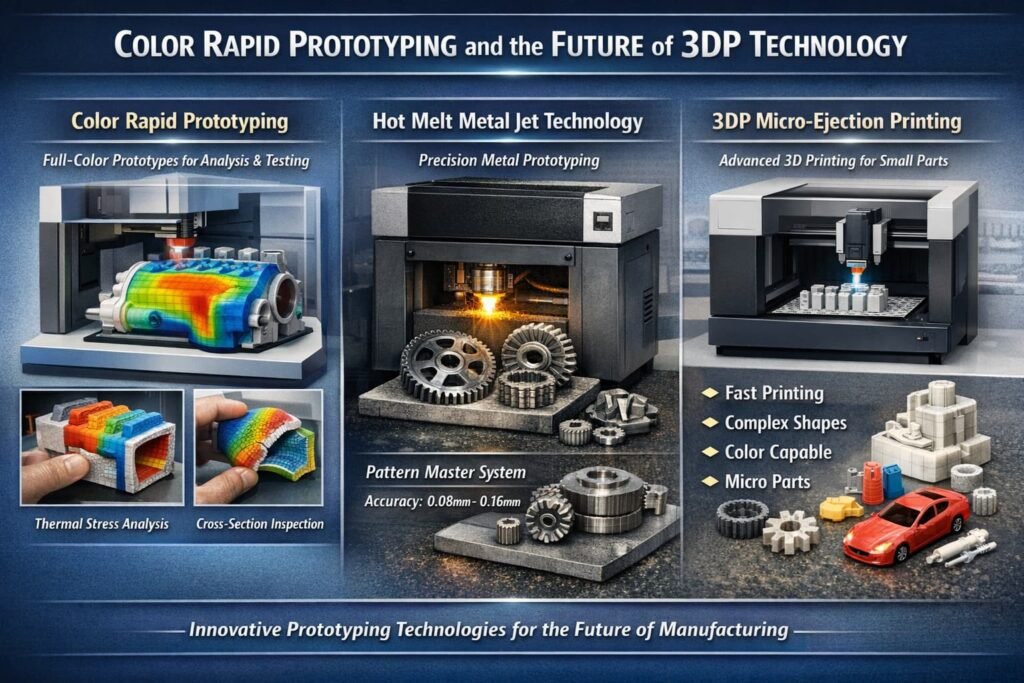
These systems use four primary colors to create up to eight different tones in the prototype model. By combining different colors in different areas, the model can visually represent information such as:
- Thermal stress distribution
- Temperature changes
- Structural load concentration
- Finite element analysis results
This makes color RP especially useful for engineering validation, because users can directly see how temperature and stress are distributed throughout a part.
By cutting the prototype, engineers can also examine how internal temperature and stress conditions change in different sections of the product.
Organizations such as TNO in the Netherlands and BMT in Germany are also actively researching color rapid prototyping technology to improve engineering analysis and product development efficiency.
Hot Melt Metal Jet Technology
Sanders Prototype Inc in the United States developed a rapid prototyping system based on hot melt metal jet technology called Pattern Master.
This technology is considered one of the faster RP systems available and allows users to produce prototype models quickly for design evaluation and verification.
The production size range of the system is approximately:
- 300 mm × 150 mm × 220 mm
The molded parts produced by this system can achieve a surface accuracy of approximately 0.08 mm to 0.16 mm.
This level of precision makes the technology suitable for detailed prototype models, design validation, and certain tooling applications.
What Is 3DP Rapid Prototyping Technology?
Three Dimensional Printing (3DP) is a rapid prototyping technology based on micro-ejection principles.
In a 3DP system, liquid droplets are ejected through nozzles and deposited layer by layer according to a programmed path. The layers gradually build the final three-dimensional shape.
Compared with some other RP technologies, 3DP offers several important advantages:
- Fast printing speed
- Ability to create complex geometries
- Good potential for color printing
- Lower material waste
- Suitable for small and detailed parts
Future Applications of 3DP Technology
3DP is considered one of the most promising technologies in the rapid prototyping industry because of its broad range of applications.
Future uses of 3DP technology include:
- Biomedical engineering
- Pharmaceutical engineering
- Micro-electromechanical systems
- Prototype mold production
- Functional product testing
- Custom low-volume manufacturing
As printing accuracy, speed, and material options continue to improve, 3DP technology is expected to become more important in both prototype production and actual manufacturing.
Color RP and 3DP are changing the way engineers evaluate products because they make prototypes easier to understand, easier to test, and easier to improve before expensive tooling begins. Which is helpful, because humans rarely agree on anything until they can hold a colorful model in their hands and argue over it in a meeting room.