
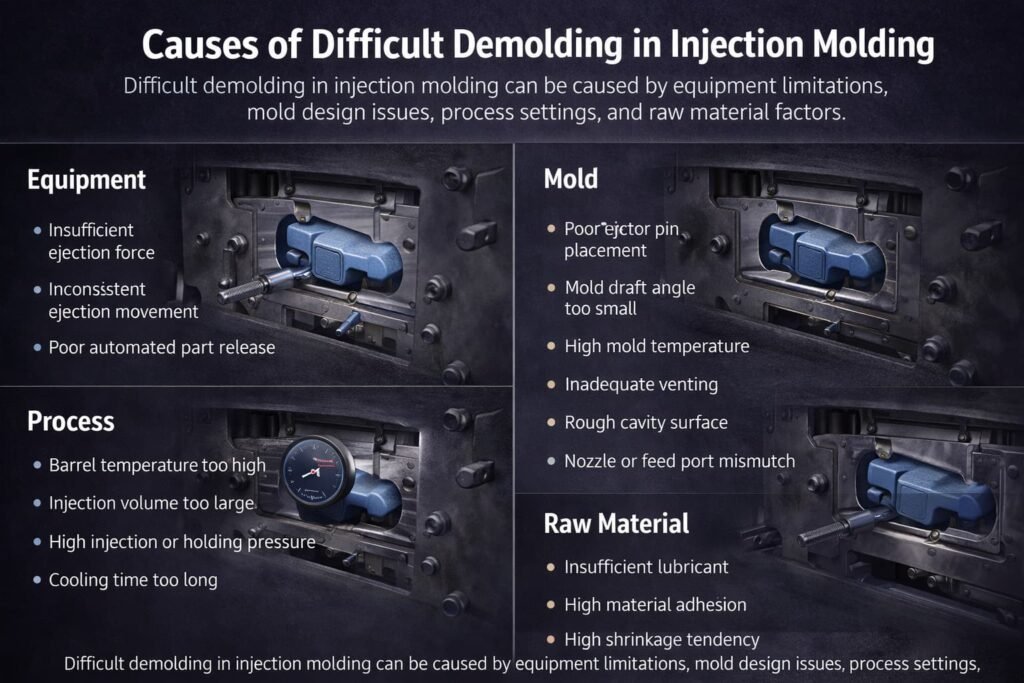
Causes of Difficult Demolding in Injection Molding
After injection molding is completed, the plastic part is normally released from the mold cavity through a single ejection action, whether a simple or multi-component ejection system is used. In standard production, the molded part should separate from the mold smoothly and fall away without additional handling.
However, for some plastic parts with complex shapes or in automated production environments, the part may remain stuck in the cavity or fail to drop automatically after the first ejection step. In these situations, an additional demolding action may be required.
Difficult demolding usually occurs when the gate, sprue, or molded part is held too tightly in the mold. This problem can be caused by equipment limitations, mold design issues, processing conditions, or raw material factors.
1. Equipment-Related Causes
In some cases, the ejection force provided by the injection molding machine is not strong enough to remove the part smoothly from the mold cavity.
- Insufficient ejection force
- Inconsistent ejection movement
- Poor synchronization in automated part release
2. Mold-Related Causes
Mold design and mold condition are among the most common reasons for demolding difficulty.
- Unreasonable demolding structure or poor ejector pin placement
- Insufficient draft angle on the molded part
- Mold temperature that is too high
- Poor venting inside the mold cavity
- Rough sprue wall or cavity surface finish
- Nozzle mismatch between the machine and mold feed port
- Nozzle diameter larger than the mold inlet diameter
If the mold surface is rough or the draft angle is too small, the molded part can grip the cavity wall more strongly, making part release much more difficult.
3. Process-Related Causes
Improper injection molding parameters can also make demolding more difficult.
- Barrel temperature is too high
- Injection volume is too large
- Injection pressure is too high
- Holding pressure is too high or applied for too long
- Cooling time is too long
When the melt temperature or pressure is too high, the plastic can pack too tightly into the cavity, which increases shrink-fit forces and makes the part harder to eject.
4. Raw Material Causes
Material formulation can also affect demolding performance.
- Insufficient lubricant in the raw material
- High material adhesion to the mold surface
- Material properties that increase shrinkage or sticking tendency
If the material does not contain enough internal lubricant, the molded part may have greater friction against the cavity surface and become more difficult to release.
How to Reduce Demolding Problems
To reduce difficult demolding in injection molding, manufacturers should review the machine ejection system, optimize mold draft and venting, improve cavity surface finish, and adjust molding parameters such as temperature, pressure, and cooling time. Material selection and lubricant content should also be evaluated during troubleshooting.
A well-designed mold and a stable molding process can significantly improve demolding performance, reduce cycle interruptions, and prevent part damage during ejection.